
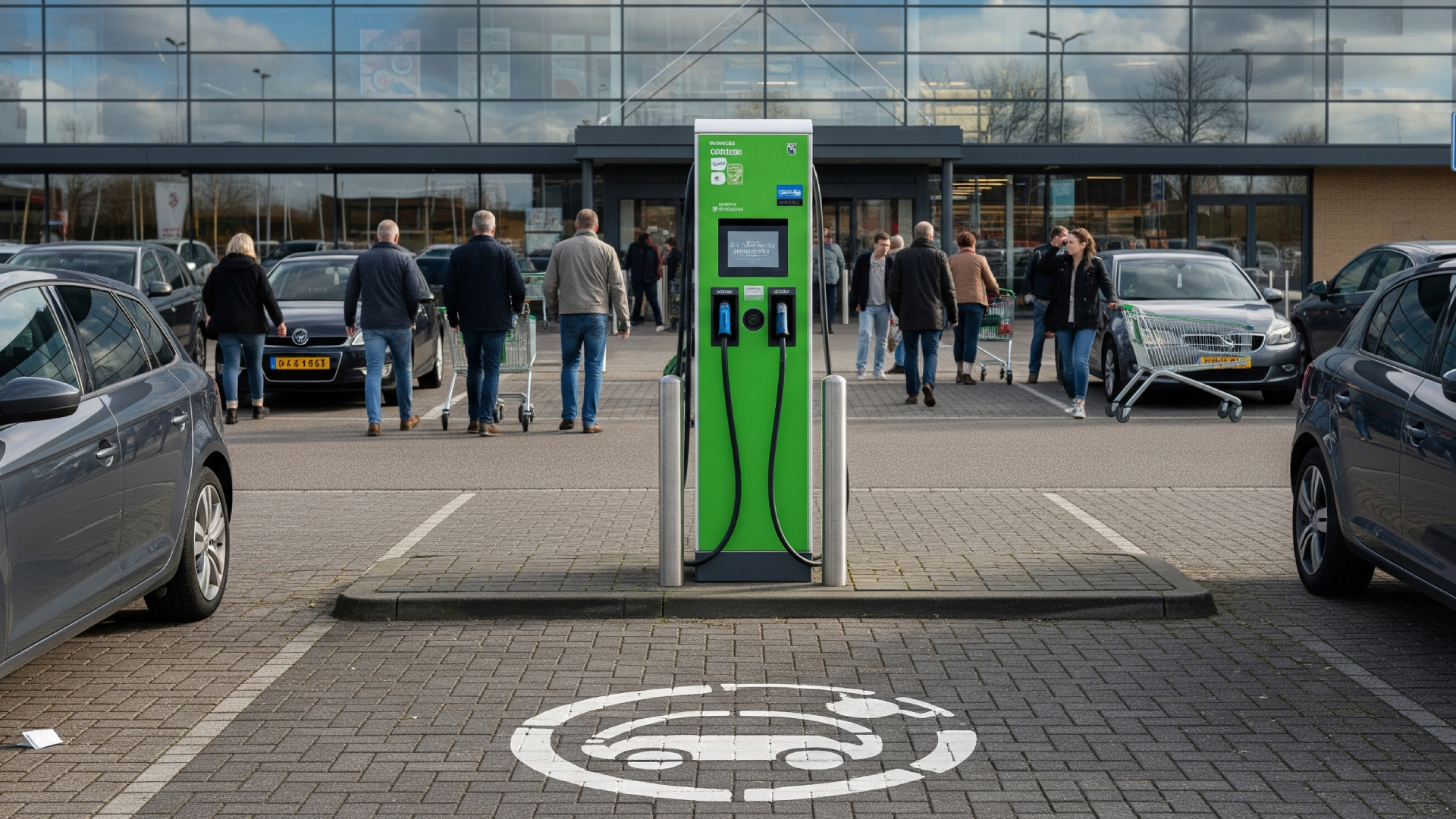
Parking at charging stations in 2025: this is allowed and not allowed
Can anyone park at charging stations?
A parking lot with a charging station is meant for electric and plug-in hybrid cars, to charge the battery. In principle, you may only park at a charging station if you are actually charging. If you have a car with a gasoline or diesel engine without charging capability, you are not supposed to park there. Whether or not it is actually prohibited depends on the sign.
Rules for parking at charging stations
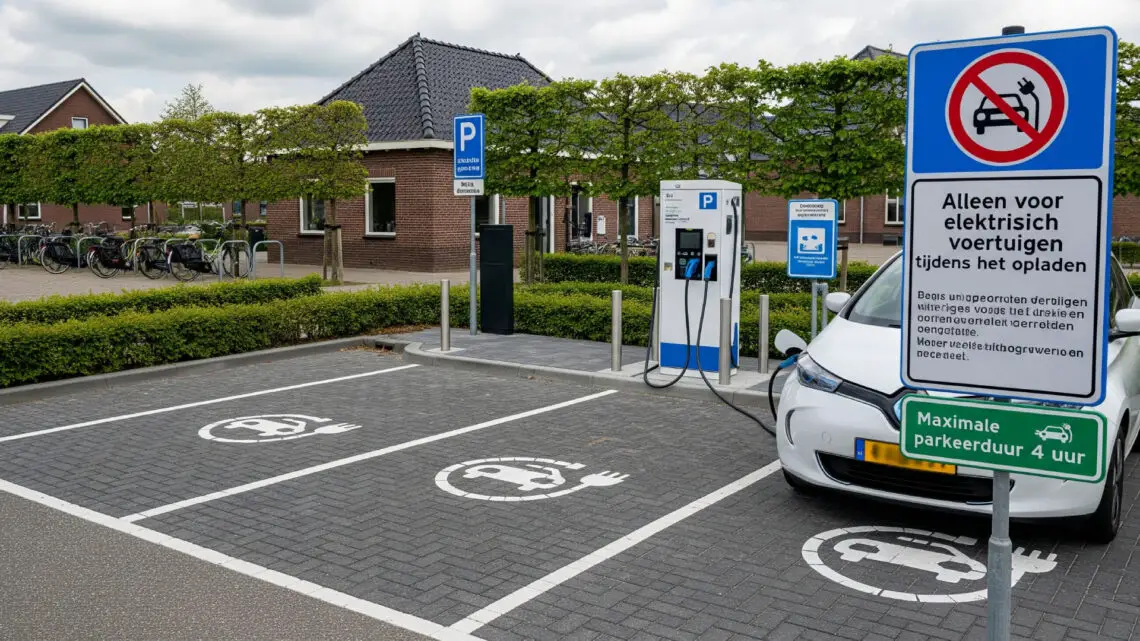
The basic rule comes from traffic laws. A parking lot with a charging station is indicated by an official traffic sign: sign E8c of the Traffic Rules and Signs Regulations 1999, a blue sign with a white P and an icon of a charging station with a power flash and a plug. Sometimes it also explicitly states: “only for vehicles that are visibly charged,” so your car may be parked there only if you are charging the battery. Is that phrase not there? Then the big blue sign still indicates the possibility of charging, but the parking lot is strictly for all vehicles. The rules further vary by municipality – they make ordinances and can designate certain parking spaces for an EV charging station. In short, pay close attention to the on-site signs.
Parking at charging stations: just for charging?
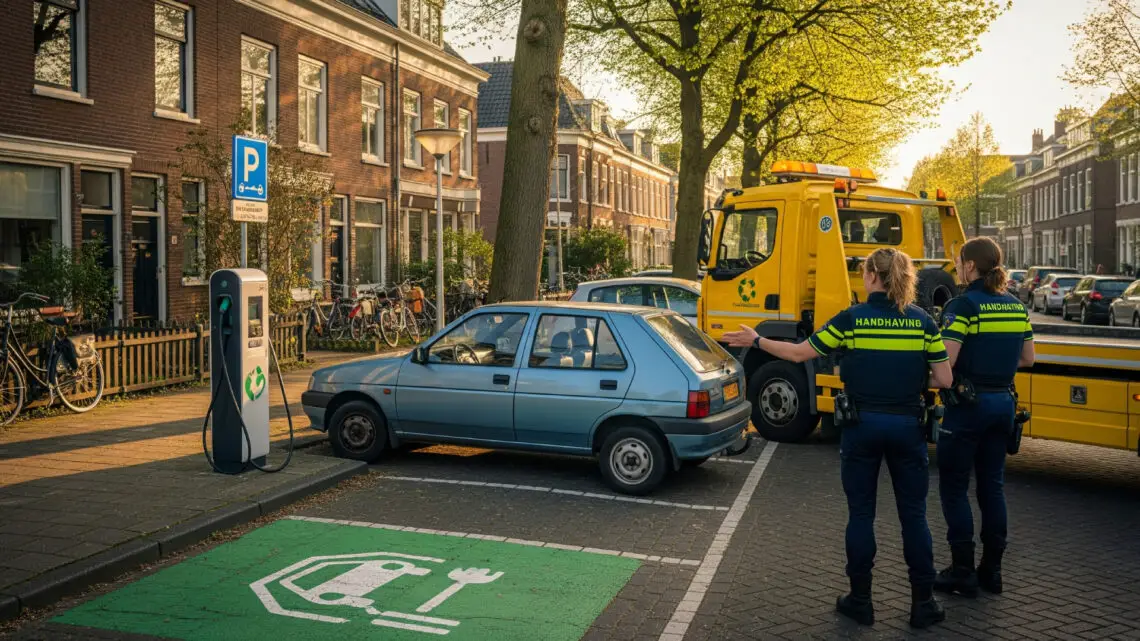
In practice, parking at a charging station usually means that your car must be connected to the station AND actually draw power. Just plugging in the cable without charging is considered abuse. Modern charging stations often register whether actual charging takes place – but then the car must be connected to the charging station. Then the charging station operator can charge a block charge . Then you pay firmly for the time you spend at the charging station too long – charge life is called this. However, the municipality enforces the rules regarding parking at charging stations, and the amount of parking fines can vary from municipality to municipality. Municipalities may also have an illegally parked car towed away – even if it is unjustly parked at a charging station.
Supreme Court ruling from 2022
However, parking in a parking lot with a charging pole is not always illegal. Fines have been handed out for it – specifically for charging pole parking, or leaving your electric car when the battery is already full – but in 2022 the Supreme Court ruled that charging pole parking is basically not punishable…
What about disabled parking tickets?
A disabled parking permit is not a carte blanche to park just anywhere. In principle, a charging spot remains a charging spot, even for disabled drivers. But if you have an electric or plug-in hybrid car, you may park and charge in any parking space with a charging station.
Is parking at charging stations prohibited for non-electric cars?
If a parking space with a charging station is not marked with sign E8c of the RVV 1999 and the addition “only for vehicles visibly charging,” it is in theory an “ordinary” parking space. In practice, municipalities almost always place that sign and sub-sign to enable enforcement and keep out ordinary cars there. So it is not the case that there is a nationwide ban on parking at charging stations for fuel cars. But the combination of traffic sign(s) and local regulations does ensure that the same can be enforced everywhere.
Differences by municipality and charging station provider
Although the legal basis is nationwide, details are often regulated by municipality or charging station operator. Some municipalities have strict maximum charging times, such as four hours during the day. Others leave it up to the charging station operator to set a “block rate” in the software for charging station stickers.
Does the charging station provider own the parking lot?
No, most public charging stations are on municipal or county land. So the parking lot belongs to the road authority. The charging station operator only owns the charging station and has no control over who is allowed to park at charging stations. However, the provider can determine in consultation with the municipality what conditions it attaches to charging, for example, the block charge rate or a maximum charging time.
Do you have to leave when your battery is full?
In many municipalities, the policy is that you must remove your electric car as soon as charging is completed. The idea is simple: charging spots are scarce and others should be able to charge there as well. Some charging stations send a notification via app or text message that charging is complete. If you then leave the car for hours, you run the risk of a block charge or even a fine if the municipality has set a maximum parking time.
Who decides what happens when violations occur?
The road authority – usually the municipality – determines the enforcement rules. It can impose fines based on traffic laws and local ordinances. The charging station provider can exert influence only through tariffs, not through traffic fines.
Charging at a public charging station or quick charger
The charging process is simple. You park your electric car in the parking lot at the charging station, connect the charging cable to the car and the pole and then start the charging process with your charging card or app. At public charging stations, you usually charge with alternating current (AC) at a capacity of, say, 11 or 22 kW, depending on the car and the pole. Fast chargers use direct current (DC) and offer much higher capacities, often 150 kW or more, making charging much faster. Payment is via your charging card, app or sometimes debit or credit card.
Charging is also parking, but parking is not always charging
Charging spots are there to charge, not just park. Municipalities and operators work together to allocate scarce charging capacity and shape that policy with traffic signs, enforcement and sometimes smart fees. After all, electric drivers all have an interest in moving cars once the battery is full so others can use the charging facility as well. Non-electric cars simply don’t belong there.
Parking at a private charging station
Do you have a private charging station? A private charging station may only be installed on private property. So the parking space in question belongs to you and you may decide who may and may not park there. The rules for illegal parking, i.e. people parking on your private parking space without your permission, are the same as for private parking spaces without a charging station. As the owner of the spot, you can file a request with local enforcement to have the wrong-way parker fined and/or towed away.