
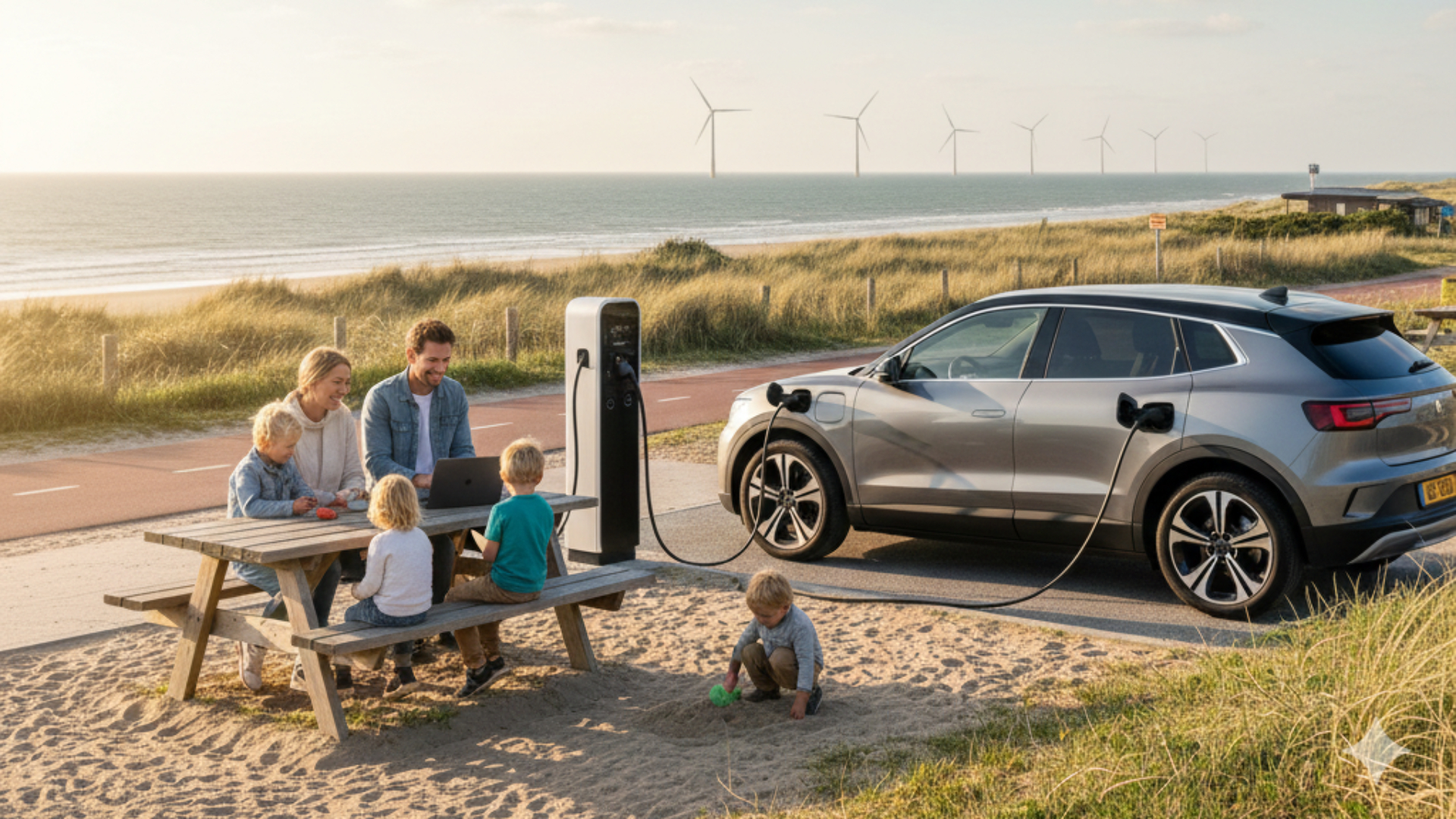
Is a road trip with an electric car a difficult task?
Range in practice often more than enough
The fear of a too small range is persistent, because most new electric cars today achieve between 350 and 600 kilometers – or more – on a full battery, although in winter it is often less. Such a range is already more than enough for commuting – and if you’re going on a long drive, you’ll still need to take a break every two hours. Along almost every European highway you will find public charging points and fast-charging stations, often in places where you would stop anyway: at gas stations, roadside restaurants and regular rest stops.
Charging on the go: the time-loss myth
Many motorists think charging on the road takes a lot of time. But that’s not so bad if you plan smartly. In fact, it makes no sense to drive your battery completely empty and then fully charge it again. That takes unnecessary time and is also less good for the battery.
Fast charging works best if you don’t charge the battery completely. As the battery gets fuller, the charging speed decreases. That’s why it’s smarter to charge briefly more often than once very long. For example, stop at a fast charger after 200-250 kilometers and recharge the battery from 20 to 80 percent. This is better for the life of your battery, and in modern EVs it often takes no longer than 20-30 minutes – just the time for a toilet visit and a cup of coffee or a snack.
Regular charging or fast charging?
For long trips on the road, fast charging is usually the best choice. Fast chargers work with direct current (DC) and deliver power from 50 to sometimes as much as 350 kW, depending on the car and the charging station. This allows you to recharge a lot of energy in a short time. For example, with an EV that can charge with up to 150 kW, it takes about 25 minutes to charge from 20 to 80 percent. During that time, you take a break and then drive another few hundred kilometers.
Regular charging – with alternating current (AC) – is especially convenient at your destination or during an overnight stay. Then you charge the battery at a leisurely pace – often with 11 or 22 kW – completely full. That way you leave the next morning with a full battery.

Where can you find charging stations on the road?
Anyone still thinking that charging stations are scarce will be surprised at how extensive the network now is. In fact, in the Netherlands the number of charging points per inhabitant is the highest in the world, but the network is also excellent in Belgium, Germany, France and Norway, for example.
Modern electric cars today are equipped with integrated navigation with charging points and with it you can easily find charging points along your route. The navigation system also calculates based on your driving style and conditions where you should make the next charging stop.
There are also numerous apps and websites that allow you to find charging stations along your route. The best known are A Better Route Planner (ABRP), Chargemap, PlugShare and Shell Recharge. These route planners take into account your specific car, current charging status, planned destination and the type of charger you want to use.

Charging pass(es) and charging cable(s).
Anyone who drives electric should actually have at least one universal charging card. With this you can access most public charging points in Europe. Some networks require a separate registration or subscription, but with a universal charging card – for example from Shell Recharge, ANWB or Plugsurfing – you have access to tens of thousands of charging stations. Furthermore, it is always wise to carry an adapter with you for emergencies, such as when you want to charge at someone’s home or at a campsite.
Tactics when the range is reduced
Not every electric car has a large battery. Some compact EVs with a smaller battery don’t get further than 200 to 250 kilometers on a full battery. Still, even with such a car you can do a long drive just fine, provided you plan the route well.
A useful tactic is to divide your drive – just like a long trip – into 150- to 200-kilometer stages. Plan in advance the charging points where you want to stop, preferably at places with amenities such as a restaurant or supermarket. That way you combine charging with useful breaks.
Use a route planner that takes into account your range, consumption and charging speed of your car. Route planners in many modern EVs do this automatically: they put together an optimal route, including charging stops, and indicate how long you’ll stop at each stop.
Benefits of electric driving on long distances
Once people get used to electric driving, they often don’t want to go back. After all, an EV drives quietly and smoothly and accelerates quickly thanks to the readily available torque – this allows them to accelerate and overtake smoothly. You also save on fuel costs. Moreover, electric driving is emission-free, thus cleaner and better for the environment.
Downside: what to consider?
Although electric driving offers many advantages, there are some practical concerns. Fast charging can significantly increase the temperature of the battery. Therefore, it is better not to use a fast charger all the time, especially if it is already hot outside.
Also, as mentioned, it is less efficient to charge the battery to 100 percent. The last part of the charging process is slow and causes additional wear and tear. Therefore, try to keep the charge status between 20 and 80 percent for the best balance between charge time and life.
Finally, it is important not to drive too long until the battery runs low. If you often drive the battery close to empty, the battery capacity decreases over time.

Smart planning and preparation
A relaxing road trip with an electric car starts with good preparation. Before leaving, check that you have all the necessary charging passes with you and that they are activated. Install a charging app or two on your phone and test if your account works beforehand.
Plan your route with a navigation system with charging stations or use a reliable route planner. That way, you’ll not only know where you can charge, but also approximately how much time it will take.
Also pay attention to the weather and terrain. Driving through hilly terrain or in cold weather consumes more energy, so you need to recharge faster. A slightly lower cruising speed (for example, 100 instead of 120 km/h) often makes a big difference in consumption.
Summary: Electric driving over long distances is easy
So a long trip with an electric car is absolutely doable. The range of modern EVs is more than sufficient, fast chargers are in strategic locations along the highway, and with a smart route planner and the right charging pass, you can get anywhere.
With a little preparation, a well-equipped car and a relaxed mindset, driving electric over long distances becomes as natural as driving a gasoline or diesel car.