
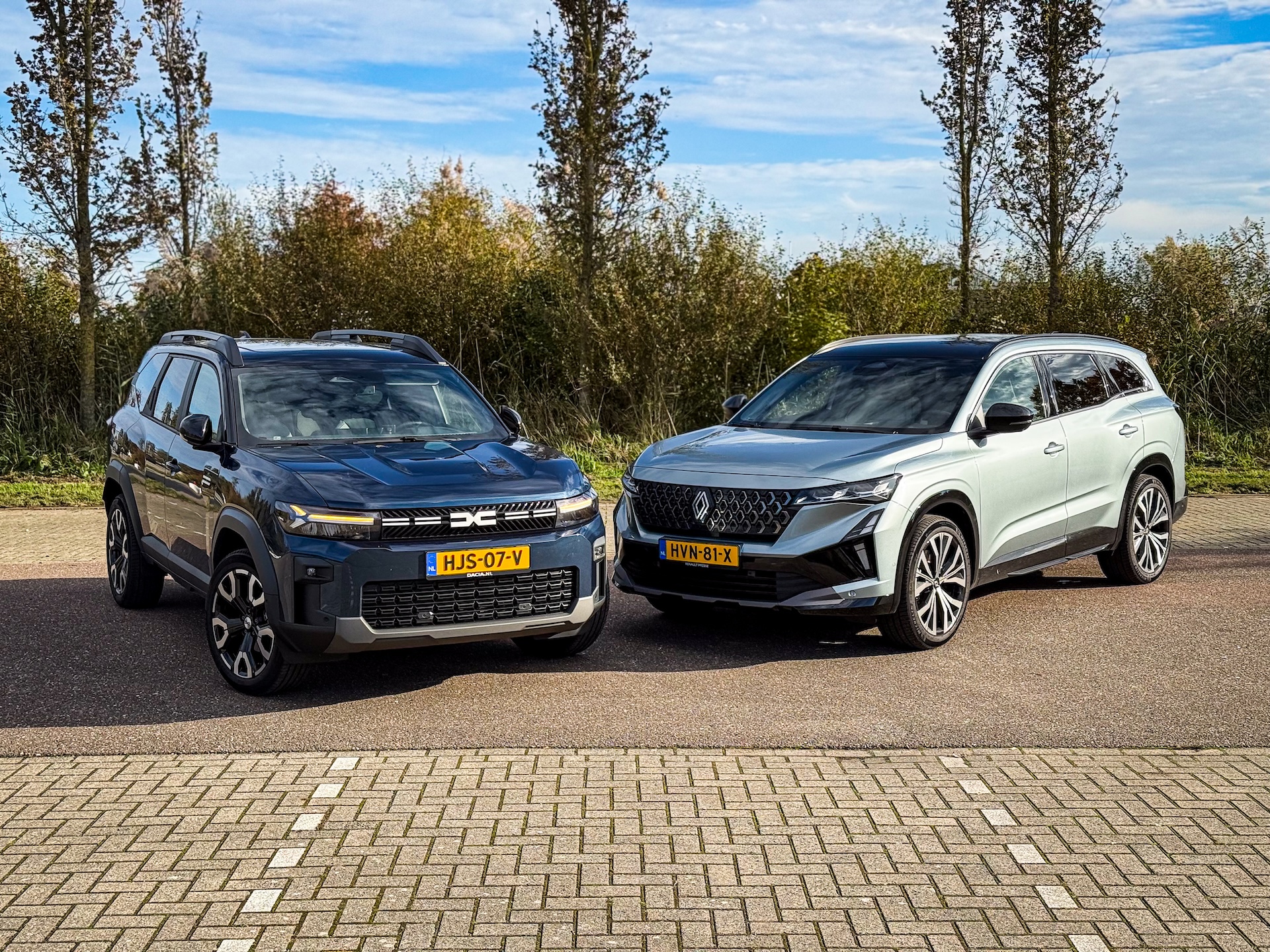
Hybrid space wonders: Dacia Bigster & Renault Espace
Different segments
This is not a comparison to see which car is the best. In fact, they are not even competitors to each other. The Dacia Bigster operates in a different market/price segment compared to the larger and more expensive Renault Espace. No, in this duo test we look purely at what you get for your hard-earned euros and what each car has to offer. To keep an overview, we divide this test into different sections, think price, dimensions, space, practicality etc.
What do they cost?
The Renault Espace full-hybrid E-Tech 200 has a starting price of 47,590 euros in the Netherlands. That is a substantial difference compared to the Dacia Bigster. That car has a starting price of 31,000 euros for the mild-hybrid-G 140. But this particular car concerns a Dacia Bigster Hybrid 155. That one costs a minimum of 35,300 euros. In the end, we are talking about a price difference of 12,290 euros, excluding options.
HYBRIDE RUIMTEWONDERS: Dacia Bigster & Renault Espace – AutoRAI TV
How big are they?
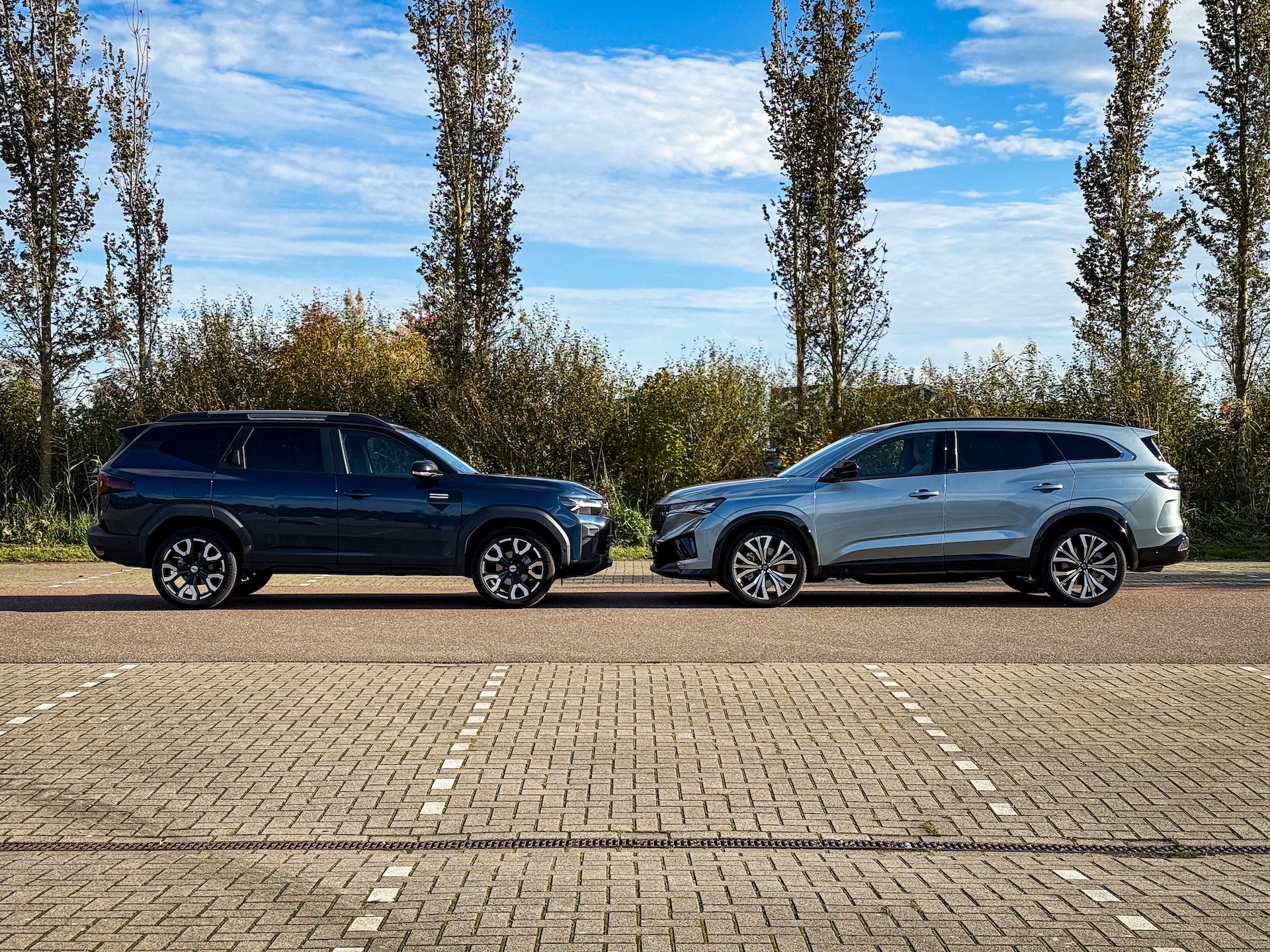
So which car is the biggest? Well, despite the substantial price difference, the differences in dimensions are quite small. The Renault Espace has a length of 4.72 meters, a width of 1.83 meters and a height of 1.64 meters. The wheelbase comes out to 2.74 meters. Then the figures of the Dacia Bigster. That car has a length of 4.57 meters, a width of 1.81 meters and a height of 1.71 meters. The wheelbase is 2.70 meters. Minimal differences, in other words.
How big is the luggage space?
Time to talk about luggage space. Let’s start with the Renault Espace. That model has boot space ranging from 692 to 943 liters of luggage space, if you opt for the five-seat configuration. Folding everything flat creates a cargo floor of nearly 2,224 liters. Although the Dacia Bigster is a size smaller, it is still hardly inferior to the Espace. In principle, in the most favorable arrangement, this model has a luggage space of 612 liters. With the rear seats folded down, this increases to 1,912 liters. Both models are extremely spacious.
Are they roomy in the back?
On this component, both models score well. As an adult of 1.85 meters, you can sit excellently in the back. In the more expensive Espace, you have slightly more options thanks to a sliding rear seat. This is movable over a distance of 22 centimeters. In the Bigster, the rear seat is fixed, but even in that model it is fine sitting. By the way, did we mention that the Renault Espace is a seven-seater? Seven seats are always standard in the Espace. Prefer a five-seater? You are free to do so and it costs nothing extra. The third row of seats is mainly for smaller people. As a 1.85-meter adult, sitting in the third row of seats is not a good idea.
What is the towing weight?
The Renault Espace Full-Hybrid E-Tech 200 has a braked towing weight of up to 1,600 kilograms. With the Bigster Hybrid 155, we’re talking 1,000 kilograms. Want a Bigster with a higher braked towing weight? Then choose a mild hybrid 140 or mild hybrid 130 4×4. Those powertrains have 1,500 kilograms of braked towing weight. By the way, the unladen vehicle weight of both models is not too bad. The Dacia Bigster Hybrid 155 weighs 1,394 kilograms unladen versus 1,584 kilograms for the Renault Espace. That’s a difference of 190 kilograms.
Is the performance okay?
Both models of course use different powertrains, even though in this case we are talking about two hybrid powertrains. And this is quite interesting: the larger Renault has a smaller powertrain.
Powertrain Renault Espace full-hybrid E-Tech 200
The Renault Espace full-hybrid E-Tech 200 uses a 1.2-liter three-cylinder turbocharged gasoline engine complemented by an electric motor. The system output comes out to 147 kW (200 hp). The gasoline engine delivers 230 Nm of torque. The electric motor adds 205 Nm of torque. The Renault has a top speed of 175 km/h and offers a 0-100 time of 8.8 seconds. Renault gives a combined gasoline fuel consumption of 4.8 liters per 100 kilometers.
Powertrain Dacia Bigster Hybrid 155
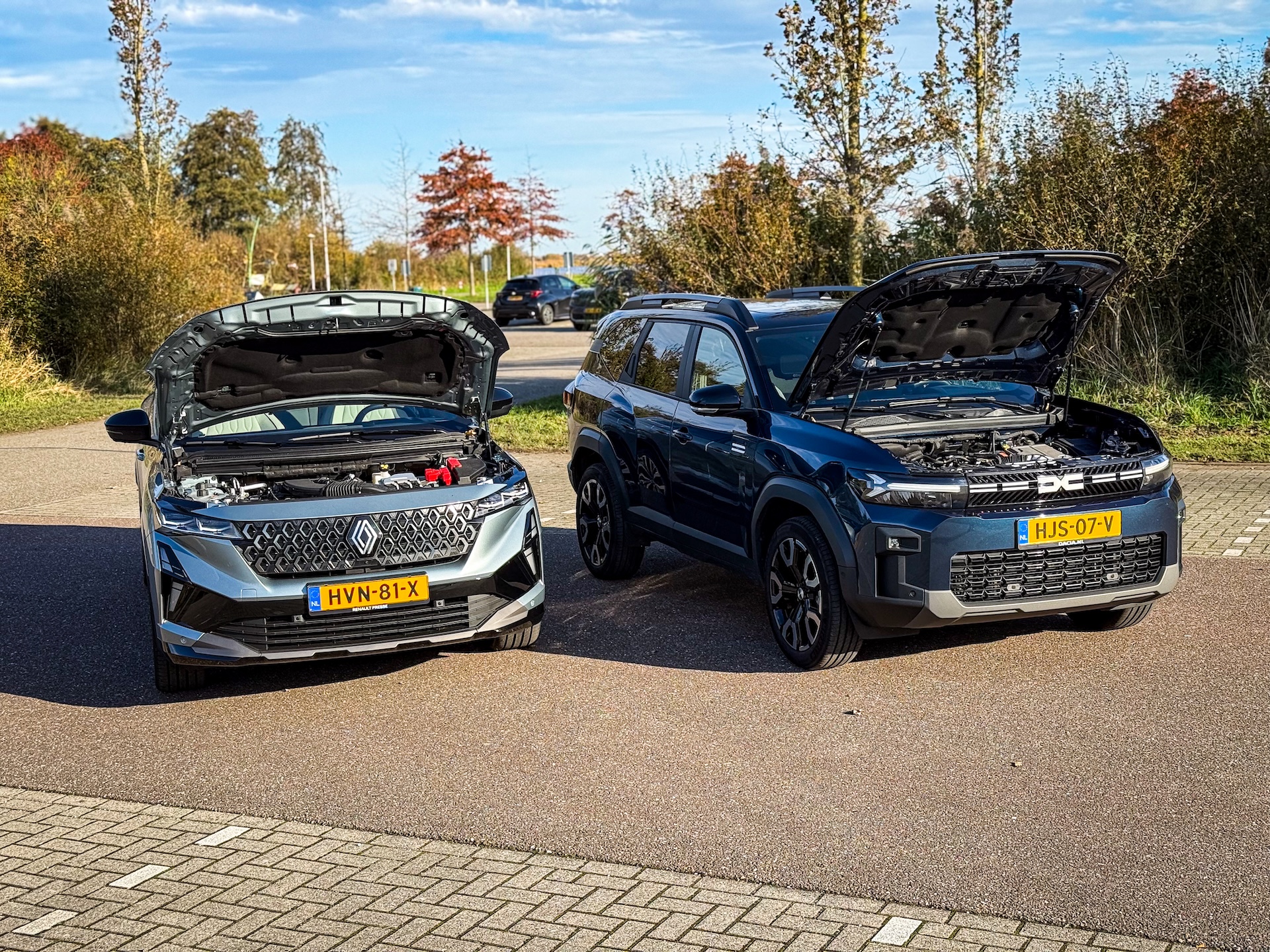
The Dacia Bigster Hybrid 155 features a 1.8-liter four-cylinder gasoline engine with electro-support. This powertrain combines a 79 kW (107 hp) four-cylinder gasoline engine with two electric motors (a 37 kW (50 hp) engine and a high-voltage starter motor/generator), a 1.4 kWh battery (230V) and an automatic electric transmission. The internal combustion engine has four gears, while the electric motors have two. In theory, with this powertrain, the Bigster can drive fully electric up to 80% of the time in the city. Moreover, the car always starts in electric mode. System power comes out to 115 kW (156 hp). The top speed comes out to 180 km/h and the 0-100 sprint takes 9.7 seconds.
Is the interior nicely built?
The interior of both models looks modern and features a comprehensive infotainment system. In the Dacia Bigster, all driving information is grouped on a 7-inch or 10-inch digital instrument panel (depending on the version), while multimedia system information is displayed on a 10.1-inch central touchscreen. The design of the center console depends on the trim chosen, as a manual transmission version looks different from an automatic version, such as this Hybrid 155. The Bigster features a soundproof windshield and thicker glass to improve acoustics. Also noticeable is Dacia’s choice of sleek carpeting and LED interior lighting with touch controls. The front seats have adjustable lumbar support. Dual-zone air conditioning with rear vent is available as an option.
Solarbay panoramic roof for Espace
The Renault Espace offers much more luxury and has an interior with a higher level of finish. As mentioned, this makes sense as the Espace operates in a higher vehicle segment. Features of the Espace’s interior include a Solarbay panoramic roof, an openR link multimedia system with built-in Google services and facial recognition. Yep, you read that right. In the A-pillar is a camera that can recognize the driver and automatically activate personal settings. Think of your favorite radio stations, seat position and navigation profiles. Handy if you share the car with several people. Both the Dacia and Renault have a special button to quickly silence unwanted ADAS systems.
How do they drive?
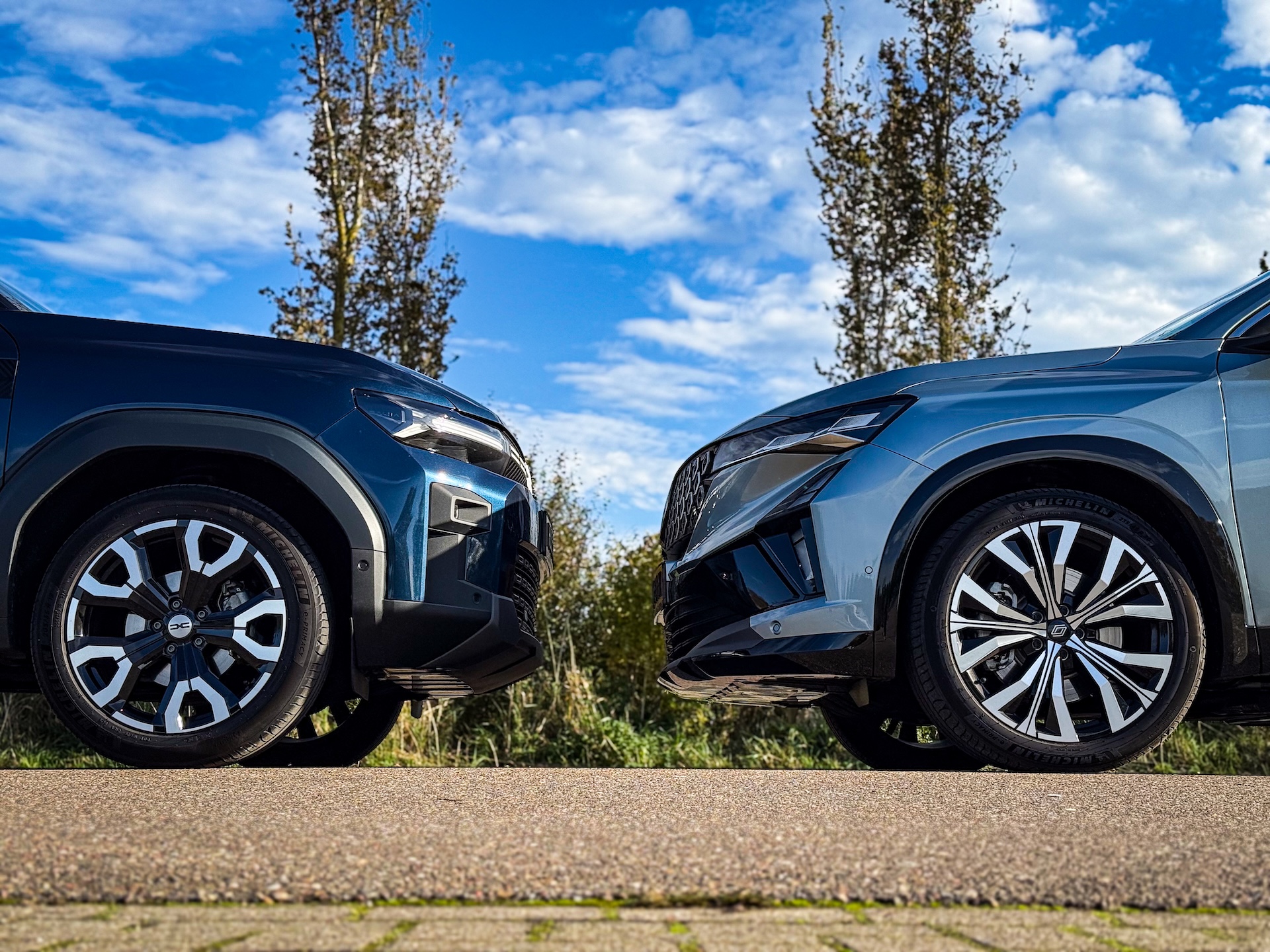
Of this duo, the Espace naturally rides extra comfortably. But the Dacia Bigster also stands its ground. When we talk about the Espace, we come to the following points: supple suspension, pleasant damping, nice and quiet due to extra sound insulation (double glazing) and seats with good support. The Bigster lets a bit more rolling noise into the interior, but also manages to convince in terms of driving. The steering is on the light side and lacks some steering feel, but otherwise this is a very fine companion. It does lean over more in corners than the Espace, a result of slightly too soft suspension combined with tire choice.
With a somewhat noisy hum, especially at low speeds, the Dacia Bigster’s engine clearly lets you know when it is starting, but the drive is nicely smooth as you would expect from a hybrid. In this respect, it is the finest powertrain in the Bigster range. At constant freeway speed, the petrol engine does switch off and on regularly. In itself it is good that it shuts off and saves fuel when it can, but the regular starting and stopping is a bit restless. “Make a choice,” you might almost say. In the end, we achieved an average practical consumption of 4.8 l/100 km. This was based on quite a lot of highway miles but still fairly varied trips. And that is certainly not bad at all considering the shape and size of the Bigster. With the heavier Renault, we ended up with an average of 6.4 l/100 km, converting to 1 on 15.6.