
How rising energy prices are changing motoring in the Netherlands
For years, the Netherlands has been in the top tier of countries with the highest fuel prices. This is not only due to the price of oil, but also largely due to the excise taxes and VAT levied by the Dutch government. More than half of the price of a liter of gasoline consists of taxes. First, the excise tax, which is a fixed amount per liter: in 2025 almost 79 cents for gasoline, almost 52 cents for diesel and almost 19 cents for LPG – without the so-called “discount,” which the government has been giving since 2022 and is maintaining for 2026, that would be even more than a euro, 65 and 24 cents, respectively. The government levies 21 percent VAT on both the fuel price and the excise duty. So you pay tax on tax! So when the oil price – due to international tensions or tighter supply – rises, the price at the pump rises extra quickly.
Rising fuel prices naturally affect car use. Especially motorists with older gasoline or diesel cars, i.e. mostly private individuals, notice that monthly fuel costs are rising. To save fuel, they try to drive less in order to fill up less often.
Businesses that rely on transportation, such as carriers, delivery services and businesses with fleets of vehicles, are also affected. They, of course, pass the higher costs on to customers. So rising fuel prices cause a chain reaction throughout the economy.
The role of excise taxes and other developments
The Dutch government uses excise taxes not only to generate revenue, but also to guide behavior. At least in theory. Higher excise taxes on gasoline and diesel should discourage the use of fossil fuels.
However, the recent rise in fuel prices is not solely the result of government policies, but mainly of international developments. Conflicts in oil-producing regions, production cuts by OPEC and fluctuations in the dollar exchange rate directly affect the price of crude oil. When that rises, so does the price at the pump. It is therefore unlikely – although the excise tax “rebate” was nearing its end at the end of 2025 anyway – that the government will raise excise taxes further to accelerate the shift to electric driving. That process is taking place largely through market pressure and European regulations.
What is certain: the Netherlands will continue to be among the countries with the most expensive fuel.
Faster decline in number of fuel engines
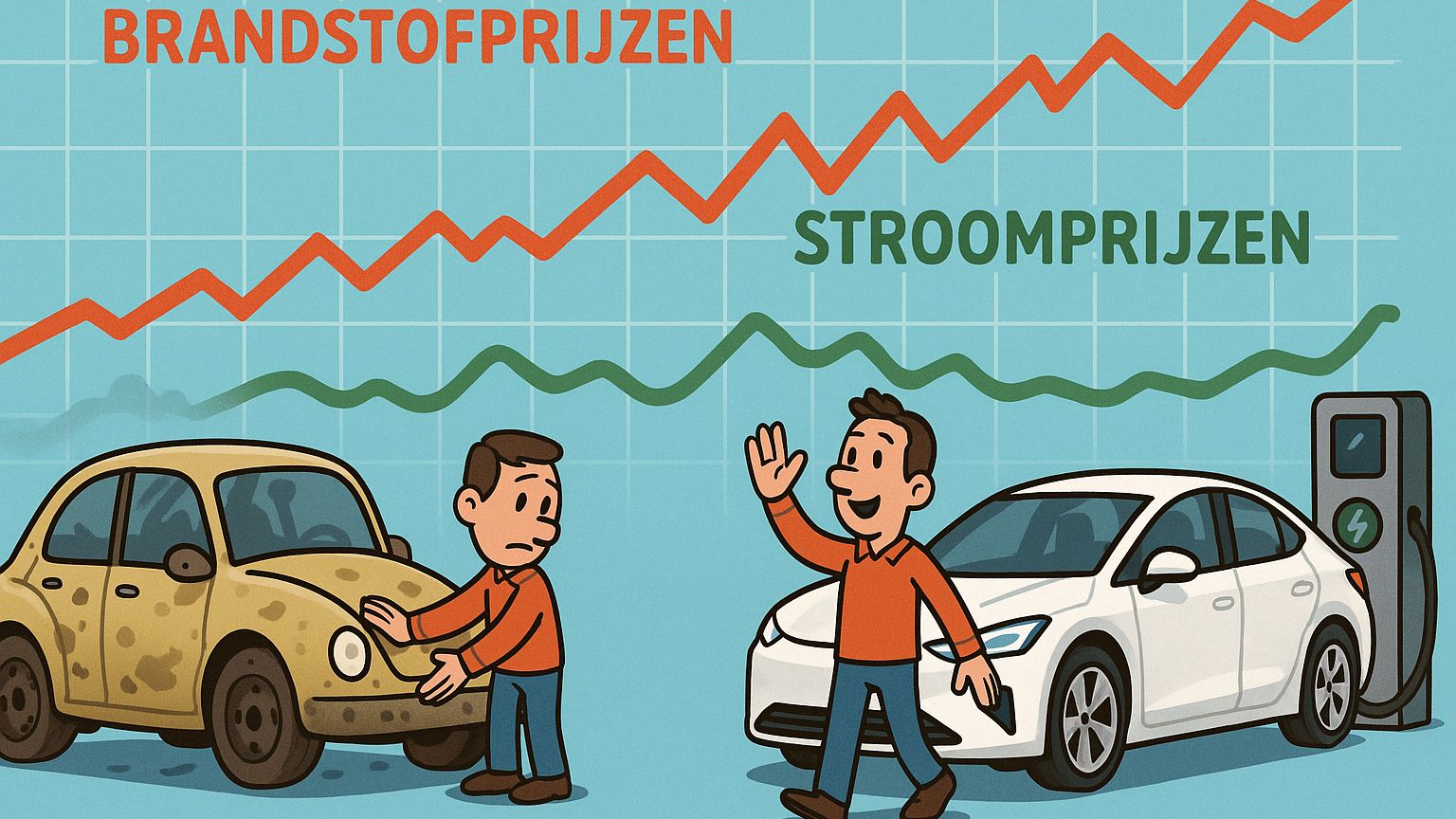
High fuel prices are making the switch to electric mobility comparativelymore attractive. It turns out that an electric car can be cheaper to operate in the long run, accelerating the decline in the number of conventional fuel-engine cars.
But there are still obstacles and there is also a downside. The purchase price of electric cars is still considerably higher than that of comparable gasoline models, and the used car supply is not yet that great. Charging infrastructure also lags behind in parts of the Netherlands, which may deter drivers from making the switch to an EV. But once total running costs – including maintenance, fuel and taxes – are factored in, electric driving is more economical in many cases. But it is inevitable that the share of electric cars in the Netherlands will continue to increase, especially among lease drivers and households with solar panels.
Electricity prices as a new factor
Motorists used to look at the price of gasoline; now (potential) EV drivers must look at the kilowatt-hour price. That electricity price largely determines whether electric driving is more economical. Also, the electricity price is mainly determined by all kinds of taxes levied by the Dutch government and much less by fuel and gas tariffs. But although electricity prices have now stabilized, the market remains vulnerable.
An increase in the price of electricity directly affects the running costs of electric cars. Charging at a public pole or fast charger then becomes more expensive. This may cause some EV drivers to charge less publicly, but mainly at home during the cheaper hours.
Households with solar panels are in a more favorable position. Those who generate their own power can charge their electric cars relatively cheaply. If the feed-in fee disappears, home power will remain financially attractive for EV drivers – too much generated power comes in handy in their EV’s battery. If it can feed back into the home power grid, there will be even less need to feed back into the public grid. Therefore, many of them are expected to invest in home storage and dynamic energy contracts to save costs in the future.
Driving less with an EV?
Does a higher electricity price cause Dutch people to drive their electric cars less? That effect seems limited. Even with higher electricity prices, the total running costs of an EV usually remain lower than those of a gasoline-powered car.
However, the rate of growth of new EVs may level off if energy costs remain high. If the cost per kilometer is too close to that of gasoline cars, some (private) buyers will postpone their purchase.
Cost allocation: fuel versus electricity
In conventional cars, fuel costs are a large part of the total cost of ownership. On average, some 25-30 percent of total car costs are directly related to fuel. Think of 2 euros per liter of gasoline and an average consumption of 7 liters per 100 kilometers: that adds up.
For electric cars, power costs are typically about 15-20 percent of total utility costs, depending on the charging rate and consumption. An average EV consumes about 18 kilowatt-hours per 100 kilometers. At a price of 40 euro cents per kWh, that works out to about 7.20 euros per 100 kilometers. That is just over half the cost of gasoline.
Even if the price of electricity rises to 60 cents per kWh, electric driving often remains more economical due to lower maintenance costs and less wear and tear on brakes and drive train. The price of gasoline really won’t drop much.
Forecast for the coming years
If electricity prices stabilize and the government commits to affordable charging infrastructure, it will strengthen the electric car’s position. The fuel car has had its day – not only because of government policies, but simply because every form of energy is becoming more and more expensive. Dutch people are driving less and more consciously and are more often choosing electric models. Yet more expensive does not necessarily mean less mobility everywhere. The car remains an essential means of transportation, especially in areas where public transportation is limited.