
European hydrogen alliance calls on automakers to accelerate hydrogen mobility
Cooperation between European operators
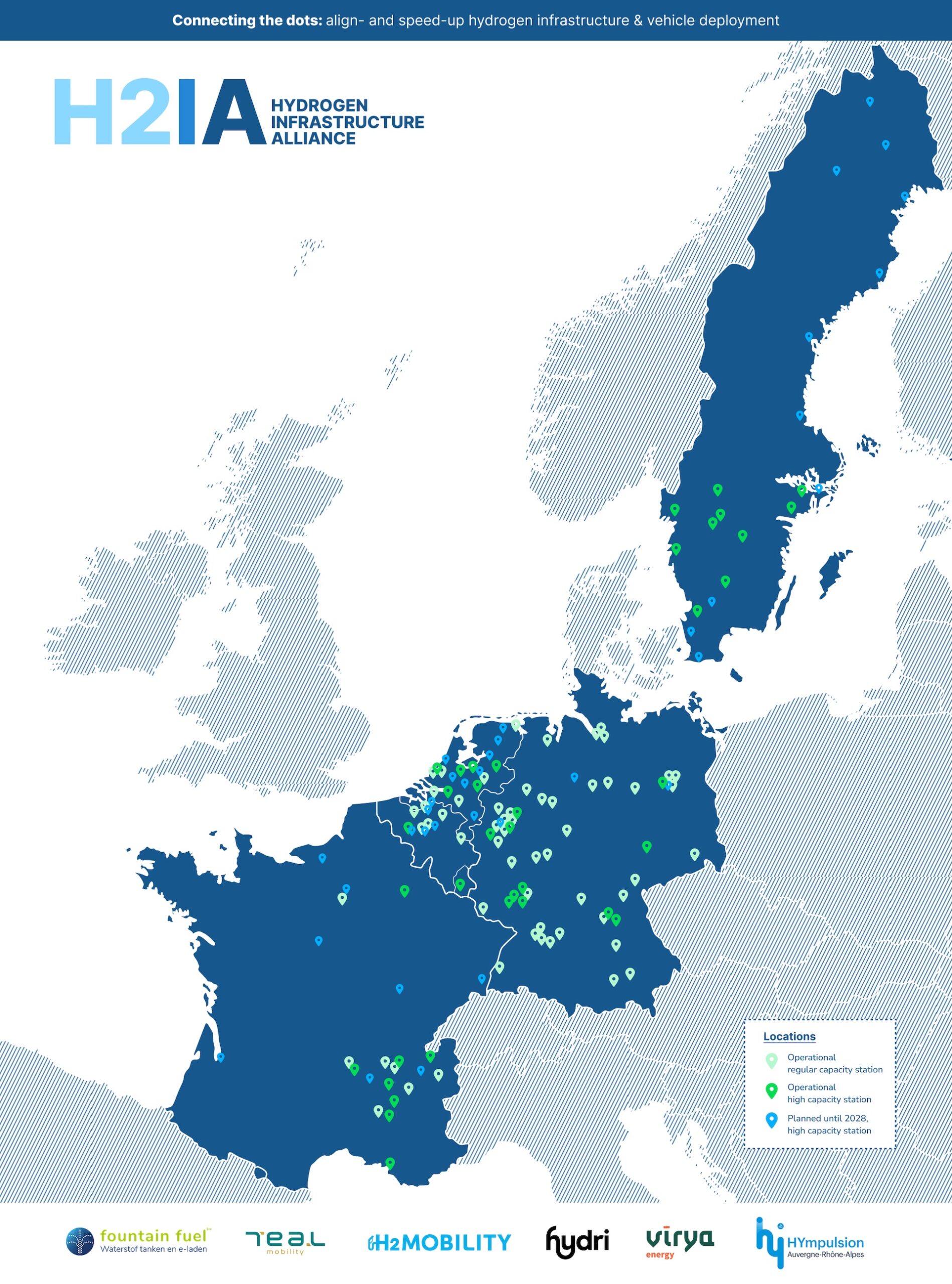
The H2 Infrastructure Alliance consists of parties from several European countries: Hydri from Sweden, TEAL Mobility and HYmpulsion from France, Fountain Fuel from the Netherlands, H2 Mobility from Germany and Virya Energy from Belgium. Together, these companies currently operate 92 hydrogen refueling stations for passenger and heavy transport. There are also plans for 39 additional large-scale hydrogen stations to be operational by 2028. According to the alliance, this expansion is sufficient to supply hydrogen to more than 1,800 trucks daily.
Member companies are in discussions with vehicle manufacturers to accelerate the deployment of hydrogen vehicles. The focus is on both light commercial vehicles and heavy-duty applications such as trucks and buses.
Breaking the chicken-or-egg problem
A recurring bottleneck with new mobility technologies is the so-called chicken-or-egg problem: without vehicles, infrastructure is not profitable, and without infrastructure, vehicle sales will not take off. According to the H2 Infrastructure Alliance, this pattern can be broken by first investing in a coherent network of hydrogen refueling stations. The alliance calls this approach “Connecting the Dots”: gradually connecting strategic locations into a European-wide network.
A robust infrastructure, according to the alliance, provides vehicle manufacturers with sufficient certainty to scale up hydrogen vehicle development and production. In turn, a larger and more diverse supply of vehicles leads to more use of the infrastructure. That process can ultimately contribute to lower costs for both vehicles and hydrogen fuel.
Comparison with mobile networks
The alliance compares the development of hydrogen mobility to the rise of mobile telephony in the early 2000s. Then a growing number of transmission towers and better coverage caused a rapid increase in cell phone use. That in turn led to further investments in networks and technological advances. With sufficient scale, the overall cost to users dropped. According to the H2 Infrastructure Alliance, hydrogen mobility can follow a similar growth path.
Hydrogen in heavy transport
Hydrogen, according to the alliance, plays a particularly important role in heavy road transport. In Germany, this is already visible in practice. There, more than 70 percent of the demand at existing hydrogen refueling stations consists of buses and trucks. Martin Jüngel, Managing Director and CFO of H2 Mobility, says that heavy transport is a determining factor for the further development of hydrogen mobility in Europe. According to him, the current infrastructure shows that a European network is feasible, but a clear commitment from vehicle manufacturers remains necessary to increase the number of vehicles.
Supplement to battery-electric driving
Members of the H2 Infrastructure Alliance emphasize that hydrogen and battery-electric driving are complementary. Both technologies are needed to meet diverse mobility needs. Hydrogen can play a role for long distances, intensive use and specific applications such as exceptional transport. Hydrogen can also offer an alternative in regions where the electricity grid has insufficient capacity for large-scale fast charging.
Hydrogen refueling in the Netherlands
In the Netherlands, the network of hydrogen refueling stations is gradually growing. There are currently public hydrogen refueling stations in Rhoon, The Hague, Arnhem, Helmond, Groningen, Roosendaal, Amsterdam and Hoogeveen, among others. As a Dutch participant in the H2 Infrastructure Alliance, Fountain Fuel is playing an important role in the further expansion of this network. The stations focus mainly on business use, public transport and logistics, but in many cases are also accessible to hydrogen-powered passenger cars.
About the H2 Infrastructure Alliance
The H2 Infrastructure Alliance was formed by Hydri, H2 Mobility, Fountain Fuel, TEAL Mobility, HYmpulsion and Virya Energy. The alliance aims to better coordinate and accelerate the development of hydrogen infrastructure and vehicles in Europe through 2028. The commitment is a cohesive European network of hydrogen refueling stations, referred to as “Connecting the Dots.
About H2 Mobility
H2 Mobility is one of the largest operators of public hydrogen refueling stations in Europe. The company is engaged in the development, financing, construction and operation of hydrogen stations. It also provides consulting, maintenance, calibration and quality assurance services. H2 Mobility was founded in 2015 and has been operating as a commercial company with a long-term focus since 2022. The company aims to offer exclusively renewable hydrogen by 2028 at the latest.