
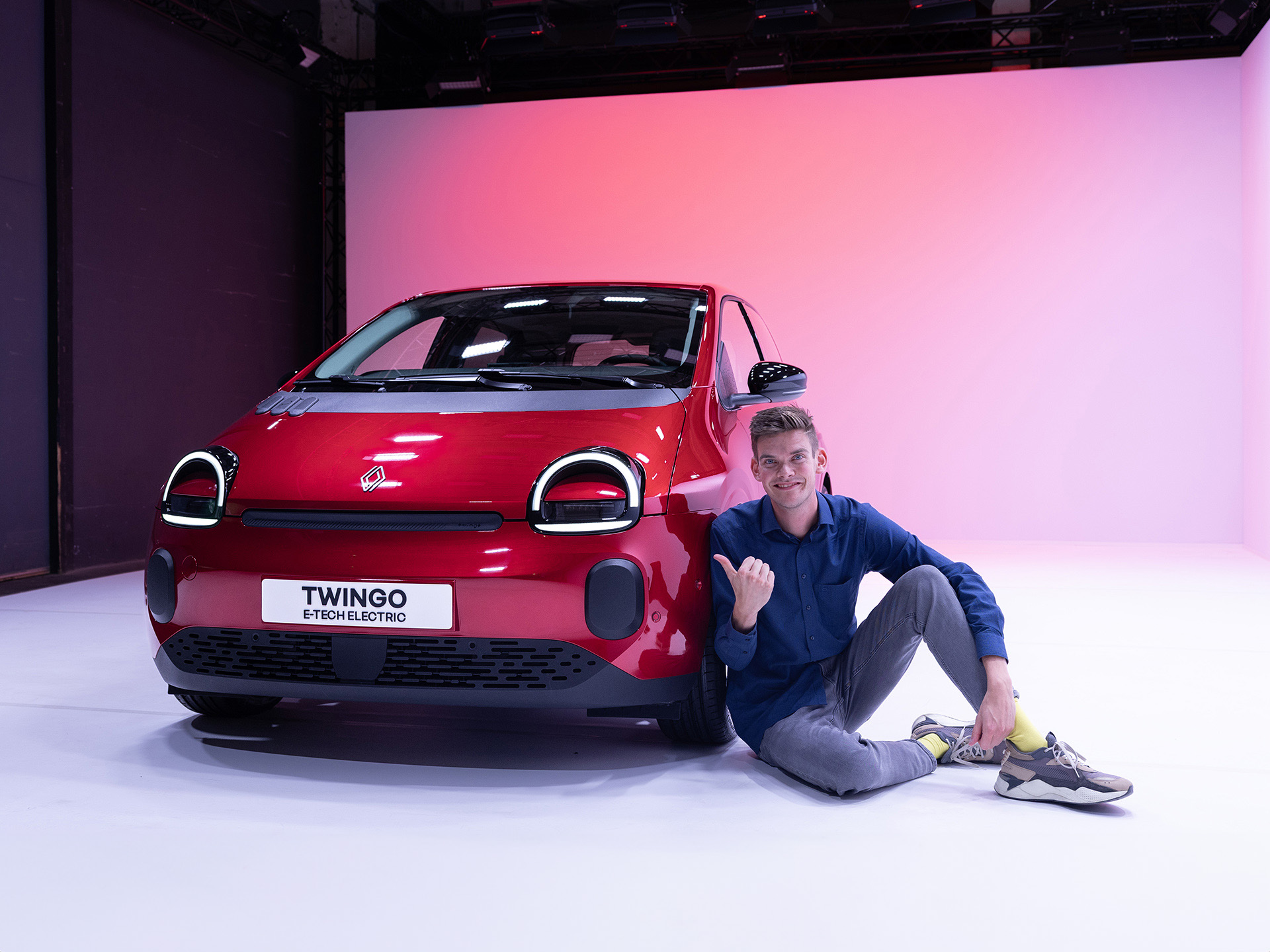
Big news in small size: this is the new Renault Twingo
Because that’s what it’s all about. Renault is adding to its electric model range and jumping into the extremely compact A-segment, just as the brand did in 1992 with the very first Twingo. This should be a compact, versatile and, above all, inexpensive city car of around 20,000 euros. Although there are a lot of similarities with this archetypal Twingo, there is also one big difference: the powertrain. Oh, and of course the price.


Subcutaneous technique
The new Twingo sits on a slightly shortened version of the AmpR-Small platform that you may know from the Renault 5. The front axle is identical to that of the Renault 5 and Renault 4, while the rear axle is derived from the Captur. So no multi-link suspension there, but a slightly simpler solution to keep costs down.
Under the hood – which cannot be opened – is a 60 kW (82 hp) electric motor with 175 Nm of torque. With that, it sprints from 0 to 100 km/h in 12.1 seconds, or from 0 to 50 km/h in 3.85 seconds, and it reaches a top speed of 130 km/h. The car weighs about 1,200 kilograms and is equipped with a 27.5 kWh LFP battery, good for a WLTP range of 263 kilometers. Charging is done with 11 kW AC in just over two and a half hours, or with 50 kW DC in half an hour. Thanks to Vehicle-to-Load, the Twingo can even power small appliances – handy if you want to bake croissants in your airfryer, though you’d probably rather choose a croissant at the boulangerie.


Remarkably spacious and practical
Although the Twingo looks compact on the outside, the interior space is striking. The luggage space starts at 360 liters, but can be expanded to as much as 1,000 liters when the rear seats are laid flat. Additional storage space can be found under the cargo floor (50 liters) and in the interior itself (19 liters), and the rear seats are individually sliding over a distance of 17 centimeters, allowing you to vary both luggage space and legroom in the rear. If you fold the passenger seat flat, you can utilize a cargo length of two meters – impressive for a five-door city car less than 3.8 meters long. By the way, it is 1.79 meters wide and 1.49 meters high – small but nice.


Design: nod to the 1992 Renault Twingo
Design-wise, the new Twingo is an ode to the first generation from 1992. Round, friendly and optimistic. The headlights almost seem to wink and numerous design influences from the original can be seen in the new Twingo. What the think of the continuous line of the hood and windshield, the three accents on this hood, of course the headlights, the striking button for the hazard lights and a slightly protruding rear window.


We could go on like this for a while. By the way, the shark fins on the taillights are elements that add their contribution to the aerodynamics of this small city racer. Then again, the door handles look slightly different, but are clearly inspired by the old ones. One more design gimmick then: the window frame at the bottom of the windows is missing – it looks sleek. The Twingo sits base on 16-inch hubcaps, optional on 18-inch alloy wheels, and is available in four colors: red, green, yellow and black. Green almost seems made to make you verkikkerd on this little car – pun intended.


Easter eggs and personal details
Everywhere in the Twingo there are small details that emphasize its character. For example, a special Twingo alphabet is incorporated into the interior ceiling, and you’ll find a small silhouette of the Twingo itself on the rear window. The sill displays French text that boils down to something like “This is where your adventure begins,” while tabs on the rear seats contain other life wisdom in French. If you open the tailgate, you will be greeted with a cry along the lines of “Open your mind” – which is aptly found.
All together, this creates a feeling as if the car is addressing you in a cheerful, almost mischievous way. In addition, you can personalize the car with modular accessories in different colors: a folding parcel shelf, extra trays, cable holders, colored transmission levers and floor mats with colorful patterns.


Versions Renault Twingo: Evolution and Techno
The Twingo comes in two versions: Evolution and Techno. The Evolution offers a 7-inch digital instrument cluster for the driver, a 10-inch infotainment screen with wireless Apple CarPlay and Android Auto, 16-inch hubcaps, cruise control, lane-keeping assist and rear parking sensors. Manual climate control and height-adjustable driver’s seat are also part of this trim.
The Techno variant tops that with an OpenR Link system that supports Google services such as Maps, adaptive cruise control with stop & go, automatic climate control, digital rearview camera, electric folding mirrors and tinted windows. One-pedal driving is also among the features of regenerative braking, and the Twingo retains the handy hotkey for driving assistance systems that you also know from the Renault 5.
Positioning Renault Twingo
The base price will be around 20,000 euros, but has not yet been officially confirmed. This price indication puts the Twingo in a competitive position in the electric A-segment. Competitors such as the Citroën ë-C3 and the Dacia Spring must lose out to the Twingo even on paper. For example, the ë-C3 Urban Range has a 30 kWh battery pack good for 212 km (WLTP) and the Spring has to make do with 225 km of driving range from a 24.3 kWh battery pack. In other words, in terms of driving range, the Twingo seems to be leaving the competition behind.
Perhaps even in the overall picture, if only because of its charming design. The new Twingo is a reminder that driving can be light, cheerful and simple. Big news in small size, then, this bubble of optimism. With 82 hp, 27.5 kWh battery, a WLTP range of 263 kilometers, the Twingo offers modern technology in a charming package. Add to that a flexible interior and digital connectivity and you have a city car that looks as likeable as it probably drives – but we’ll have to wait and see….


