
Wireless charging of electric cars
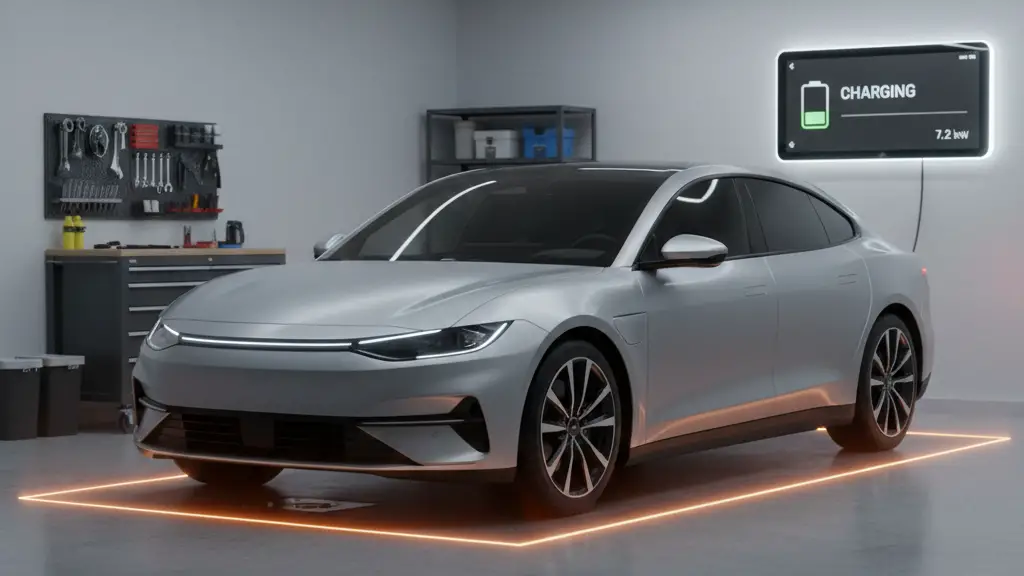
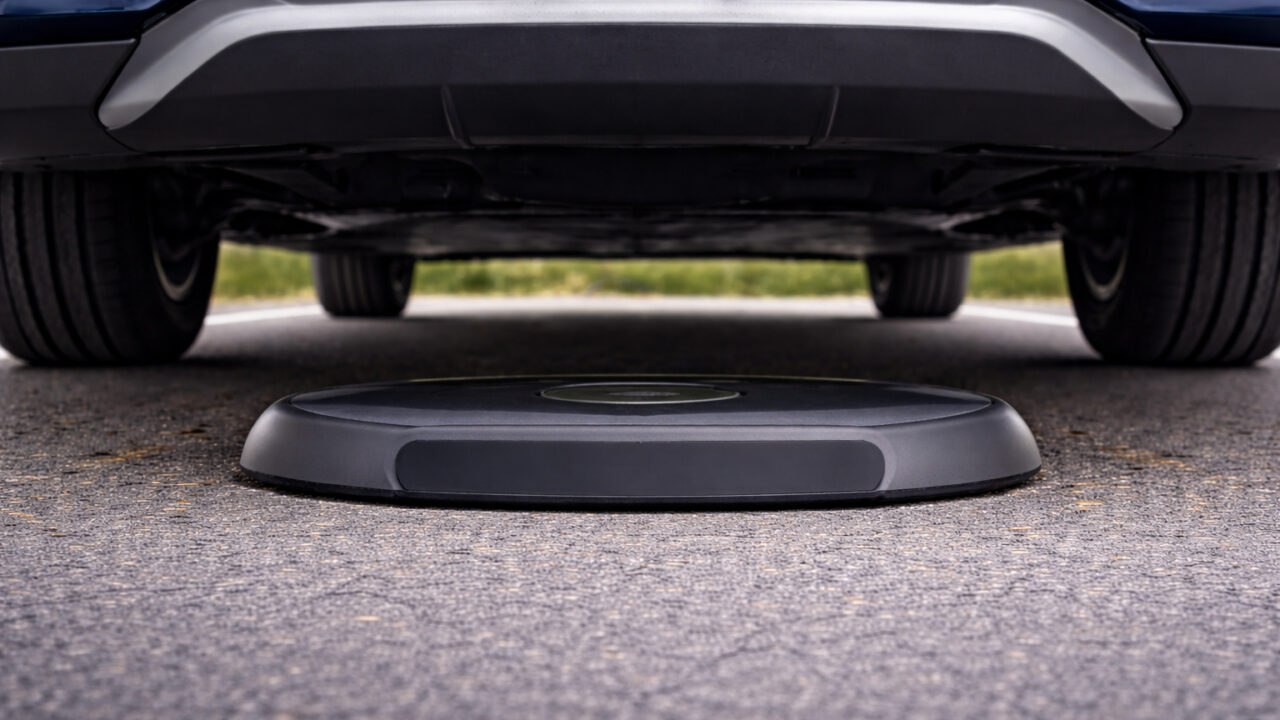
Wireless charging – or inductive charging – is a way to transfer energy to an electric vehicle (EV) battery without a physical charging cable. So your car is not plugged in; you park it above a charging plate in the ground. A receiver is mounted under the car. As soon as both parts come into range of each other, charging begins automatically.
The system consists of two components:
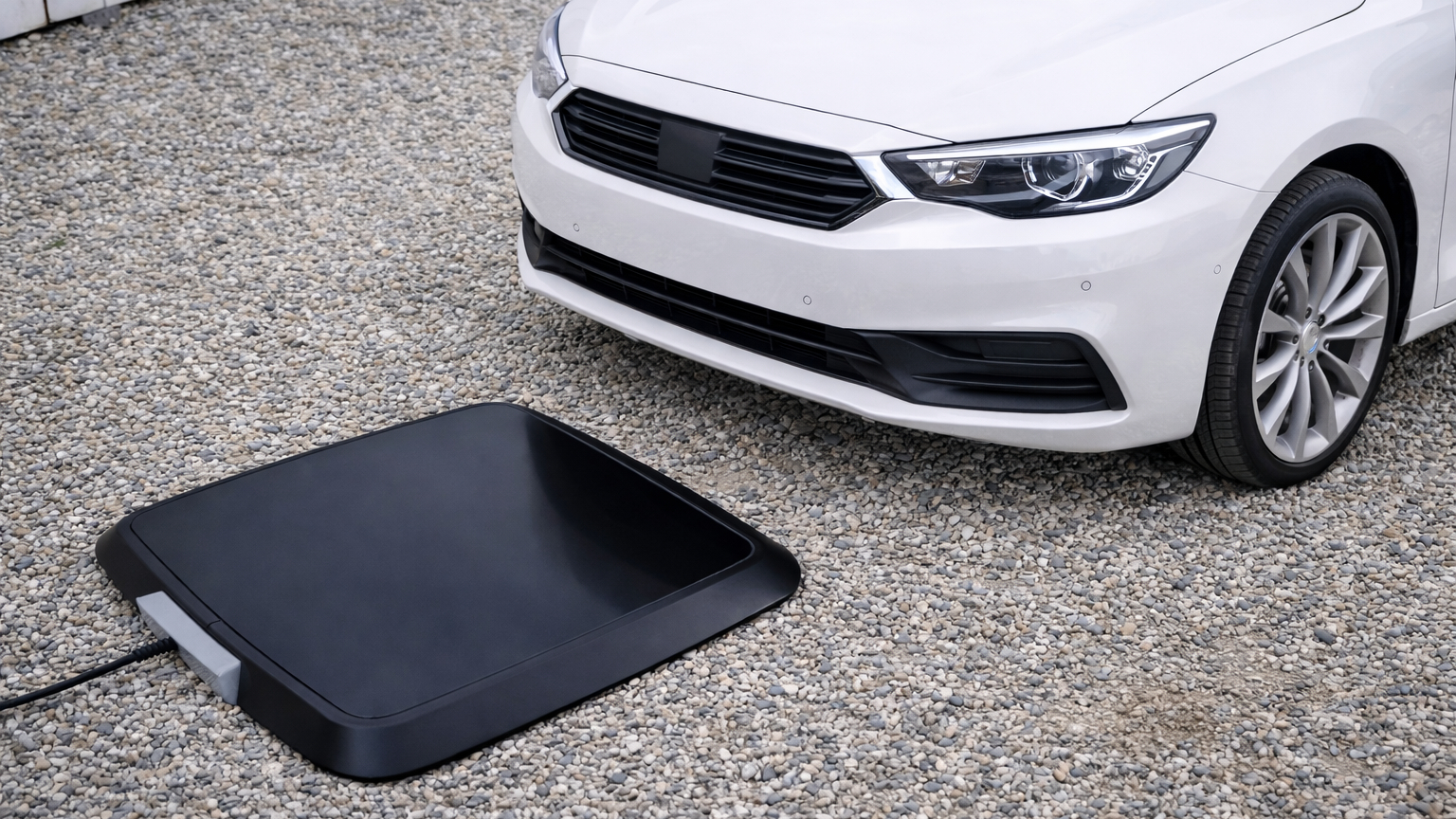
- a loading plate (transmitter) in the floor or street;
- a receiver under the car that converts the electromagnetic field into electrical energy for the battery.
Wireless charging is done with alternating current. A magnetic field between the two elements transmits energy. The technology is based on the principle of resonant inductive coupling. If the coils in the transmitter (the charging plate) and the receiver (under the car) have the same resonant frequency, the efficiency increases.
How exactly does wireless charging work?
When you park the car over the loading plate, the system automatically searches for the correct position. This is done with the help of sensors or cameras. If the car is positioned correctly, the charging process starts. The charging point communicates with the car, just like charging with a charging cable. The charging speed is controlled by the on-board charger.
Capacities are usually between 3.7 and 11 kW. Some pilot projects are working with 20 kW and above for higher charging rates. In theory, higher powers are possible, but heat generation and efficiency still play a limiting role.
The efficiency is between 85 and 93 percent, slightly lower than that of cable charging, according to test projects. This difference is narrowing due to improvements in electronics and coil technology.
Is wireless charging already possible in the Netherlands and Europe?
Wireless charging is still in its infancy, but the first practical tests are already running. In the Netherlands, there are pilot projects at cab services, municipalities and universities. Similar trials are underway in countries such as Germany, Norway, Sweden and France.
Public wireless charging stations do not yet exist, but that is expected to change in the next few years. Manufacturers and charging station developers are working together on standards, including SAE J2954, the international standard for wireless charging. That standard will make large-scale rollout of wireless EV charging easier.
How to register and how to bill?
Wireless charging uses the same infrastructure as charging with a cable. You register via a charging card or app. In tests, however, automatic charging is often used: the car is recognized and charging starts without a pass. Checkout is done afterwards, as with systems like Plug & Charge.
So for consumers, there are few changes to be expected around wireless charging compared to current charging and payment. The technology behind registration and payment can be completely integrated into existing systems.
What requirements must your electric car meet?
Not every electric car can be charged wirelessly. The car must be equipped with:
- An inductive receiver, or charging module under the floor;
- A software update that supports communication with the wireless charging point;
- on-board electronics that can handle the power of the induction system.
Some models are prepared for wireless charging, but do not yet have the receiver. Other cars can in principle be retrofitted, but this requires extensive assembly (installation at the bottom, coupling with the on-board charger). For now, this is something that is only happening in pilots.
What requirements must the charging point meet?
A wireless charging station consists of:
- A buried or built-in loading plate with coils;
- an inverter that converts the energy into the appropriate electromagnetic field;
- communications hardware for authentication and payment processing;
- a completely waterproof and weatherproof system that operates safely under all conditions.
The installation must be perfect. Too much distance between car and plate lowers efficiency or even stops the charging process. Standards such as SAE J2954 help achieve uniformity so that cars and charging stations communicate well with each other.
Which cars are suitable for wireless charging?
Currently, mostly premium brands have prototypes or test vehicles. Consider:
- BMW 530e (plug-in hybrid) – one of the first models to offer wireless charging as an option in test form;
- Mercedes-Benz EQ models– under development for future inductive charging options;
- Hyundai and Kia – working on inductive charging modules based on E-GMP platform technology;
- Volvo and Polestar – are participating in Nordic test projects for inductive charging;
- Tesla – working on its own system.
Currently, wireless charging is mostly technology in the pilot phase. Large-scale availability is not likely to come until around the end of this decade.
Cost of wireless charging
Costs are difficult to determine at this time because wireless charging is not yet standard consumer technology. Guide prices from pilot projects show:
- installation wireless home charging point: between 2,500 and 4,000 euros;
- conversion of a car: depending on model and manufacturer between 1,000 and 3,000 euros.
The price per kWh is slightly higher than for cable charging because of the lower efficiency. In test cases, this difference averages 5-10 percent. As the technology improves, this becomes smaller.
Wireless charging at home
Home wireless charging is seen as one of the most important applications. You no longer have to grab a cable and the car automatically starts charging as soon as you park in the driveway or garage.
What you need:
- a wireless charging station integrated into the ground, driveway or garage floor;
- a connection to your meter box, similar to that of a regular charging station;
- possibly modification of your car if it does not already have a receiver;
Installation requires a professional and is more complex than that of a regular charging station because the ground must be milled out.
Wireless charging at public charging stations
Public induction chargers are still rare, but infrastructure is already being prepared. Testing is underway in several cities:
- cabs that automatically load at queues so drivers do not have to get out;
- electric buses charging wirelessly at stops and terminus;
- dynamic charging lanes, where cars charge as they drive (Sweden and Israel are already testing this).
For passenger cars, parking spaces in cities, shopping malls and mobility hubs are mainly considered.
Difference with cable charging
The biggest differences:
- ease of use: no cable, no dirty hands, charging starts automatically;
- Efficiency: slightly lower than charging with cable;
- costs: higher for now due to expensive hardware;
- speed: currently limited to 3.7-11 kW; future systems promise higher powers.
Still, many manufacturers see wireless charging as a logical next step toward fully automated mobility. The basis is there. The technology works, the standards are ready and the first practical tests are promising. For consumers, the wait is for suitable cars and affordable charging stations. At home, wireless charging will probably be the first to break through, followed by public infrastructure.