
What does the carbon tax mean for business drivers?
What is the carbon tax for business cars based on?
In the 2026 Budget Memorandum and the 2026 Tax Plan, the government specifically proposes thecarbon tax for business cars. From 2027, employers will have to pay an additional levy if they provide a car “with CO₂ emissions,” i.e. with a fuel engine, to an employee. TheCO2 tax amounts to 12 percent of the list value of the car (including VAT and bpm) per year. This is not a European measure, it is a Dutch tax construction.
This tax is referred to as a “pseudo final tax. In this case, that means that the employer must pay the tax in addition to the regular payroll tax. He may not pass the pseudo tax on to the employee. The levy coincides with the start of the European emissions trading system, ETS-2, which is expected to make fuel prices more expensive again by 11 to 13 cents.
What is the goal?
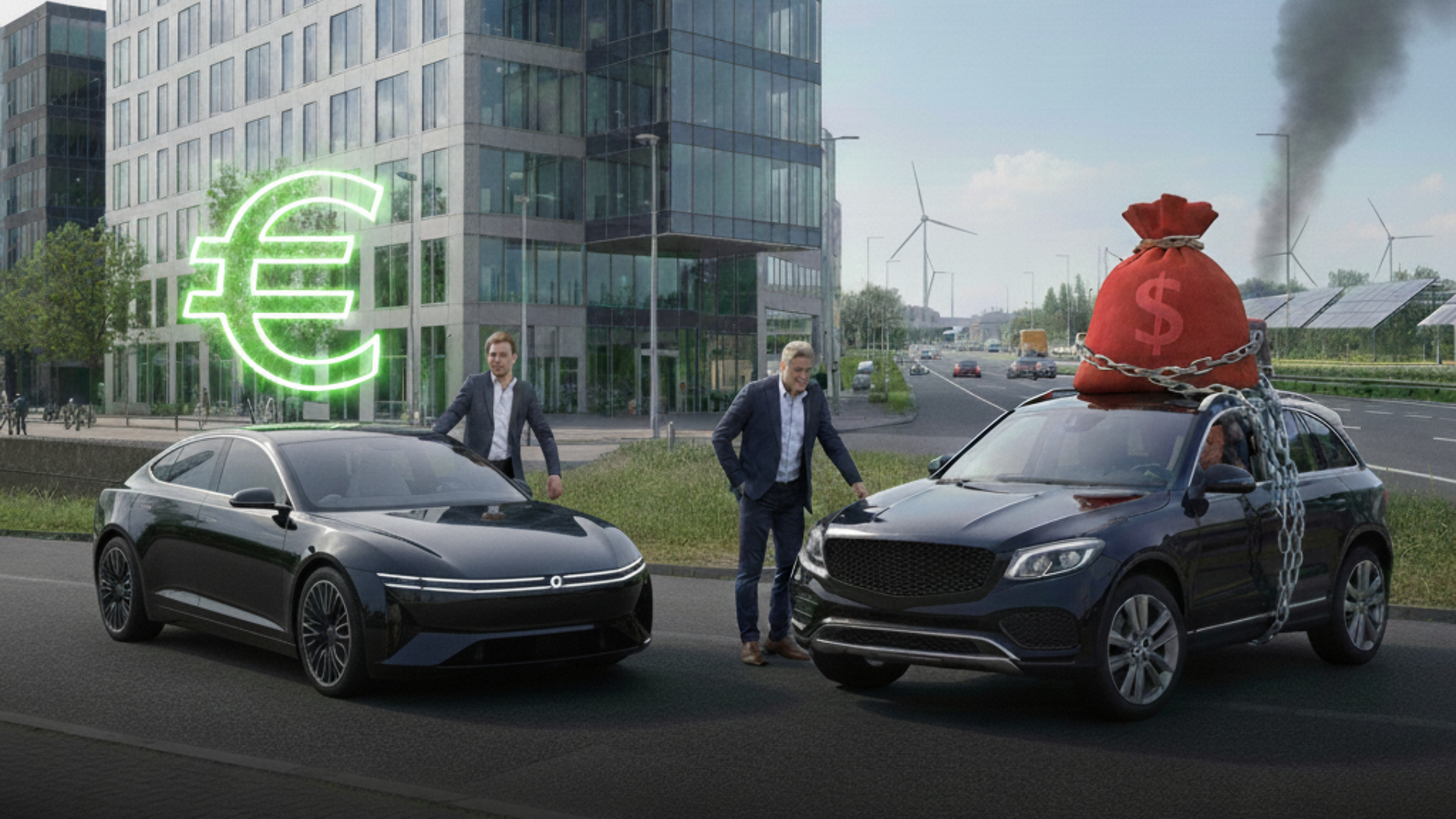
The purpose of thecarbon tax on business cars is primarily to change behavior: to encourage employers to green their business fleets and to offer no or fewer fuel-engined cars to their employees. The idea is that the extra cost of fuel engine cars will make electric cars relatively more attractive.
How is the levy calculated and when?
From January 1, 2027, employers will have to pay an annual 12 percent levy for cars with CO₂ emissions. Not on the number of kilometers driven, but on the list value (including VAT and BPM), if those cars are also used privately and that private use falls under the additional taxable benefit scheme.
Note: for theCO2 levy, commuting to and from work does count as private use, whereas for the regular addition to income, commuting is considered business use. So even the employer of someone who does not receive an additional taxable benefit and who drives less than 500 kilometers privately according to the standards for additional taxable benefit, will be subject to theCO2 tax.
For cars put into service before Jan. 1, 2027, there is a transitional arrangement. NoCO2 tax is payable for those cars until Sept. 17, 2030.
Who should pay thecarbon tax?
The levy is explicitly payable by the employer who provides the car. He may not pass this levy on to the employee. Any own contribution by the employee for the private use of the company car does not affect the amount of theCO2 tax.
Private use and exceptions
TheCO2 tax on fuel-engined business cars applies if the car may also be used privately. Commuting is classified as private use under the new scheme, regardless of how it is viewed for purposes of addition. Of course, locally completely emission-free vehicles (i.e. electric cars) are exempt, as are, in principle, cars that are (or can be) used exclusively for business and not privately. Incidental private use due to force majeure or special circumstances may fall outside the scope of theCO2 tax, provided the employer can prove it.

What does this mean for the business driver?
For the business driver himself, nothing changes fiscally. The addition to income for private use will continue to exist according to the existing rules. For the employee, it does mean in practice that he will have less choice of (cheaper) cars with a fuel engine or that he no longer gets that choice.
The additional cost burden will fall entirely on the employer. It can therefore make other choices: it can decide to provide only emission-free cars to its employees in order to avoid the extra charge.
Developments and effects
The introduction of theCO2 tax on business cars is not yet final. At the time of writing, both the House of Representatives and the Senate have yet to approve the 2026 Tax Plan. Details may therefore still change, such as the level of the levy percentage and the details of the transitional regime.
Possible fallback options for employers include providing a mobility budget instead of a car. With the possibility of employees opting for a fuel-powered private car instead of such a company car.
There may also be an anticipation effect: companies will still purchase as many fuel-engine cars as possible in 2026 to avoid the tax under the old rules until Sept. 17, 2030.
CO2 andCO2 emissions
CO₂ (carbon dioxide) is a gas released from the combustion of fossil fuels (gasoline, diesel, natural gas, coal) and from a variety of industrial processes. These emissions contribute to the greenhouse effect and climate change. Excessive emissions lead to changing weather patterns, melting ice and rising sea levels. The government is counting on the fact that by making carbon emissions expensive, behavior can be regulated.
Can the Netherlands save the climate with this tax? Making CO₂ emissions and other tax incentives expensive is mainly symbolic and aimed at national ambition, innovation and behavioral change. Whether it is enough depends on cooperation at the European level, technological progress and international efforts. Common criticism is that the additional national levies mainly create additional burdens without changing much overall. Moreover, emission-free alternatives are far from always available, so making them more expensive alone will not solve anything.
CO₂ levy aimed at employers
In summary, the new CO₂ levy for company cars (in the form of a so-called pseudo-final tax) is intended to force employers to phase out company fuel cars. The levy – calculated on the catalog value of the car – must be paid by the employer. He may not pass it on to the employee. The levy does not apply to electric cars.
There ís already a carbon tax for industry, designed to reduce emissions at large industrial companies with financial incentives. The outgoing administration has plans to decommission or reduce this industrial tax. Since the same idea of making CO₂ emissions more expensive is now being extended toward mobility policy, the business community is hoping for the same for the pseudo-final tax onCO2 emissions for fuel-engined business cars.
