
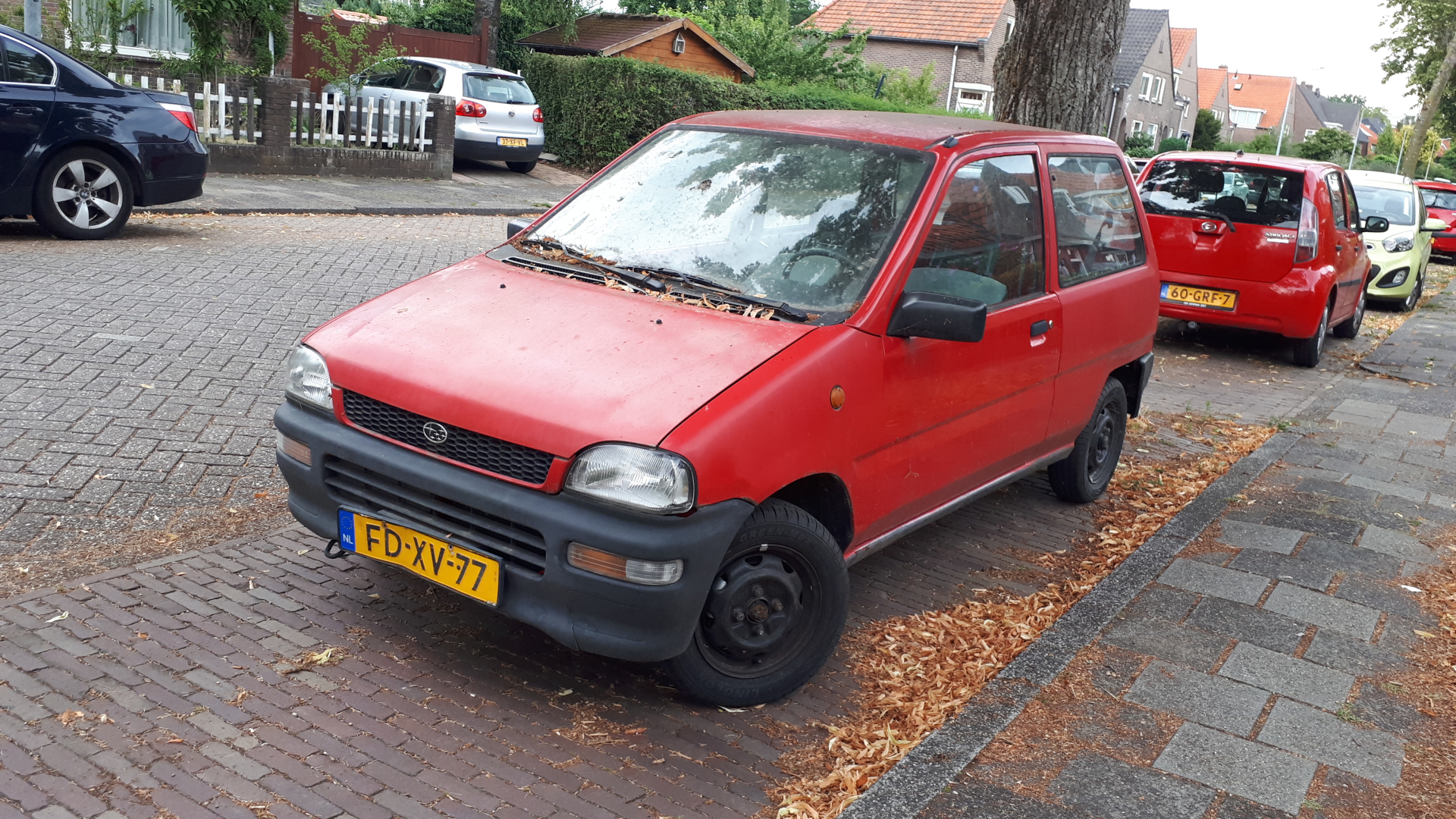
Spotted: a Subaru Mini Jumbo
The spotted specimen
In Zeist, we saw this 1992 Subaru Mini Jumbo SDX. This makes it one of the very last examples. While it was once a common player in the A-segment, it has been quite a while since we have come across one. Of all generations together, there are still 101 registered in the Netherlands, 76 of which are of this model generation. It is remarkable that no less than 75 of all Mini Jumbos in the Netherlands no longer have a valid license plate, so the chance of seeing one in the wild has indeed become small.


Predecessor of the Subaru Mini Jumbo
The story of the Subaru Mini Jumbo begins in 1972, with the introduction of the Subaru Rex in Japan. A kei car that, despite its compact size, had the engine in the back, under the luggage compartment. With that, the little car had both front and rear luggage space, though neither were large. Still, all in all, you could transport a remarkable amount, given its compact exterior dimensions.
Outside Japan, the Rex was delivered as a Subaru 500 or 600, with the type name referring to engine capacity, albeit rounded up by a wide margin. Despite coming across a grainy photo of a Subaru 500/600 in Europe, it seems that this model was not yet officially delivered in Europe.

Chapter two: Subaru Mini Jumbo to Europe
In 1981, the second model generation of the Rex hit the market. Now it was a more conventional little city car, with the engine “just up front” and a rather average, sleek design for the time. Sure enough, this model officially made the crossing to Europe. In some markets the 600 type name was retained (later the 700), but in many countries the model was sold as the Subaru Mini Jumbo. Unlike that name suggests, by the way, there was no larger Jumbo model.

third generation
The third-generation Subaru Rex, or the second Subaru Mini Jumbo, saw the light of day in 1986. Like many kei car competitors, the car evolved into a somewhat taller hatchback model, but for its time it remained a fairly average city car. For the European market, some type name variants were again devised. For example, it was on sale in some countries as the M60/M70/M80 or Signet.
With this third generation, the engine lineup was larger than ever, but only the two largest of these were available in Europe. ‘Largest’ is relative here, as these were a 665 cc two-cylinder and a 758 cc four-cylinder. Power was 27 kW (37 hp) to 31 kW (42 hp). Although the car weighed only about 600 kg, depending on the version, the 0-100 sprint took 17 to as much as 20 seconds. The engines were very reliable and with a fuel consumption of 5.7 l/100km (1 on 17.5) very economical.


Succession for the Subaru Mini Jumbo
After a facelift in 1989, the Subaru Mini Jumbo remained in production through the first months of 1992. Its successor was called the Subaru Vivio. Another model that you once saw regularly, but is now becoming quite rare in the streets.
