
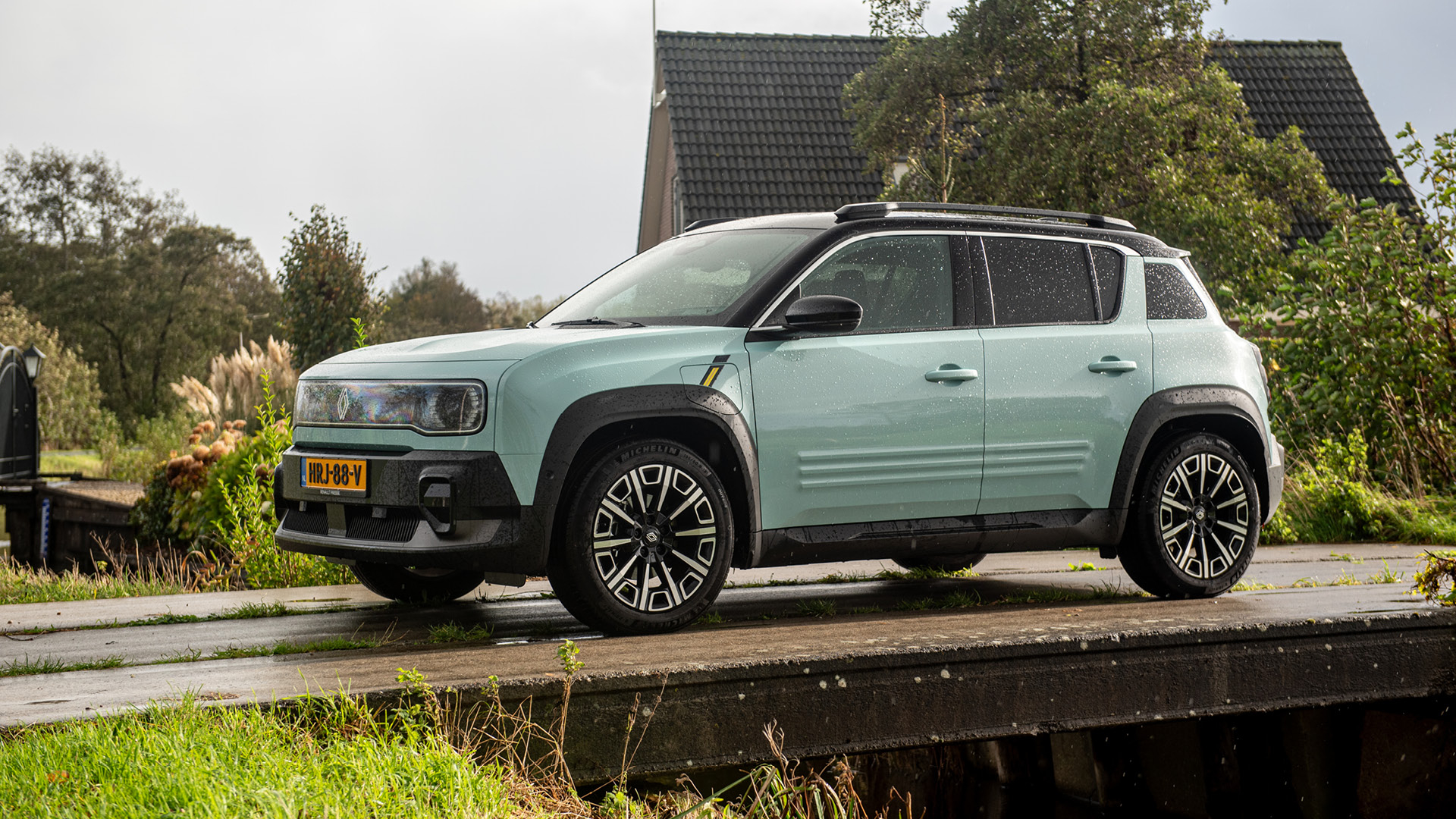
Review – Renault 4 Iconic Comfort Range (2025)
Design and practical features
Of course, the new Renault 4 is heavily inspired by the classic original. However, it is a lot bigger. Not only because modern cars are bigger than they were decades ago, but also because the new 4 is meant to be a somewhat roomier alternative to the 5. So where the original 4 was a model below the 5, the new one is positioned at the same level or even slightly higher. Just as you have the Clio and Captur with fuel engines, you now have the 5 and the 4 in the electric segment.
In terms of body shape, the Renault 4 is somewhere between a hatchback and an SUV. Given its dimensions and higher seating position, we consider it to be the latter, although the term “crossover” is certainly appropriate here as well. Whereas we found the seating position in the Renault 5 a bit on the high side, it comes into its own in the 4. The Renault 4 has good clear bodywork, although the rear window is a bit on the small side.
In the Renault 4, the larger body compared to the 5 mainly benefits luggage space and rear seat space. The 5 offers 326 liters, while the Renault 4 comes to 420 liters. That’s even a lot more than in the Captur (377 liters). The space in the back seat was a bit disappointing in the 5, but is also noticeably better in the 4. However, it is still not really spacious. With 1.80 m, we can just sit “behind ourselves” and that is still doable in terms of space, but there is no margin left.
Powertrain Renault 4 E-Tech Electric
The new Renault 4 is available with two powertrains: the Urban Range and the Comfort Range. The former has a 90 kW (120 hp) and 225 Nm electric motor. A 40 kWh battery pack, together with a WLTP consumption of 14.2 kWh/100 km, provides a range of 308 km. The Comfort Range offers 110 kW (150 hp) and 245 Nm, but most importantly a larger 52 kWh battery pack. With a WLTP consumption of 15.1 kWh, that’s good for 409 km of range.
In both cases, top speed is capped at 150 km/h, and with 9.2 versus 8.2 seconds, sprint times to 100 km/h are not much different either. Registration weights are 1,410 and 1,462 kg, respectively. That’s just one weight class difference for road tax purposes, but for an EV both weights are not too bad. The towing weight of both models is 750 kg anyway.

Charging and range in practice
At an ordinary charging station, the Renault 4 can charge with up to 11 kW. Fast charging, depending on the powertrain, goes with 80 or 100 kW, with the higher power applying to the larger battery. As a result, fast charging time is similar down the line: the familiar 20 to 80% charging in about half an hour. This is also achievable in practice, provided the battery is up to temperature.
We drove the Comfort Range. In practice, this gave us an average consumption of 18.6 kWh/100 km, after a week with fairly varied mileage (comparatively a lot of highway) and cool outside temperatures. A neat score.

Performance and handling Renault 4
The technically identical Renault 5 is praised for its driving characteristics. As expected, this is no different for the Renault 4. This model also offers tight handling and at the same time good driving comfort. Of course, the Renault 4 is slightly larger and, depending on the version, about 100 kg heavier than the 5. This may make it a little less playful, but the difference is not really great. It remains an EV that is also fun on winding shortcuts.

Prices and equipment
The Renault 4 is available from 29,990 euros. Upgrading to the larger battery and more powerful engine brings the price to 32,990 euros. Go for top-of-the-line Iconic model, seen here in the photos, the price comes to 36,490 euros. The Techno, of course, is in between.
For a detailed overview of prices and equipment, please refer to the most current price list at www.renault.nl. However, we do mention a few highlights here. Standard equipment is already quite complete, for example, with 18-inch alloy wheels, full LED lighting, heated door mirrors, keyless entry & start, 7-inch digital instrument cluster, 10-inch central display for multimedia, cruise control with speed limiter, reversing camera and rear parking sensors. A heat pump is also standard, which provides some extra efficiency, especially in winter.
Upgrading to the Techno is worth considering because of things like adaptive cruise control, a larger (10-inch) instrument cluster, infotainment with built-in Google services and voice controls, a wireless smartphone charger and a more comprehensive audio system.
Top-of-the-line Iconic model additionally offers privacy glass, seat and steering wheel heating, a power-adjustable driver’s seat and automatic parking. Of course, the test car is also loaded with options. These include the contrasting black roof, a Harman Kardon audio system, a package with additional driving assistants and a V2L adapter. All in all, the price of the test car in the photos comes to 39,240 euros.
Conclusion
The Renault 5 already managed to score with good value for money and appealing driving characteristics. It was not voted