
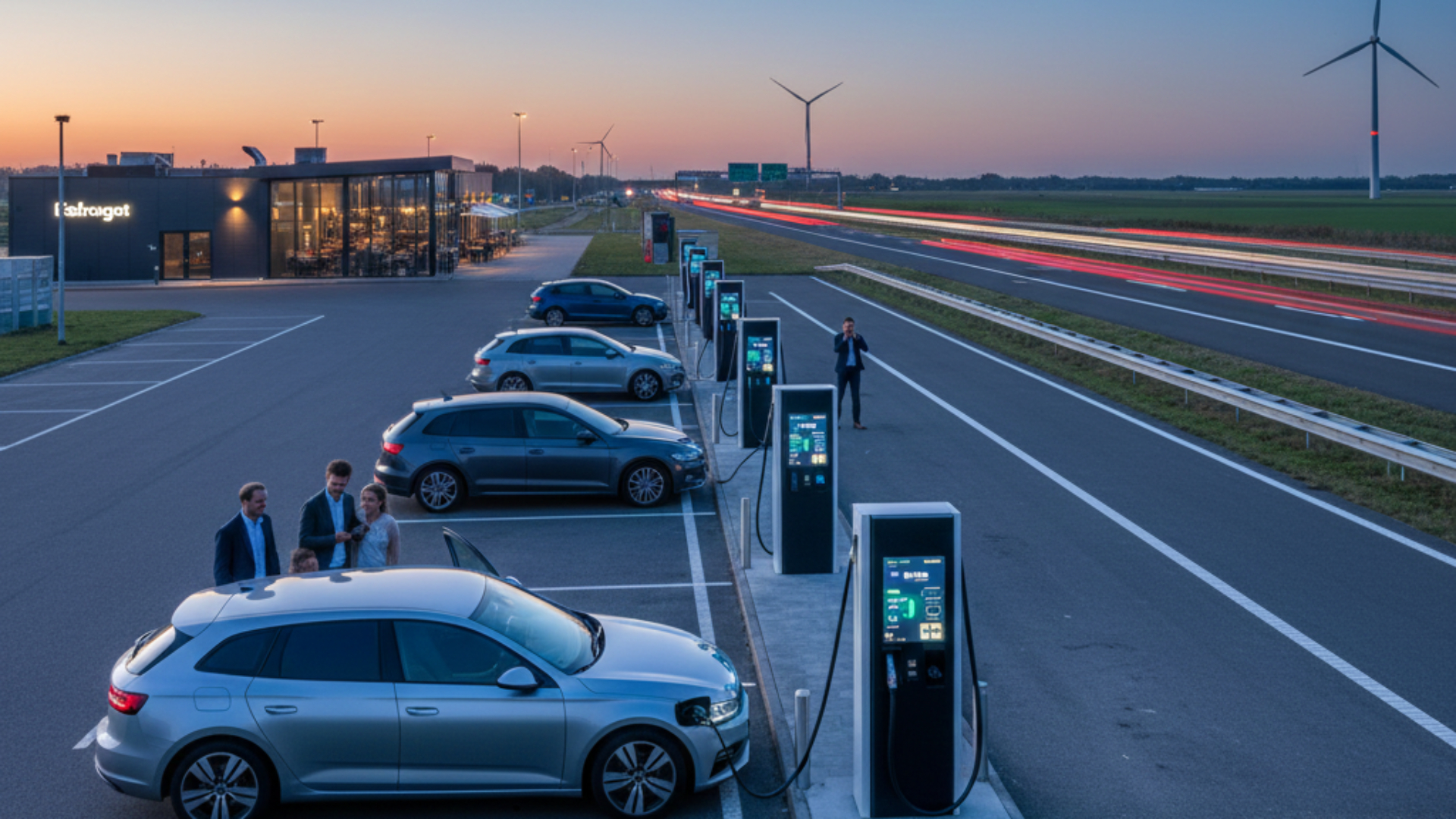
Fast charging: this is how fast charging an electric car works
Fast charging makes long electric vehicle (EV) trips possible without having to wait a long time before you can continue. However, fast charging or DC charging is different from regular charging at a public charging station or at home. The difference is mainly in the power of the fast charging station and the way the battery handles the charging process. To properly understand how fast charging works, it is important to know the difference between AC charging – as you do at home or along the street – and DC fast charging.
AC/DC
With a regular AC charger, you use your own charging cable and your EV’s internal inverter – also called an onboard charger. That converts alternating current (AC) from the charge point into direct current (DC), because a battery runs exclusively on DC power. The capacity of that internal inverter determines how fast you can charge. Often the capacity is between 7 and 22 kW.
Fast charging works differently. A fast charger sends the direct current (DC) from the grid to the battery without the intervention of the internal inverter. As a result, the charging current can be much higher and capacities can reach 150 kW and even more than 350 kW at the newest fast charging stations. That makes charging on the go so much faster.
What do you need?
To fast charge, first of all, you need a car that supports fast charging. Not every EV can do that, but by far most can. Some EVs can charge up to 50 kW, others up to 120, 250 or even 300 kW and above. The maximum charging capacity is set by the manufacturer and you cannot adjust it yourself.
You also need a charging card or app that works with the provider of the fast-charging station where you want to fast-charge. A subscription is not mandatory, but it can provide lower rates. However, you don’t need to bring your own cable with you for fast charging: every fast charger has a fixed cable attached, usually with a CCS plug. Only older Japanese EVs still use CHAdeMO. Larger fast-charging stations usually have such a type of plug available as well.
Charging point requirements
The fast charging station must also meet requirements. Of course, the charging station must support DC charging and provide sufficient power. A station with 50 kW is usable, but today you mostly see 150 and 300 kW fast chargers. Modern fast charging stations often have cooled cables because the high power generates a lot of heat.
Smart energy control also plays an important role: the station continuously monitors how much power is available and distributes it when multiple cars are charging at the same time.
Car requirements
Technically, your EV must be able to do more than just accept a high charging current. Battery temperature control is also crucial. A battery works best within a certain temperature range. Many modern EVs therefore have an active cooling system that maintains the battery’s temperature during charging. Some EVs can even preheat the battery when you set the fast charge point in the navigation. This allows the battery to immediately charge at maximum speed. If your EV does not have this feature, the charging speed may be lower if the battery is cold or just too hot.
Practice
In practice, fast charging works very simply. You drive to the charging station, choose a free charging spot and connect the cable from the fast charger to your car. Then you start the charging session with your charging card or via the provider’s app. The EV and the charging station then communicate with each other. They determine the right voltage, the ideal charging current and tune the maximum power that is safe. Charging is faster when the battery is relatively empty. In the first phase of fast charging – often to about 30 or 40 percent – your car uses the maximum charging power it can handle. After that, the charging rate gradually flattens out – this is normal for the way lithium-ion battery absorbs energy.
The last 20 percent of charging takes longer. This is due to battery protection. As the charge level increases, the battery must be filled more precisely. That means the car scales back the amperage more and more.
Fast-charging to 100 percent is not only unnecessary; more importantly, it takes a disproportionate amount of time and puts unnecessary strain on the battery. Most manufacturers recommend fast charging to about 80 percent if you want to maintain maximum speed as well as protect the life of your battery.

Cost
The cost of fast charging is higher than ordinary charging at home or at an AC charging station. Fast chargers use complex technology, powerful power connections and expensive cooling systems. You also pay for convenience and speed. At home, you might pay 30 to 40 cents per kWh; fast-charging rates can be as high as 70 cents and more, depending on the provider and sometimes even by location. So it’s smart to check what the rate is before you leave, especially if you’re making longer trips that require multiple recharges.
Advantages and disadvantages of fast charging
Fast charging has distinct advantages. You’re back on the road much faster than when using AC charging points. For long trips, fast charging is simply necessary – as well as in situations where you need to recharge quickly.
Still, there are drawbacks. Higher costs are a factor, but the higher load on the battery also comes into play. Structural fast charging causes extra wear and tear in the long run. The battery’s capacity decreases slightly faster than when you charge mainly at home or at a regular charging point. Therefore, manufacturers recommend using fast charging only when necessary and not as a standard charging method.
Another disadvantage is that you depend on the availability of fast-charging stations. In the Netherlands the network is excellently developed, but in other countries you can go to fewer places. It can also be busy at charging locations. Fortunately, the network is growing rapidly and the charging infrastructure is improving every year. The development of smart charging hubs and gigawatt chargers is also moving fast; waiting times are likely to decrease further in the future.
Fast charging up to 80 percent
Why shouldn’t you charge your battery to 100 percent on a fast charger? That’s because of the chemistry of the battery. A lithium-ion battery feels most comfortable between, say, 20 and 80 percent. Within that range, the battery processes energy most efficiently and its temperature remains stable. Above 80 percent, you have to charge extra carefully to avoid overcharging. That takes extra time and increases the load on the cells. If you do it occasionally, such as before a mountain pass or a long drive with no charging points, it’s not a problem. But if you often fast-charge to 100 percent, the battery’s internal resistance can increase. In the long run, that leads to slightly less capacity and possibly a lower maximum charge rate.
Energy consumption
Energy consumption also plays a role. During fast charging, some energy is always lost in heat. With higher charging capacities, that loss is greater than with slow charging. This means that fast charging is slightly less efficient per kilometer. In practice, you don’t notice this directly, but it does contribute to higher overall costs and less optimal battery load.
Fast charging valuable function
Fast charging is an essential, valuable feature of electric driving thanks to the flexibility it provides. By being intentional about how often and for how long you fast charge, you keep your battery in good condition and can charge efficiently. Most importantly, use fast charging for its intended purpose: quick recharging when you’re on the road – not as a daily routine. That way you get the most out of your battery and electric driving remains practical and sustainable. Modern battery technology is becoming increasingly robust, charging networks larger and charging speeds higher. This makes electric driving increasingly attractive. Fast charging is not a panacea, but a powerful tool that makes electric driving more practical for everyone.
