
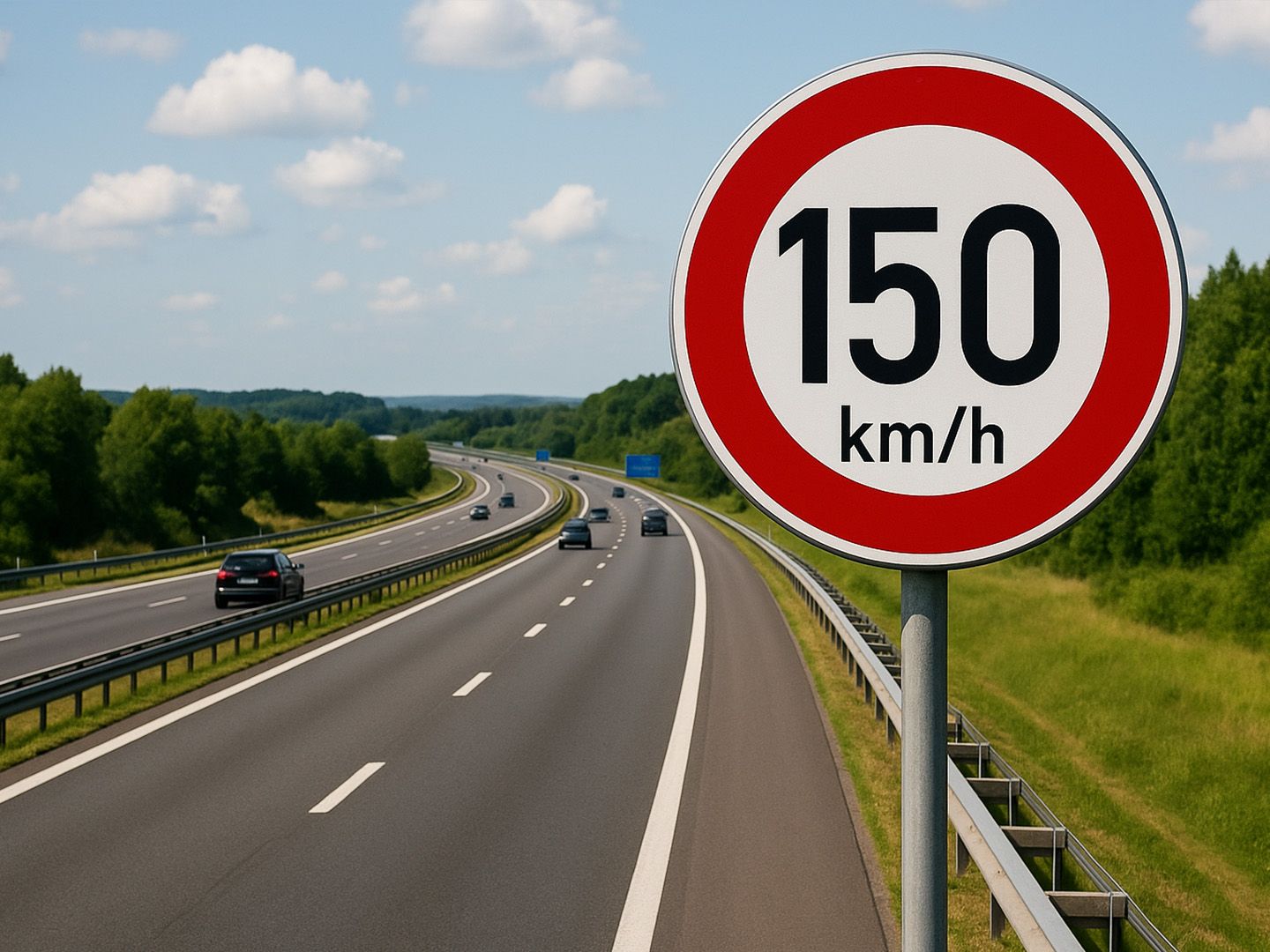
Explainer: Will you really be allowed to drive 150 km/h on the highway in this European country soon?
Czech Autobahn?
Just a warning for speeders: no, the Czech Republic is not suddenly turning into some kind of German Autobahn without a limit. But something special is happening. Starting this year, you will be allowed to go faster than the familiar 130 km/h on certain sections in the Czech Republic. The new upper limit: 150 km/h.
Where will soon be allowed and not allowed?
Before raising the speed limit on a large scale, the Czechs are starting a trial on one stretch. The first test location is a stretch of the D3 highway between Tábor and České Budějovice. There, the road authority is installing special variable traffic signs that show the speed limit depending on weather and traffic density. Driving there on a sunny day with little traffic? Then the sign jumps to 150 km/h. If it gets busy or wet, the limit simply drops back to 130 km/h.
Why exactly now?
The increase is possible through a law change in 2023. This is the first time in 28 years that the limit is going up in the Czech Republic – in 1997 they went from 120 to 130 km/h. While many European countries are actually lowering speeds to reduce emissions and accidents, the Czech Republic is choosing a different course. The right-wing government sees higher speeds as modernization as well as a way to shorten travel times.
What does the trial look like?
On the D3, a 50-kilometer stretch was equipped with 42 variable traffic signs. The installation cost some 2.2 million euros. The trial will start this fall. Only after a thorough evaluation – taking into account safety, accident statistics and support among motorists – will it be decided whether other highways will follow, such as the D1 near Ostrava or the D11 towards Hradec Králové.
Europe and speed: the Czech Republic as a maverick
If the 150 km/h is officially implemented, the Czech Republic will have the highest speed limit in Europe. By comparison:
- Poland and Bulgaria apply 140 km/h.
- Austria briefly experimented with 140 km/h, but reversed that.
- The Netherlands just went to 100 km/h during the day, for theoretical environmental reasons.
- Germany remains the exception: there are still stretches of Autobahn with no maximum.
What do the critics say?
Not everyone is enthusiastic. Road safety experts and the Czech Automobile Club warn that higher speeds lead to more serious accidents. Also at play is the argument of CO₂ emissions: driving faster means more consumption and thus more emissions. Proponents, on the other hand, point to modern cars that can technically handle 150 km/h without problems and shorter travel times.
So, can you shelf gas now?
Just a little more patience. For now, the new limit applies only on test routes, under favorable conditions and only from the end of September. Anyone driving 150 km/h on the highway elsewhere in the Czech Republic still risks a hefty fine.
Also watch: