
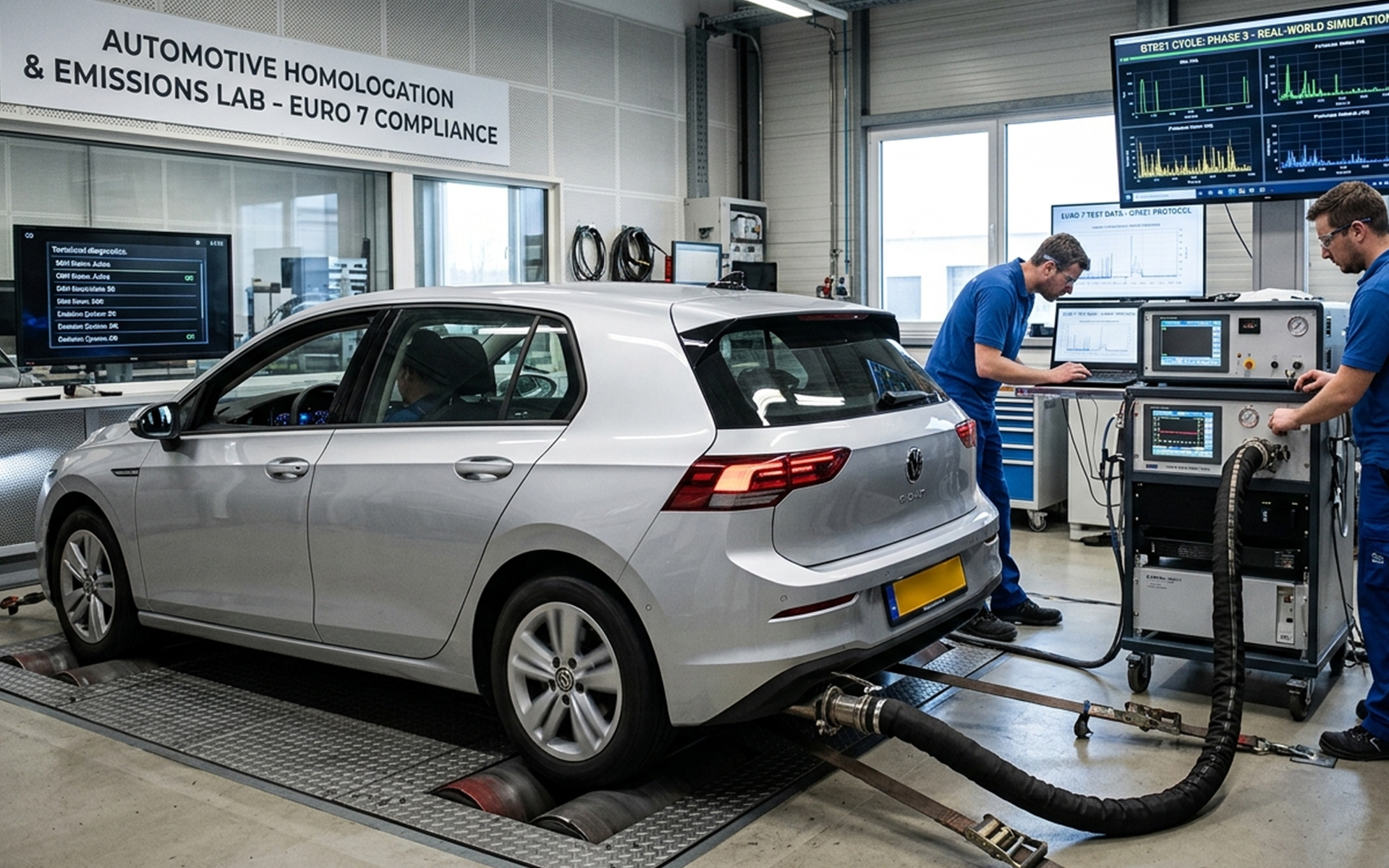
Euro 7 emissions standard: these are the implications of homologation protocol GTR21
What is GTR21?
GTR21 stands for Global Technical Regulation No. 21 and is part of an international framework being developed under the banner of the United Nations (UNECE). The purpose of these so-called GTRs is to harmonize global technical standards. In the case of GTR21, it deals specifically with vehicle emissions under realistic driving conditions.
Whereas previous emissions tests often took place in controlled laboratory environments, GTR21 emphatically focuses on real-world driving. Consider city driving, highway driving, cold starts and under varying loads. The protocol precisely prescribes how these conditions are to be simulated and measured.
From laboratory to reality
A key difference from previous standards, such as Euro 6, is the shift from theoretical test cycles to realistic driving data. Euro 6 already used the WLTP test and Real Driving Emissions (RDE) measurements, but GTR21 goes a step further. The measurements will be more comprehensive, last longer and cover a wider range of situations. For example, it not only looks at nitrogen oxides (NOx) and particulates, but also at emissions during extreme conditions, such as:
- short trips with cold engine
- heavy load, such as when pulling a trailer
- driving at low and high outside temperatures
For manufacturers, this means that optimizing for one test moment is no longer enough. The entire powertrain must continue to perform cleanly under all conditions.
Stricter requirements, broader scope
Euro 7 combined with GTR21 raises the bar. Not only for combustion engines, but also for hybrid and even electric vehicles. The latter may sound surprising, but EVs also face new regulations, for example around brake and tire wear.
For cars with internal combustion engines, emission limits will be further tightened and also enforced for longer. Whereas previously emissions were considered over a limited lifetime, vehicles must now meet standards over a much longer period. Think 200,000 kilometers or more.
This has direct implications for technology. Components such as catalytic converters, particulate filters and NOx storage systems must become more durable and effective. Software plays an increasingly important role in this, as systems must continuously adjust based on current driving conditions.
Impact on automotive engineering
The influence of GTR21 can be seen in almost every part of the car. Engines are becoming more complex, but also smarter. Think about:
- advanced exhaust after-treatment systems
- improved thermal management systems
- more accurate sensors and monitoring software
In addition, integration between hardware and software is becoming increasingly important. Manufacturers must collect and analyze real-time data to keep emissions within limits. For hybrid powertrains, this means that the cooperation between combustion engine and electric motor must be tuned even more precisely. The transition moments – for example, when the engine kicks on – are critical for emissions and are thus explicitly covered by GTR21’s test protocol.
Cost and complexity for manufacturers
Stricter requirements inevitably bring higher development costs. Car manufacturers must invest in new technology, extensive testing procedures and additional validation.
For smaller models and cheaper segments, this can be a challenge. In some cases, it may even mean the disappearance of certain engine variants simply because they are no longer cost-effective to make meet the new requirements. At the same time, this process is accelerating electrification. Fully electric models have an advantage in terms of exhaust emissions, although they too will therefore face additional requirements around wear emissions.
Implications for the model range
You can see the influence of GTR21 and Euro 7 in the range of new cars. Expect less variation in traditional engines and a further shift toward hybrid and electric driving. Compact cars with simple internal combustion engines are under pressure. The cost of bringing them up to new standards does not always outweigh the selling price. As a result, supply is shifting toward more complex but more efficient powertrains. For consumers, this means that choice is changing. Not necessarily less, but different. More focus on electrification and less on pure internal combustion engines.
Future Prospect
GTR21 is not an end point, but an intermediate step. The development of emissions regulations continues, influenced in part by technological advances and societal pressures. The combination of stricter standards and more realistic test methods will reduce the gap between official figures and real-world use. This is an important step toward transparency and reliability. For car manufacturers, this means that flexibility and innovation remain crucial. For you as a motorist, the playing field is changing, with more emphasis on efficiency, sustainability and smart technology.
Case study from Peugeot
The Euro 7 standard officially only applies to all new models from Nov. 30, 2026, and to all newly sold vehicles from Nov. 30, 2027. Peugeot is already anticipating this new, stricter emissions standard and decided to apply the GTR21 procotol with immediate effect. This leads to a change in the officially certified output of some current plug-in hybrid models. These models do not undergo any technical modifications, so performance, fuel consumption and emissions remain unchanged.
Under the GTR21 homologation protocol, the approved combined power of the PEUGEOT 3008 and 5008 plug-in hybrids is now 225 hp (166 kW). As a result, the new commercial designations of these models are henceforth:
- PEUGEOT 3008 PLUG-IN HYBRID 225 CAR
- PEUGEOT 5008 PLUG-IN HYBRID 225 CAR
The approved combined output of the PEUGEOT 408 plug-in hybrid is 240 hp (177 kW), with the new commercial model name:
- PEUGEOT 408 PLUG-IN HYBRID 240 CAR
The new homologation protocol GTR21 for combined power has already been applied to the new PEUGEOT 308 Plug-in Hybrid 195 hp Automatic.
Statement Porsche
Porsche previously released a statement about GTR21. Which reads as follows:
“The maximum drive power of an all-electric vehicle depends on different conditions than the maximum drive power of an internal combustion engine vehicle. To ensure optimal comparability and reproducible results, Porsche determines the advertised drive power of its all-electric models according to the guidelines of the UN Global Technical Regulation No. 21 (GTR21).
The power test is performed with a sufficiently charged battery on an air-conditioned test bench. Peak power is delivered for the duration prescribed in the standard, which is 2 to 10 seconds depending on the measurement method.
The GTR21 does not provide for measurement from standstill. Therefore, Porsche slightly modifies the measurement method for determining Launch Control power and accelerates the vehicle from standstill with Launch Control activated to a reference speed. The measurement begins as soon as the vehicle is accelerated under full load.
The drive power available during normal driving may be significantly lower than that measured on the test bench. Important factors include power demand duration, speed range, charge status and battery and drive train temperature.”