
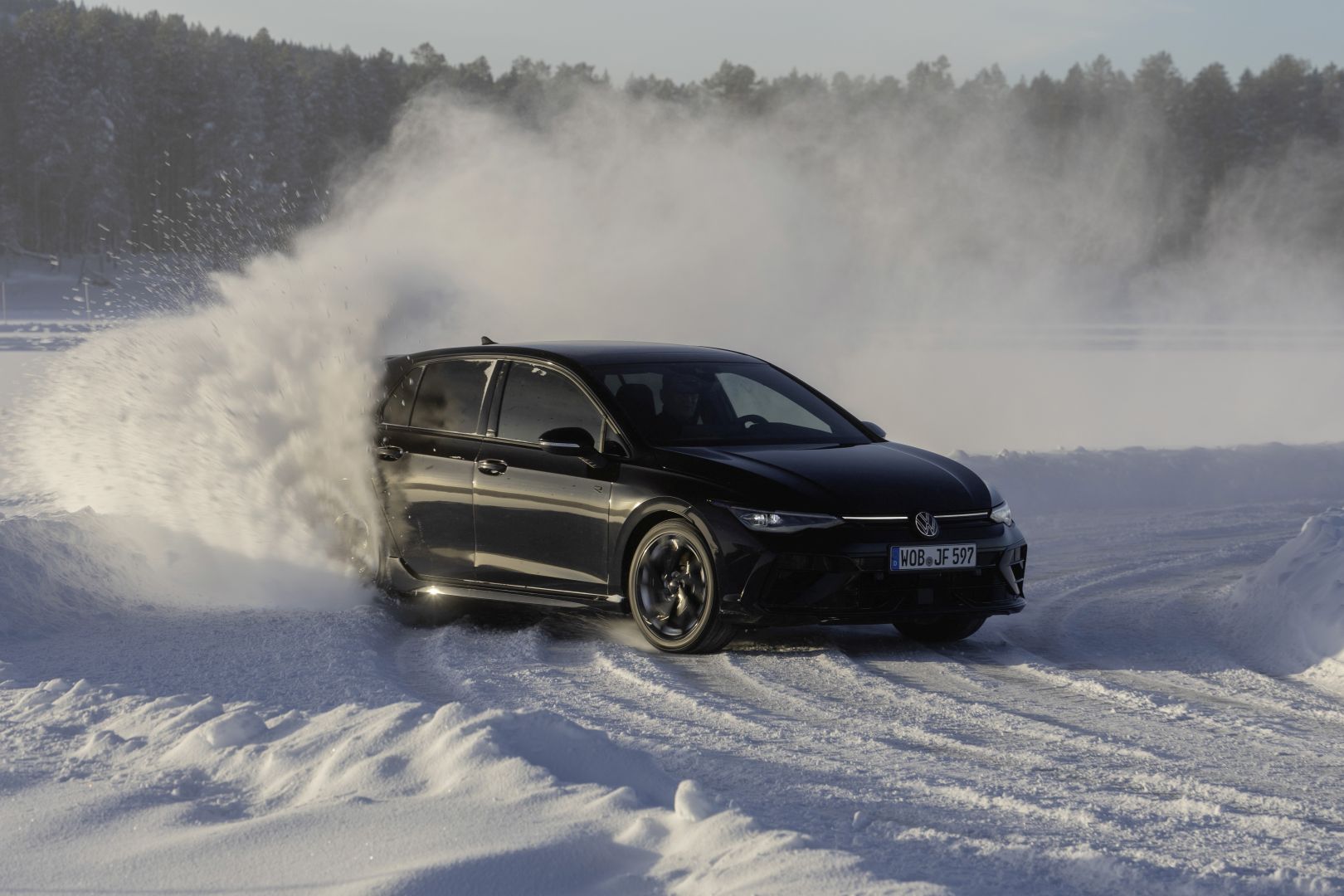
Volkswagen Golf R (2025) Review – At 160 km/h over an ice lake!
Test paradise for car manufacturers
Arvidsjaur is a place where engineers gather in winter to explore the limits of their creations. It is almost surreal to see how this remote village is a test paradise for German car manufacturers. There is even a twice-weekly scheduled service in winter from Munich (where BMW, Audi, Porsche and Mercedes-Benz personnel board) via Hanover (the boarding point for Volkswagen) to Arvidsjaur. Just a five-minute drive from the local airport, Volkswagen has its own frozen lake at its disposal, on which several tracks and test circuits have been laid out with snow plows.
333 hp and torque vectoring
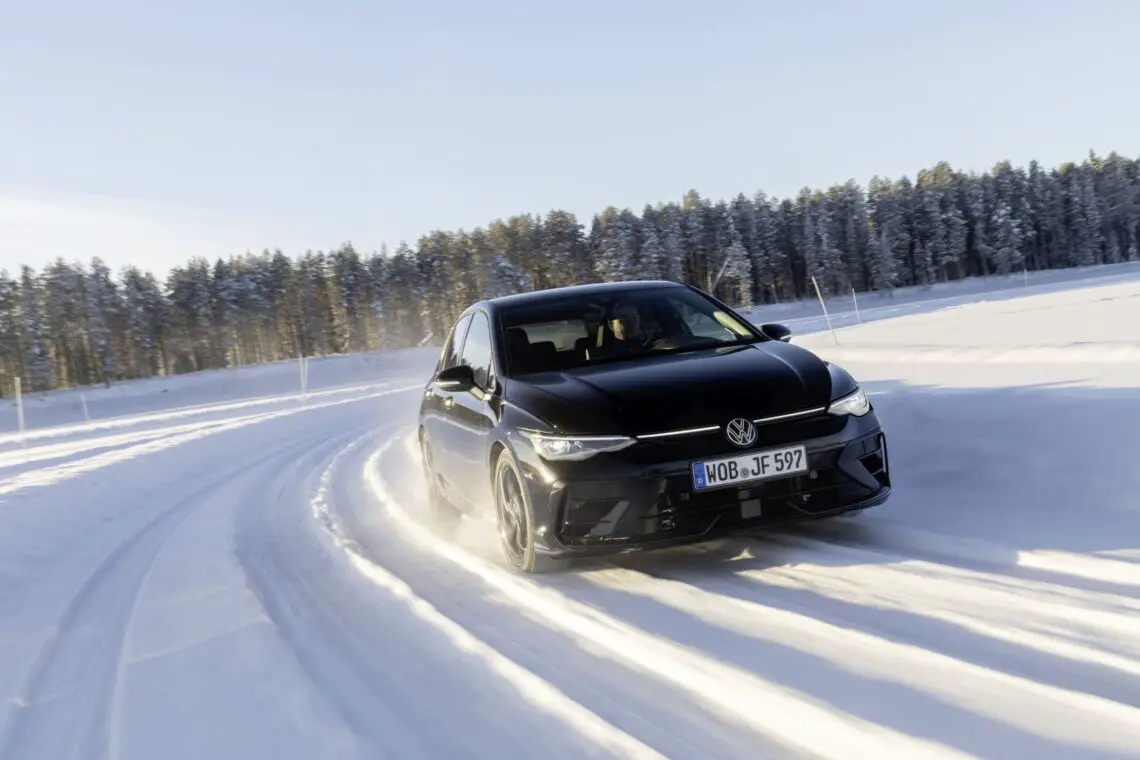
We came to Sweden to test several 4Motion models from Volkswagen. 4Motion is Volkswagen slang for all-wheel drive. The most splashy 4Motion model is the new Golf R. Under the hood of the new fast Golf is a 2.0-liter TSI gasoline engine with 245 kW (333 hp) of power and 420 Nm of torque.
With the optional Performance Package, the Golf R sprints from 0 to 100 km/h in just 4.6 seconds and reaches a top speed of 270 km/h. If it’s on asphalt, of course. It’s not just the brute force that impresses, but especially how the forces are transferred to ground.
The Golf R uses torque vectoring, a technical trick that makes the car extra agile. The system distributes torque not only between the front and rear wheels, but also between the left and right rear wheels. This allows up to 100% of the torque to be sent to the outer wheel in a corner, reducing understeer. The result? A car that feels extremely agile and precise, even on slippery ice.
Riding on ice
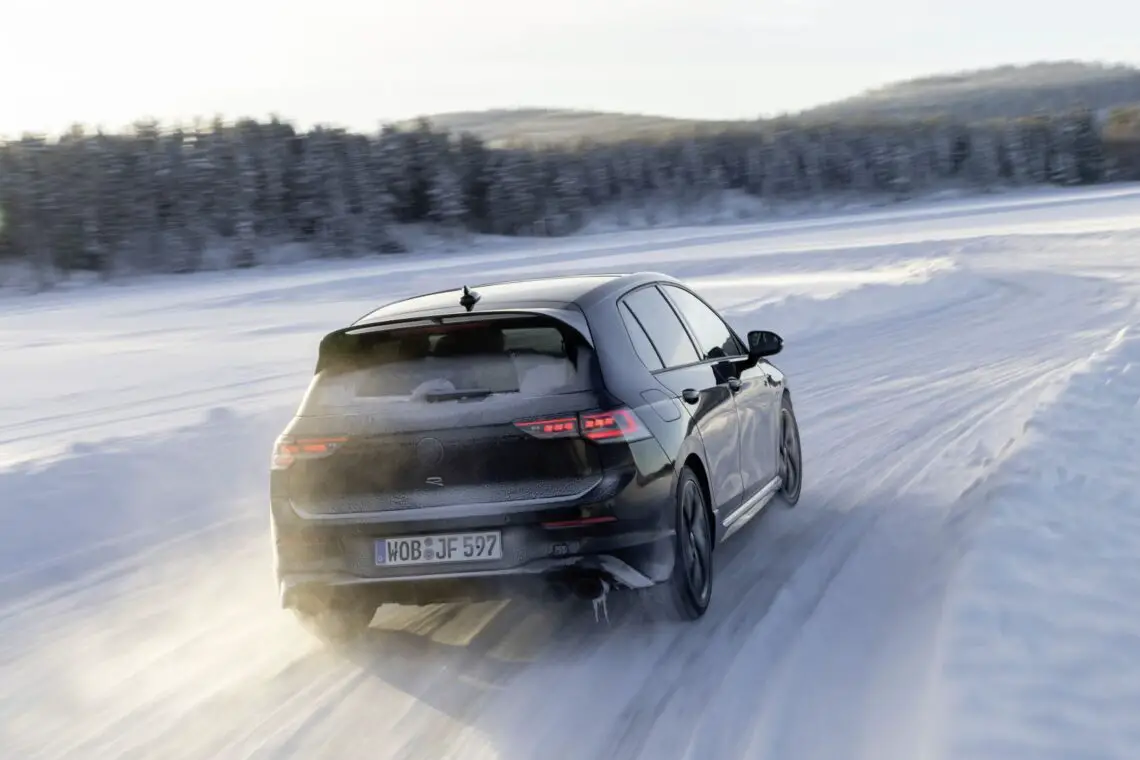
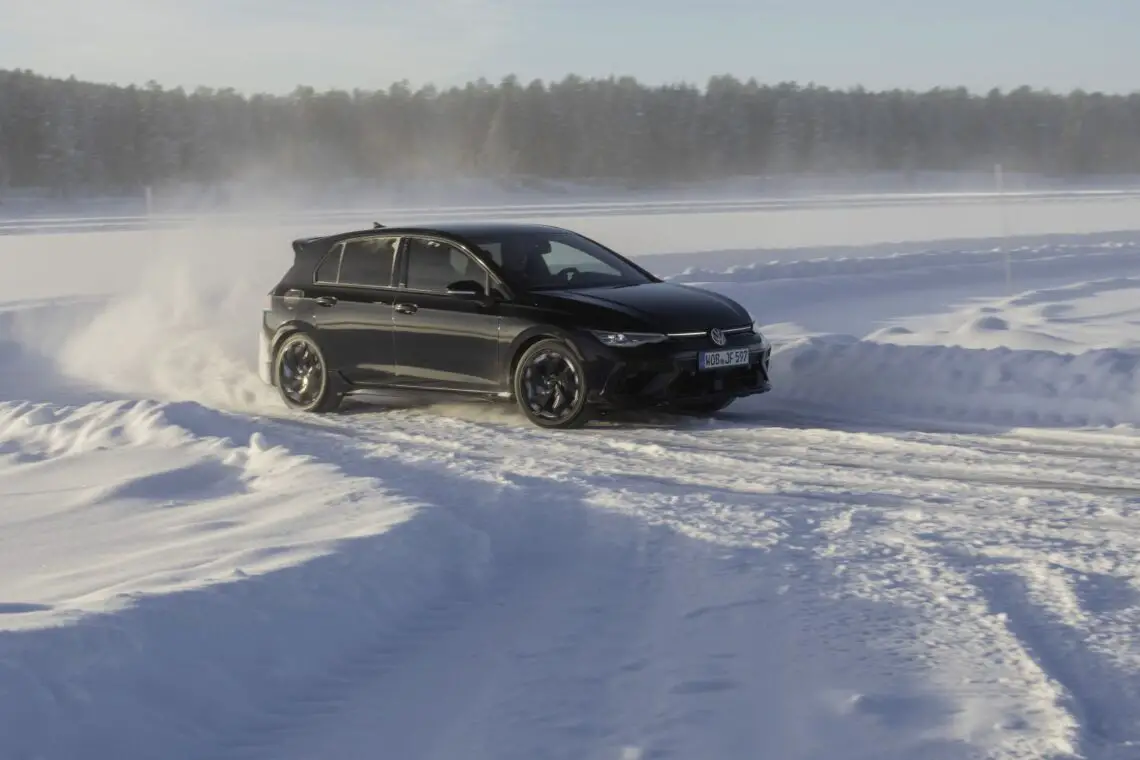
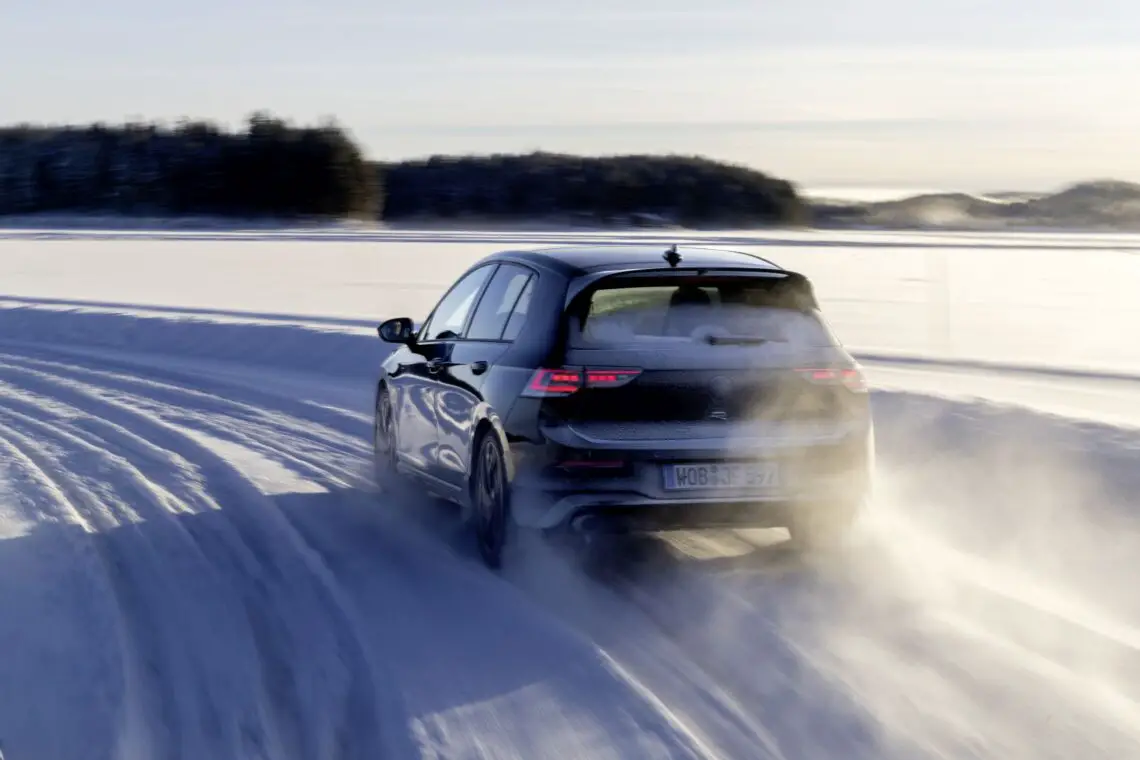
On the frozen Swedish ice lake, we get a chance to put the Golf R to the test in a big way. The surface is literally ice slippery, so grip is hard to find. The tires are fitted with small studs, but the ESP is completely off, so we can experience the car in its purest form. The Golf R has to pull out all the stops to get the power onto “the road surface. But it succeeds surprisingly well.
Thanks to torque vectoring and the adaptive Dynamic Chassis Control (DCC) chassis, the Golf R feels both stable and agile. The system continuously adjusts damping based on the surface and driving style. The driving style on ice, of course, is different than on the road. Braking is of no use and steering sometimes isn’t either. Giving full throttle at the right moment does. On ice it is not about speed, but about balance and precision. Knowing where the weight goes, so you can steer in time and dose the gas.
Nürburgring
The Golf R has several driving modes – Eco, Comfort, Sport, Race, Drift and Special – each offering a unique driving experience. Race mode keeps the turbocharger spinning at higher speeds, providing instant power delivery as soon as you press the gas pedal. Drift mode, available with the Performance Package, allows for controlled drifts. We skip that mode because drifting is already almost automatic on ice. We put the fast Golf in Special mode. This driving mode is actually designed for the Nürburgring. The adaptive suspension softens slightly, because the Nürburgring has many bumps and potholes. The frozen lake is also by no means a billiard sheet, so this driving mode provides the best driving experience here.
The real thing
After an afternoon of controlled sliding, we almost get the idea that we have a talent for this sport. But then after dinner, Volkswagen asks us if we’d like to take a lap with a factory driver after dark. We get in with Manuel, a Mexican driver who has seen just about every track in the world. He has only been driving on ice for a couple of years. It’s not his specialty, he tells us. Our expectations are not that high.
But before we know it, we are flying at 160 km/h over the ice track where a few hours earlier we ourselves dared not go faster than 80 km/h. Now we really notice what the Golf R is capable of. While whooping in the rev limiter at high speed, we ask Manuel if the car has been modified to rally spec. “No,” is the answer. Yes, the tires have slightly larger studs than “our” test car that we drove in the afternoon, and up front are four giant rally emitters so bright that four villages away probably think they are seeing the northern lights in the distance. But they are. After about ten minutes of tearing around, we get out and take a deep bow for Manuel and the Golf R.
Conclusion
The new Volkswagen Golf R is more than just a powerful hatchback. It is perhaps the highlight of 50 years of Golf history. Not surprisingly, since newer is almost always better in car land. But the question is whether there will ever be a better one, because the days of the petrol Golf could be numbered. Those who can and want to spend 86,000 euros on a fast hot hatch should therefore not wait long. If this is the Golf R’s last party on petrol, it will at least go into the books as a stunner.
See also: The very last time? Golf R (2025) Review – AutoRAI TV