
This material will soon be in your car interior!
Bamboo rooted in Japanese culture
Bamboo is rooted in Japanese culture. Bamboo has been a familiar part of daily life in Japan for centuries and is used for many different purposes, from furniture and storage to tools and transportation. Lexus is a pioneer in using bamboo in its cars as a versatile and durable material with less environmental impact.
Wide range of materials
As a raw material, bamboo can be processed into a wide range of materials, from an alternative to leather and plastic to composites and carpet textiles. Using bamboo contributes to a circular design principle while providing something that feels luxurious yet responsible.
Durable material
You are going to see the material prominently featured in many of Lexus’ latest models, whether they are study models or production models. Highlighting bamboo also reflects Lexus’ social commitment and desire to “give something back” to the communities in Japan that produce and harvest bamboo.

Creating experience
Viviana Hohenstein, CMF Designer, at Lexus Design, gets awed by bamboo. In her role, she is responsible for Colour, Material and Finish in the interiors of Lexus models. “We also call this CMFx, with the ‘x’ of experience. Because this formula ultimately results in a certain experience on board a car,” says Hohenstein in an interview with AutoRAI.nl.
“Innovate to preserve.”
“In our car interiors, we want to innovate fully. We apply our credo of ‘innovate to preserve’. A deliberately chosen slogan, because sustainability is extremely important to us. And we mean sustainability in the broadest sense of the word. For us, bamboo is incredibly important.”

Bamboo: extremely versatile
“Bamboo is very versatile. We can make textiles from it, as well as carpets, types of composites, and bamboo also possesses a carbon-like substance. That carbon, in turn, we can use as a pigment in automotive paints. So we can do anything with it,” Viviana says. She shows several applications of bamboo, including a plastic sheet with a motif of marble. “We already apply this material in Lexus models, for example in the latest generation Lexus ES. There is still a little bit of plastic in it, but the main ingredient is bamboo.”
Strong growth
According to Hohenstein, bamboo grows incredibly fast. “After just one year, it is suitable for harvesting. If you leave bamboo longer, they are seriously large trees. So we can harvest the plants quickly and apply them in our cars. It may be the material of the future, at least for Lexus. Bamboo is abundant in Japan and is also considered a pest in some regions. So getting rid of bamboo – and applying it in a sustainable way – is very interesting for us.”

Bamboo components in the interior
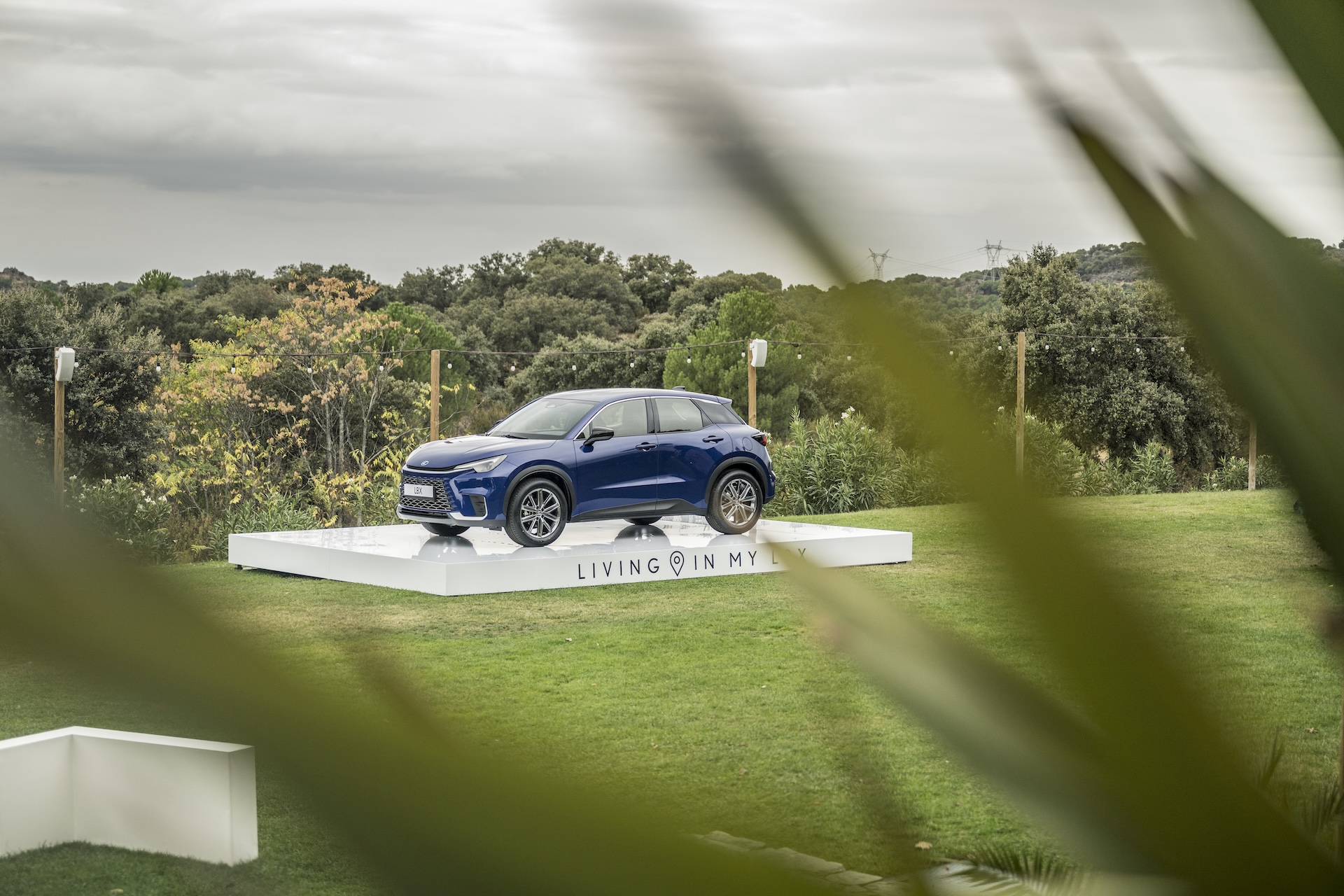
So future models from Lexus will get more bamboo components in the interior. The Lexus LBX does not yet contain the material; the Lexus ES will get the scoop as a production model. The LBX is, however, a B-segment crossover with probably the most luxury per square meter in this segment.
Lexus LBX
So what makes this LBX different from other B-segment crossovers? That’s not only 10-year warranty, but also luxury. The top layer of the dashboard is nice and soft, Lexus applies an extra soundproof windshield, and the car does not have windshield washers on the hood, but washers built into the windshield wipers. There is also luxurious stitching and faux leather trim. Without bragging: this really is a car with high levels of luxury. If Lexus also adds the homely feel of bamboo, they have something really special on their hands in Japan.
Bamboo, a special plant
Bamboo is an unusual plant. Many people think it is a tree, but in reality bamboo belongs to the grass family. So it is actually a kind of giant grass, although its sturdy, woody appearance suggests otherwise. Within that large family of grasses, bamboo forms its own subfamily, the Bambusoideae. There are hundreds of species, from small ornamental bamboos that grow in pots to towering giant bamboos that can reach thirty meters in height.

New bamboo shoots
What makes bamboo so unique is the way it grows. The stems – or actually culms – rise from underground rhizomes, called rhizomes. That network underground is what drives the rapid growth of bamboo. The rhizomes continuously produce new shoots. Once such a shoot rises above ground, it does not first need to form a solid trunk, as a tree does. It immediately grows in height. This is because the stem is already hollow inside and made up of segments, making it light yet strong enough to stay upright.
Growth rate
In that stem, something special happens: bamboo has growth zones at each node. Instead of one growing point slowly working upward, all segments grow simultaneously. As a result, under ideal conditions, the plant can grow as much as a meter a day. The rate of growth depends on temperature, humidity and amount of sunlight. In warm, humid regions – such as parts of Asia – conditions are perfect, and that’s where you see the highest growth rates.
Impressive reputation
Another thing that helps: bamboo doesn’t have to expend its energy creating thick bark or annual rings. Everything the plant absorbs in terms of water and nutrients goes directly to growth. It’s a system entirely focused on speed and efficiency. That explains why bamboo has such an impressive reputation as the fastest-growing plant in the world.
Used as a building material
In Asia, as mentioned, it has been used as a building material for centuries because it is pliable but sturdy. From the stems, houses, furniture and even bridges are made. Instead, the young shoots end up in the kitchen, as they are edible and considered a delicacy. In the West today, you also increasingly see bamboo in textiles, paper and durable products: from toothbrushes to flooring. So Lexus is also applying the material in car interiors.
Weedy or non-weedy
In gardens, bamboo is popular because of its peaceful, green look. Yet it is wise to note that not every species behaves as neatly. Weedy bamboo spreads at lightning speed via its rhizomes and can take over the entire garden within a short time. Non-growing species, such as Fargesia, stay neatly in place and are therefore better suited to smaller gardens or as hedges. Eliminating proliferating species – as Lexus does – and incorporating the materials in a sustainable way helps maintain the natural balance. “That’s what we mean by ‘innovate to preserve,'” Viviana emphasizes.


