
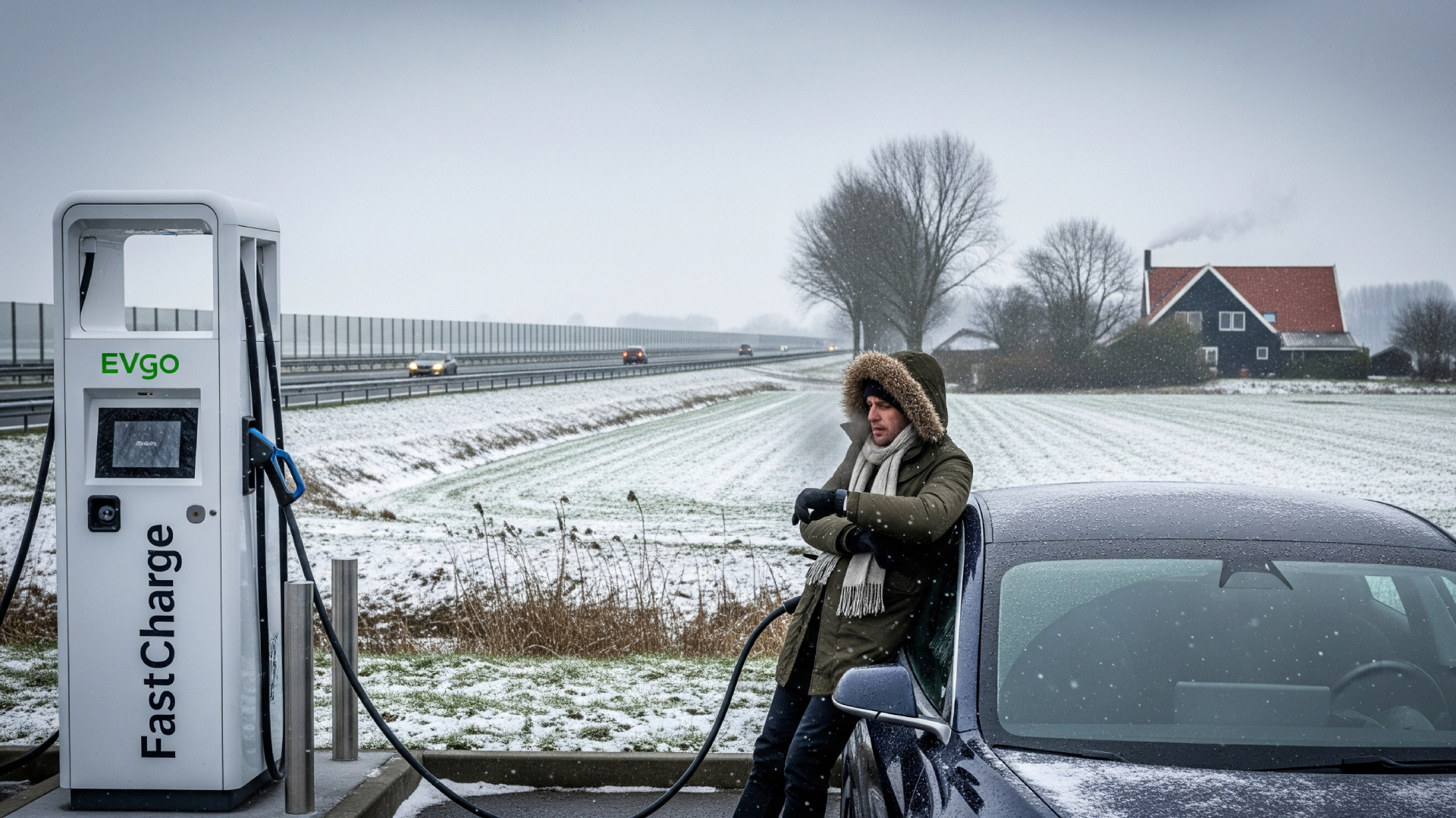
Can electric cars withstand winter cold better these days?
The electric car’s winter problem
When the first modern electric cars entered the market, it was soon found that low temperatures negatively affected performance. Range sometimes dropped by as much as 30 to 40 percent, especially at temperatures around freezing. This is because the chemical reactions in the battery are slower in the cold. Also, heating the interior and bringing the battery up to temperature required a lot of energy, at the expense of range.
With frost, other inconveniences also arose. The charging process was slower because the battery cannot charge efficiently until it reaches a certain temperature. This was especially noticeable with fast chargers: the promised charging speed was often not achieved.
Why cold limits the range
To understand what has changed, it is good to know why cold has such an impact. The lithium-ion battery in EVs works optimally at temperatures between about 20 and 30 degrees Celsius. In winter, the temperature of the battery can drop well below this range. As a result, internal resistance increases and less energy is available.
At the same time, heating the interior costs a lot of electricity. Unlike a gasoline or diesel car, an electric car does not have a fuel engine that provides “free” heat. In older EVs, the cold in the interior was driven away with electric resistance heating. This consumes an enormous amount of energy, resulting in a significantly reduced range.
What automakers are doing differently now
In recent years, manufacturers have invested heavily in technology to winterize electric cars. One important step is so-called “battery conditioning. Many new EVs feature a fluid circuit that can actively heat and cool the battery. When the outside temperature is low and the car is still on the charger, the system warms up the battery to the optimal operating temperature before departure. This happens automatically. In some EVs, the navigation system works in conjunction with the battery conditioning system, which on the way to a fast charger already warms up the battery on the way for optimal fast charging.
Heat pumps are also increasingly present in EVs as standard or optional equipment. A heat pump uses much less energy than traditional heating. The system works like an inverted air conditioner, extracting heat from the outside air or battery residual heat. This leaves more energy for propulsion.
Not least, batteries have also been improved. New cell chemistry – such as lithium iron phosphate (LFP) and improved nickel-manganese-cobalt (NMC) cells – is more resistant to temperature fluctuations. The internal construction of batteries has also been modified, with more efficient insulation and integrated heating mats.
Loading speed in winter
Fast charging at, say, -5 °C used to be a frustrating experience. Today, it is much less so. Thanks in part to battery conditioning, modern EVs get much closer to the charging speed promised by the manufacturer. Brands like Tesla, Hyundai, Kia, BMW and Mercedes-Benz have systems that automatically warm up the battery as soon as you enter a fast charger as your destination.
Charging infrastructure is also a factor. New charging stations often have advanced cooling and heating systems in the charging cables, making the charging process less sensitive to weather conditions.

Comfort improvements
Not only the technology under the hood has been improved. Comfort in winter has also increased significantly. Pre-heating that you can control remotely via an app is standard on many EVs. This allows you to heat the interior and the seats while the car is still at the charging station. This way, it does not cost you any range and you get into a pleasantly warm car.
Manufacturers have also paid attention to local heating, such as heatable seats and armrests and a heatable steering wheel. This reduces the need to heat the entire interior. This saves energy and limits the range less.
Less problems cold start
With older electric cars, it was common that in extreme cold, they simply would not charge or start until the battery had warmed up. Thanks to smart software and better temperature management, this is now rare. Even in temperatures well below zero, you can simply drive off with a modern EV.
Driving style and range in winter
So the technology has improved. But the driving style – even in winter – also affects the range. Short trips where the battery has to be reheated repeatedly cost more energy than long trips. Manufacturers therefore recommend planning longer trips and preheating the car at the charging station whenever possible.
Tire choice also plays a role. Winter tires have more rolling resistance due to their softer rubber compound and tread, which costs slightly more energy. Modern EVs partially compensate for this with efficient drivetrains, but it remains a concern.
Are electric cars winterproof now?
Thanks to improvements in recent years, electric cars today are much more resistant to winter conditions. Batteries stay at temperature thanks to active conditioning, heat pumps reduce energy consumption for heating, and charging speeds are more stable.
Still, there remains a difference between summer and winter. The range can still be several dozen percent lower in severe frosts, simply because physics sets its limits. But in the past, performance and comfort dropped significantly and the difference is now much smaller and more manageable.
Future developments
Progress is not stopping. Car manufacturers are working on solid-state batteries, which perform better at low temperatures and charge faster. They are also refining heat pump systems and making software ever smarter at predicting and optimizing energy use.
Moreover, driver knowledge is increasing. More and more EV drivers know how to make the best use of their EV in the winter, for example by pre-heating, seat and steering wheel heating, and if possible, charging when it is warm.
Yes, modern EVs are more winter-resistant
Electric cars have become more winter-resistant in recent years. Previously, cold severely limited range, charging speed and comfort. Modern EVs incorporate smart technology to greatly reduce those effects. Battery (pre)heating, heat pumps, improved chemistry and smart software make all the difference.