
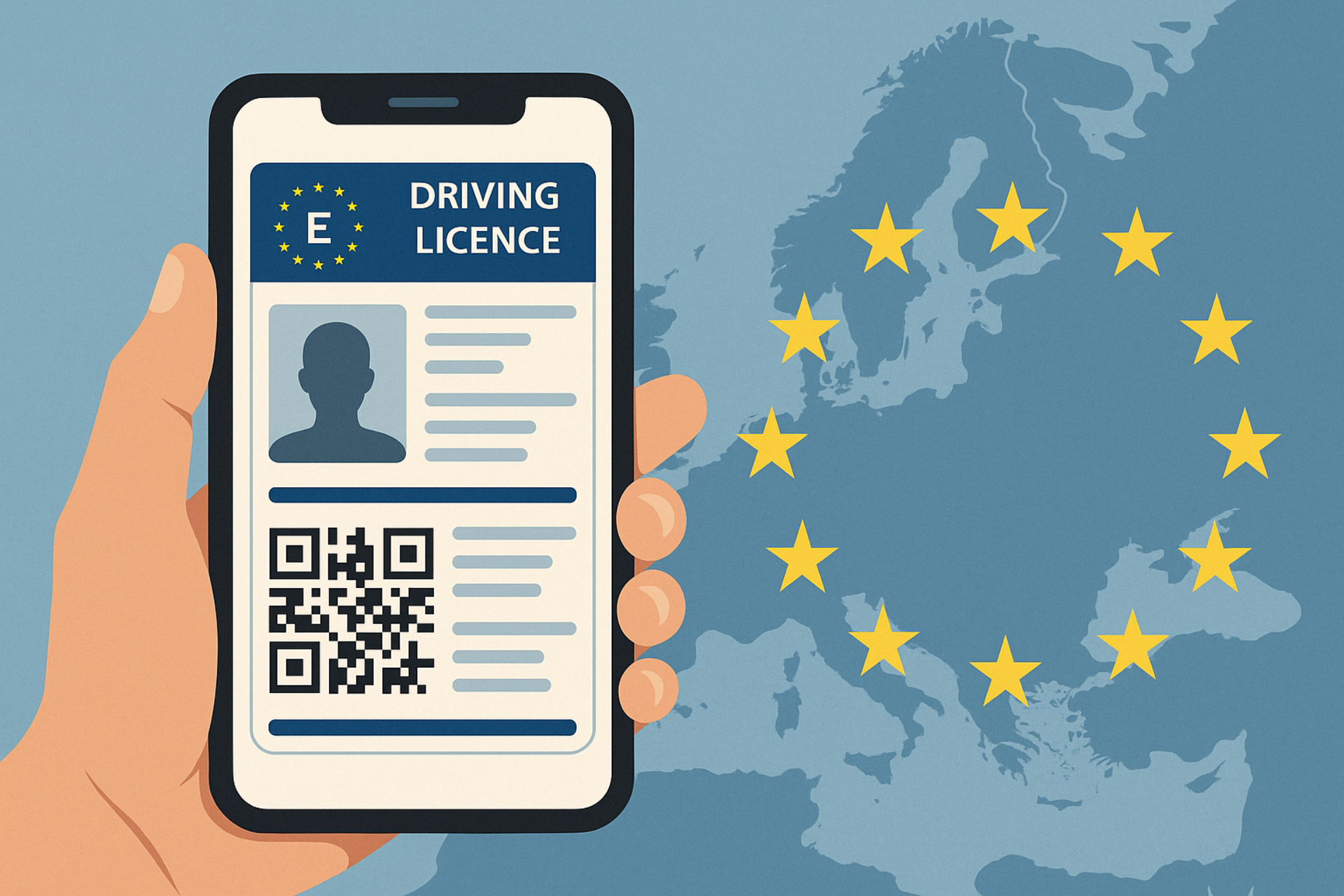
Will the driver’s license of the future affect our mobility?
What is the driver’s license of the future?
With the “driving license of the future,” you no longer have a physical badge, but your driving license is digitally recorded. This is going to happen uniformly in the European Union. The digital driving license includes smart links, standardized data and real-time verification. Coming in 2030, this driving license combines technology (digital identity, blockchain, etc.) with legal and administrative policies (EU directives, national legislation) for more efficient, safer and freer mobility.
In the European vision of the future, that means your digital driver’s license:
- in your smartphone, in a secure digital wallet;
- legally equivalent to the classic pass;
- can be automatically renewed and managed;
- has the same use value in all EU member states;
- is easier and more reliable to check for its validity.
European vision of the future? Does the EU play a role?
Yes of course! The European Union plays a crucial role – without the EU, there will be no uniform digital driving license by 2030. The EU sets the minimum requirements for driving licenses in the member states: how data must be recorded and exchanged, validity, medical screening, harmonization.
EUDI Wallet
The EU has also adopted regulations for the “European Digital Identity Wallet” or EUDI Wallet – and the technological infrastructure for the digital European driving license. The EU requires that the digital driving license issued in the Netherlands, for example, is of course also valid in the other EU countries – and vice versa. Therefore, in the run-up to the introduction of the digital driving license, the EU coordinates testing, standardization and monitoring of its introduction in all EU countries and determines the harmonization of medical screening,

Will the digital driver’s license of the future replace the current driver’s license?
Yes. In March 2025, the European Council and the European Parliament reached a preliminary agreement that all EU citizens can have a uniform digital driving license by the end of 2030 at the latest, which is then stored in the European Digital Identity Wallet – the EUDI Wallet. It will still be possible to keep a physical driving license for the time being, especially for people without smartphones or situations where acceptance of a digital document is not guaranteed.
Timing and implementation
The European timing and implementation directive has yet to be formally adopted. Then member states must transpose it into national legislation, after which they have about four years to implement it. The plan is for EU member states to make the EUDI Wallet available to citizens by the end of 2026. By 2030, the digital version of the driver’s license should then be the standard, with the physical pass as an option. So the years until 2030 represent the transition phase to the digital driving license.
Are the driver training and theory and practical exams changing?
The requirements of the theory and practical exam will not actually change. However, there may be additions and adjustments for the digitalization of the driver’s license.
Driving Education
- Instructors should prepare students for digital checks, use of the digital driving permit and possibly the use of the EUDI Wallet.
- Courses can include additional modules on digital technology, cybersecurity aspects (handling your data safely) and cross-border use of the driver’s license.
- The learning tools (theory lessons, e-learning, simulators) should integrate with the digital systems: for example, students should practice how to show their digital driver’s license through the EUDI Wallet and abroad.
- In countries where mobile driving licenses are already in use (such as Austria), such aspects are being tested in driver training experiments.
Theory- and practical exams
The basic skills (traffic rules, traffic insight, vehicle control) remain necessary, of course. But the new directive proposes some additional topics:
- awareness of active safety technology (ADAS systems), driver assistance systems, sensors and how they work together;
- Knowledge about data management, privacy, security of digital identity documents;
- safe smartphone use in the car(!), blind spots, the dangers of open doors (in autonomous parking, for example).
As for the practical exam, the assessor/examiner may use digital validation (e.g., your smartphone linked to your EUDI Wallet) or the examiner may verify that the exam candidate meets the requirements through digital means. But the practical standards for maneuvering technique, traffic insight and observation remain the same.
In short: the basics remain the same, but instructors and students need new (digital) skills not directly related to driving.
Validity period and other changes
The EU agreement includes the following for the digital driver’s license of the future:
- For vehicle categories such as car/motorbike, the validity is 15 years from issuance;
- if the driver’s license is also used as an identity document, the validity period is 10 years;
- States may apply limited validity for older drivers (e.g., over 65).
New model driving license (2025)
A new model driving license will be in use in the Netherlands as of June 1, 2025. The change mainly concerns the design and additional and improved authenticity features (about eleven new features) to prevent fraud and forgery. The technical content (chip, NFC reading) is unchanged. This new model is a modernization of the pass, with better security, but is not the step to full digitization. It is an “intermediate step” toward the driver’s license of 2030: a modern, more secure physical driver’s license that could possibly coexist with and eventually transition to the digital version.
Ratio 2025 badge vs. driving license after 2030
In the years until about 2030, the pass and the digital driving license may coexist. Those who apply for or renew a driver’s license before the digital rollout will get the pass model 2025. After the rollout around 2030, the digital driving license will be the standard, with the physical pass as an alternative. The pass will remain valid anyway until the date on it and will not become invalid once the digital driver’s license is introduced. Both will continue to coexist for some time.

How will the driver’s license of the future affect mobility?
Accelerated cross-border mobility
The digital driving license will be “interoperable,” meaning that various systems, organizations and processes will recognize it and have access to it. Then a Dutch driver in Spain can easily prove through the EUDI Wallet that he has an official driving license. It also reduces administrative barriers, making travel, border controls and renting a car easier.
Less red tape and faster processes
Digital driver’s licenses are easier to renew, replace and update upon change of address, etc. This reduces waiting times at municipality and CBR. So there is less need to physically ‘visit the counters’. Moreover, checks by the police become easier: no old-fashioned visual inspection or reading equipment, but a look at your driving license in your EUDI Wallet – much more efficient and reliable.
More secure and fraud-resistant
With advanced cryptography, digital authentication, automatic verification and uniform data, it is much more difficult to forge or misuse driver’s licenses. This increases confidence in the system. Drivers who do not meet medical requirements conditions or expired licenses are more quickly filtered out of the system, or automatic alerts can be issued.
Greater flexibility and innovation in mobility
A smart, digital control system of driving privileges can be linked to other mobility services, such as car sharing, e-scooters, autonomous vehicles, shared cars – your digital driving license can be automatically verified on various platforms. It also makes it easier to offer mobility services across borders: a rental company in another country can instantly verify that the driver is authorized to drive.
Is our mobility changing?
The digital driver’s license of the future will change mobility in the Netherlands and Europe somewhat, but not dramatically. It is mainly an administrative undertaking. The new 2025 Dutch pass is a step toward this future – not the final destination. But it already prepares the system for secure, reliable digital integration. The foundation for the digital European driving license is being laid, while the real leap into the future is yet to come.