Tesla Powerwall now available in the Netherlands: a Tesla battery for your wall at home
Tesla Powerwall in the Netherlands
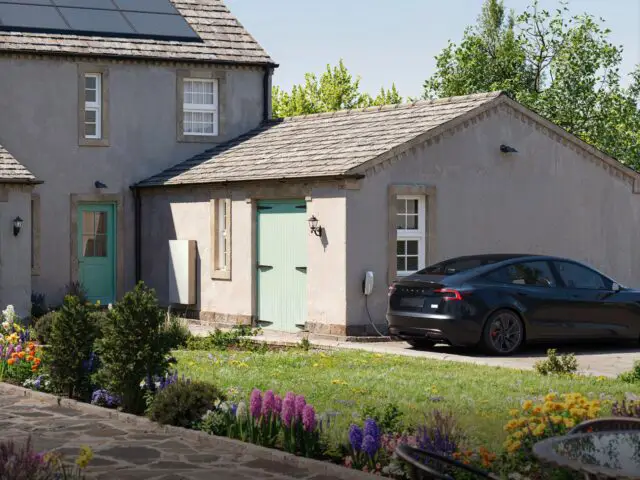
As the car gets smarter, so does the home. In the future, a battery-electric car could cooperate with your own home, such as by functioning as an additional energy source. More and more BEVs have vehicle-to-home functionality where power for home appliances as well as lighting comes from your car’s battery. Smart, of course, because that’s how you lower your energy bill. The Tesla Powerwall goes a little further.
Home energy storage
Car manufacturer Tesla also sees a future in home energy storage. Because it’s obviously a waste if your solar panels generate energy, but then send that same energy back to the grid because you’re not doing anything with it.
Saling scheme
The net-metering scheme will end from January 1, 2027. Owners of solar panels will no longer be able to offset self-generated electricity against their consumption as of 2027. They will, however, receive compensation for supplying power back to the energy supplier.
Households and small businesses can feed self-generated electricity back into the grid until December 31, 2026. The net-metering scheme allows them to offset their generated electricity against their consumption each year. They do not have to pay taxes on this. If solar panel owners generate more than they consume, they receive compensation for the surplus.
Why is the balancing scheme ending?
The net-metering scheme will end in 2027. Earlier the plan was to phase it out from 2025. But the cabinet has decided to stop the scheme altogether in 2027 and not phase it out earlier.
The balancing scheme ends because:
- balancing costs money. Therefore, many power companies raised their power prices, even for people without solar panels. The government thinks this is unfair, because not everyone can buy solar panels.
- the government gets less tax revenue because of the balancing scheme.
- the government wants to encourage households to use self-generated power instead of supplying it back. This is because directly using self-generated power puts less pressure on the electricity grid.
- solar panels are increasingly cheaper and more efficient. This makes it interesting for households and small businesses to buy solar panels even without the net-metering scheme.
People who generate electricity will no longer be allowed to offset it against the electricity they use as of Jan. 1, 2027. They can, however, continue to supply the power back to the grid. For all power that solar panel owners feed back, they will receive compensation from the energy supplier. Until 2030, this compensation must be at least 50% of the bare delivery rate of electricity. That is the electricity rate without taxes.
Energy suppliers often also charge for the return of electricity. Also called a feed-in fee or sometimes called a feed-in penalty. These may only be costs that the energy suppliers incur to process the power they supply back. The Consumer and Market Authority (ACM) oversees these fees.
Self-generated and used power
On electricity that people generate themselves and use directly, they pay no taxes. Nor do they pay any costs to the energy supplier on this. Therefore, using directly self-generated electricity results in a lower energy bill. It also reduces pressure on the electricity grid.
Introduction Dutch market
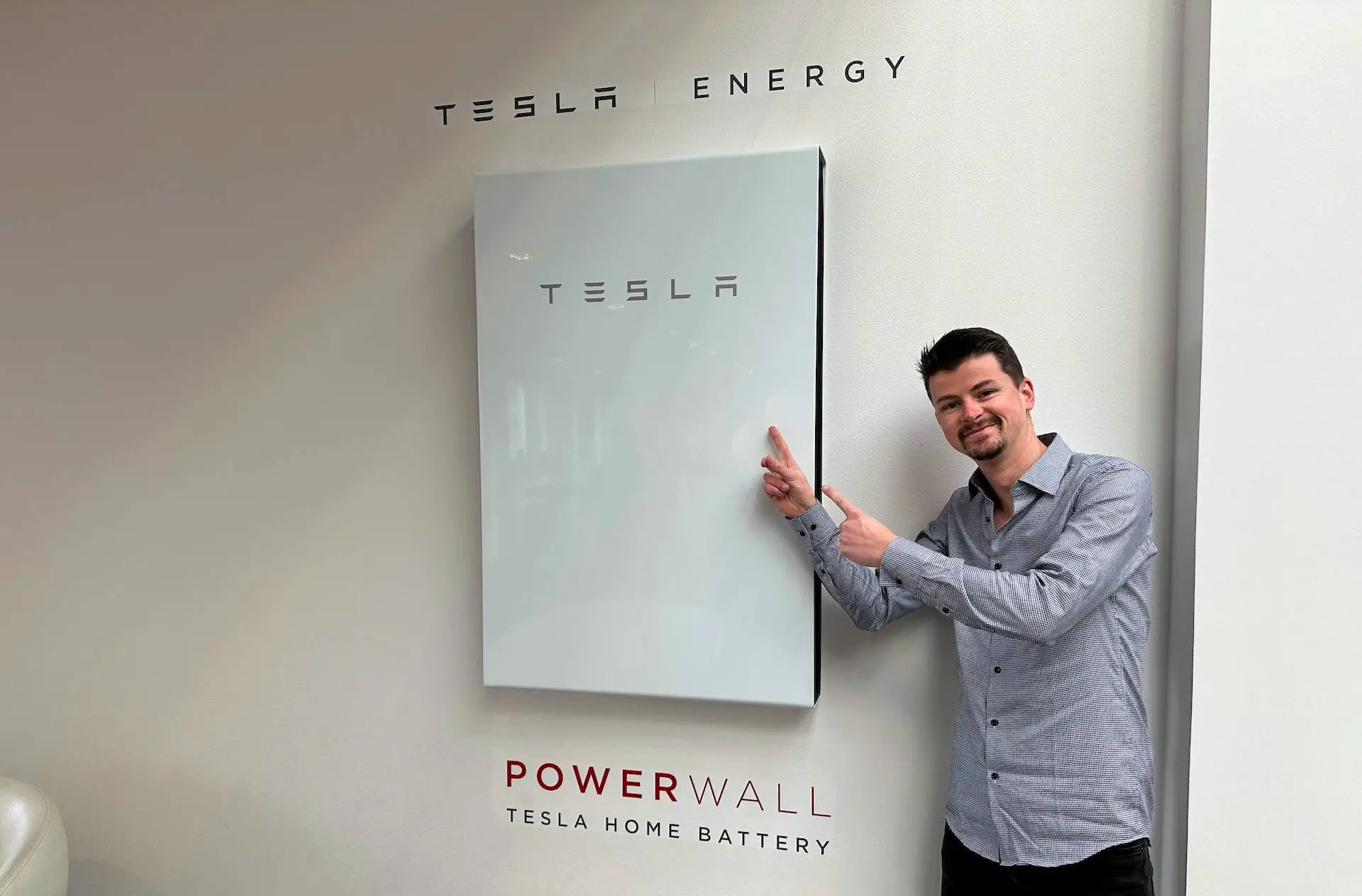
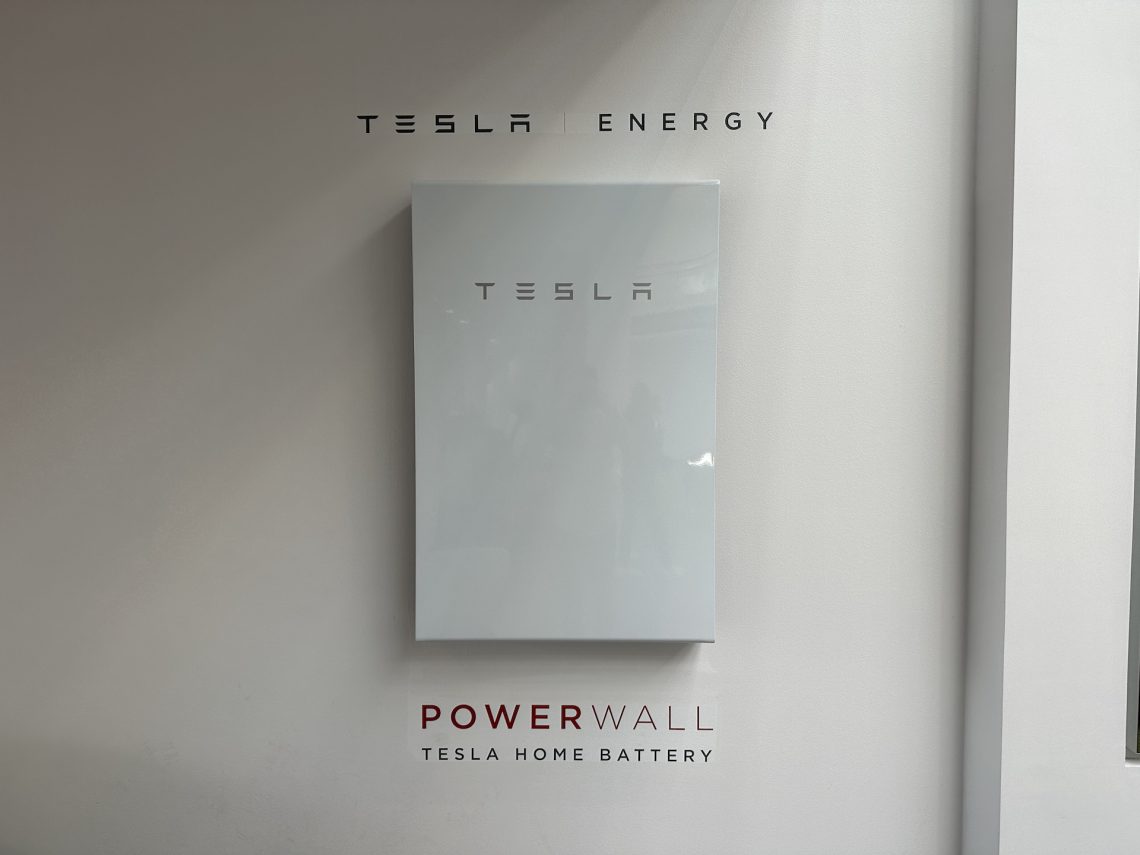
At the headquarters in Amsterdam, the Powerwall has been hanging on the wall since 2023. But now the moment has finally arrived. Tesla will officially start selling the Powerwall in the Netherlands. That was first supposed to be 2024, but eventually it became July 2025.
What exactly is that, a Tesla Powerwall?
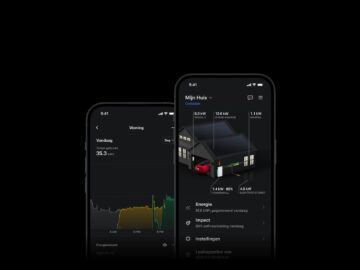
Powerwall is a battery that stores energy, detects power outages and automatically becomes your home’s power source when the grid fails. The best solution is to connect a Powerwall to solar panels to charge the battery with solar energy. A full Powerwall can power your home for days. This makes you less dependent on the power grid by storing solar energy for use when the sun is not shining.
TESLA POWERWALL: a Tesla battery for home on your wall – AutoRAI TV – (video recorded 2023)
Large flat refrigerator
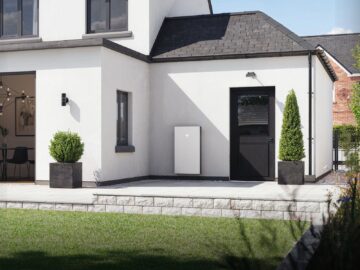
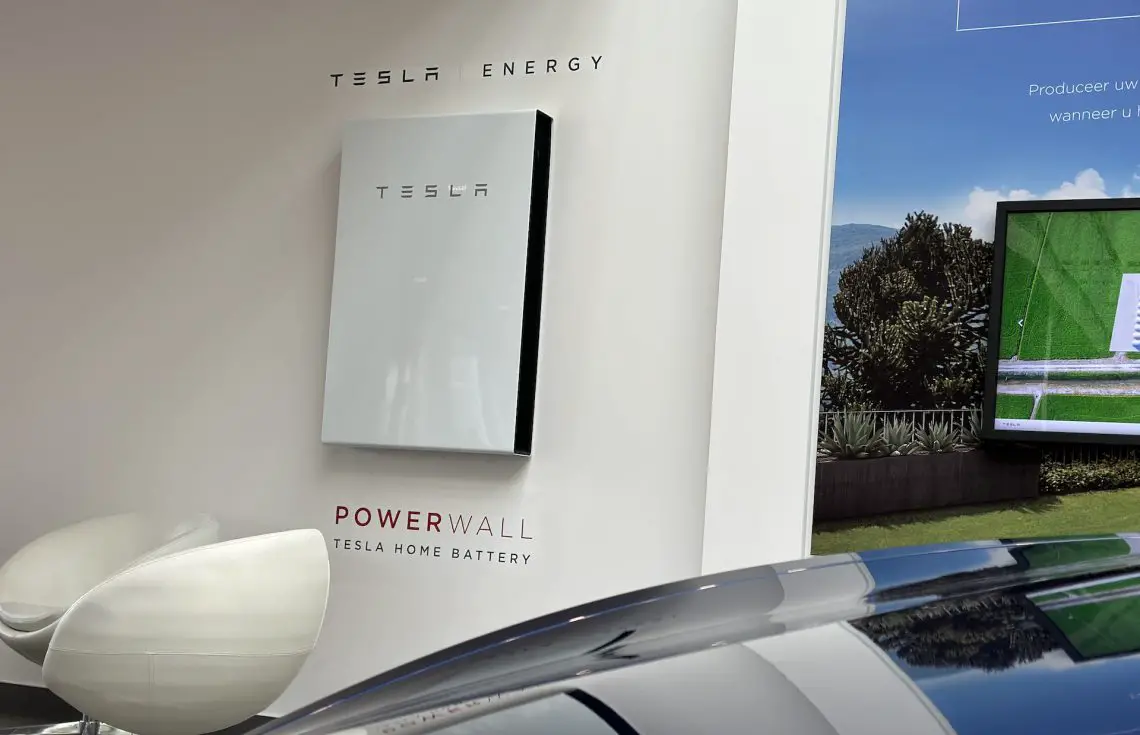
Tesla’s Powerwall looks minimalist. You can think of it as a large flat refrigerator. Tesla deliberately kept the design quiet so that the 1.15-meter-tall device would fit any home type. The Powerwall weighs 114 kilograms and houses 13.5 kWh of batteries. It can deliver 7 kW of peak power and 5 kW of continuous power. The Powerwall can be floor or wall mounted, indoors or outdoors. You can link up to four Powerwalls together, so solutions are also possible for larger properties. Between -20°C to + 50°C, the Powerwall is safe to use. Also nice, you get a 10-year warranty.
Almost no buttons
What stands out is the minimal amount of buttons. No cables are visible, nor does the module have hot vents. Thus, children and pets cannot hurt themselves.
Tesla Powerwall price
Then the most important thing: the price. You pay a fee of 6,450 euros for one Powerwall plus one Gateway of 1,150 euros. The price does not include VAT, the cost of site inspection, technical inspection, delivery, installation and commissioning, administration fees and all other fees and charges. The final price will be confirmed by a certified Tesla installer. For two Powerwalls you will pay 12,900 euros and for three it will be 19,350 euros. The cost of one Gateway remains the same.
Tesla Powerwall Specifications
Energy Capacity
13.5 kWh – additional energy capacity with the Powerwall 3 Expansion
Power from the grid
Up to 11.04 kW, depending on local conditions
Backup stream
Up to 11.04 kW, depending on local conditions
Starting Current (LRA – Locked Rotor Amps) of 185 A
Fast switching to backup current
Inverter
Solar feed-in efficiency 97.5%
Three solar inputs with trackers for maximum output
Features
Dimensions and weight
H x W x D
1,105 mm x 609 mm x 193 mm
130 kg
Scalable
Up to four units
System expansion possible at any time
Max. 40.5 kWh additional energy storage per unit
Installation
-20°C to 50°C
Flood and dust resistant
Integrated inverter and system controller
Guarantee
Operating time: 10 years