

Toyota Gazoo Racing unveils GR GT and GR GT3: Holy moly!
GR GT and GR GT3
The GR GT and GR GT3 are flagship models that embody TGR’s philosophy of building ever better cars based on motorsports. Their development – beginning at the concept stage – was carried out by a single team led by TMC president Akio Toyoda, also known as Master Driver Morizo.
Driver-centric
Professional drivers Hiroaki Ishiura, Tatsuya Kataoka and Naoya Gamou, gentleman driver Daisuke Toyoda and in-house test drivers collaborated with Toyota Gazoo Racing engineers. The development of the GR GT was entirely driver-centered. The GR GT3, a race car based on the GR GT, was also developed using this methodology.
Following in the footsteps of the Toyota 2000GT and Lexus LFA
The GR GT and GR GT3 follow in the footsteps of the Toyota 2000GT of yesteryear and the Lexus LFA. One of the goals in developing the GR GT and GR GT3 was to preserve “the secret recipe for building cars” and pass it on to the next generation as “Toyota’s Shikinen Sengu*. The two models are the result of veterans of developing the Lexus LFA transferring skills and techniques to younger members, actively applying new technologies unique to Toyota for improved vehicle performance, and taking on numerous unprecedented challenges.
* Shikinen Sengu: A ritual in which a Shinto shrine is periodically rebuilt.
Race car for public roads
The GR GT was designed and developed as a race car suitable for use on public roads. As an expression of the commitment to a “driver-first” approach, development not only sought to provide a high level of dynamic performance for the GR GT, but also to create a sense of unity between car and driver. The GR GT is equipped with a hybrid system that combines a newly developed 4.0-liter V8 twin-turbo engine with a single electric motor. In addition to maximum system power of at least 650 hp and maximum system torque of 850 Nm or higher (development targets) for overwhelming performance, undiminished attention was paid to three key elements: low center of gravity, low weight with high rigidity and strong aerodynamic performance.

An ultimate low center of gravity
At the beginning the development — which is still ongoing — of the GR GT, engineers began with the goal of achieving the lowest possible center of gravity by thinking about how both the overall height of the vehicle and the position of the driver could be lowered as much as possible.
Attention was then paid to the use of a front-mounted engine and rear-wheel drive for good maneuverability in borderline driving. The center of gravity of heavy components, such as the 4.0-liter V8 twin-turbo engine with dry-sump lubrication, the rear-mounted transaxle and other key mechanisms, has been significantly lowered through optimized positioning. The center of gravity of both the driver and the car has been roughly equalized by striving for an ideal driving position that should improve the sense of unity between car and driver and ease of driving.
Full aluminum body frame
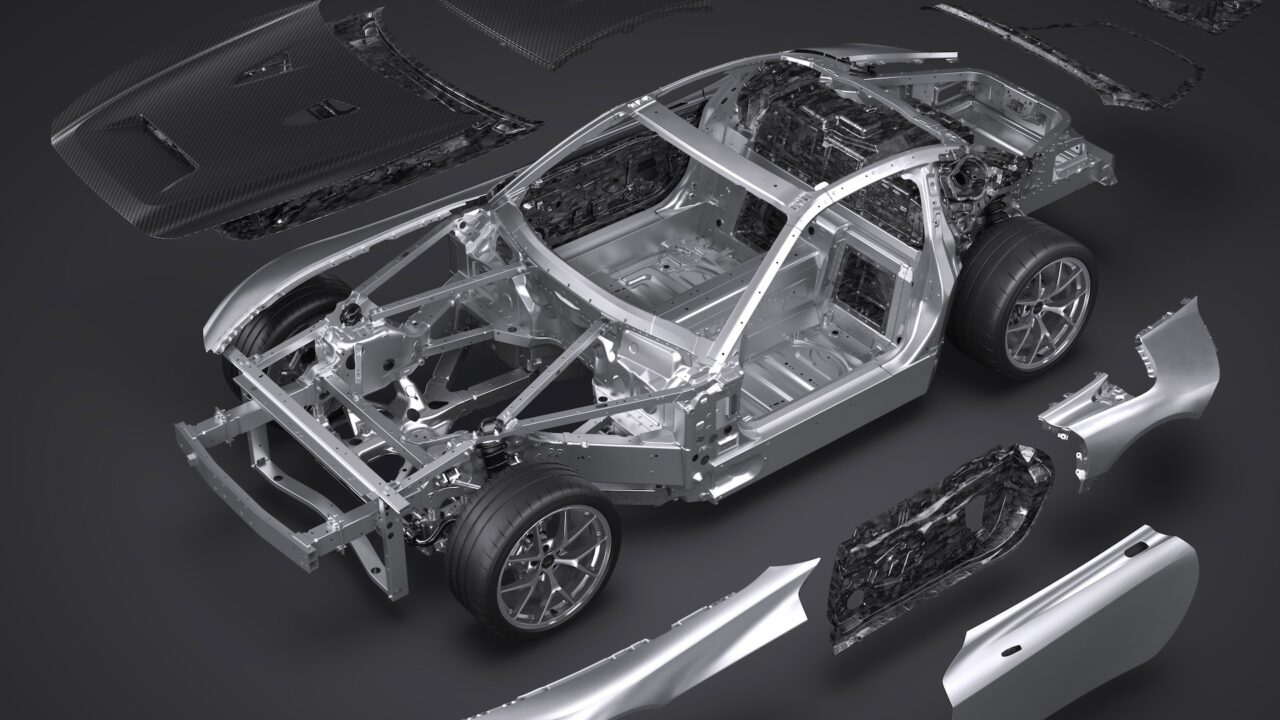
High rigidity and low weight are achieved by using Toyota’s first all-aluminum body frame. The use of carbon fiber reinforced plastic (CFRP), plastic and other lightweight materials in the body panels has resulted in a strong but lightweight body.
GR GT (prototype)
The process of exterior styling differs from that of other Toyota models. Traditionally, attention shifts to aerodynamics only after the completion of exterior styling, but with the GR GT it went the other way around. First the ideal aerodynamic performance was established, then the exterior styling was initiated. Aerodynamics engineers and exterior designers worked together to achieve styling that sought aerodynamic and cooling performance.
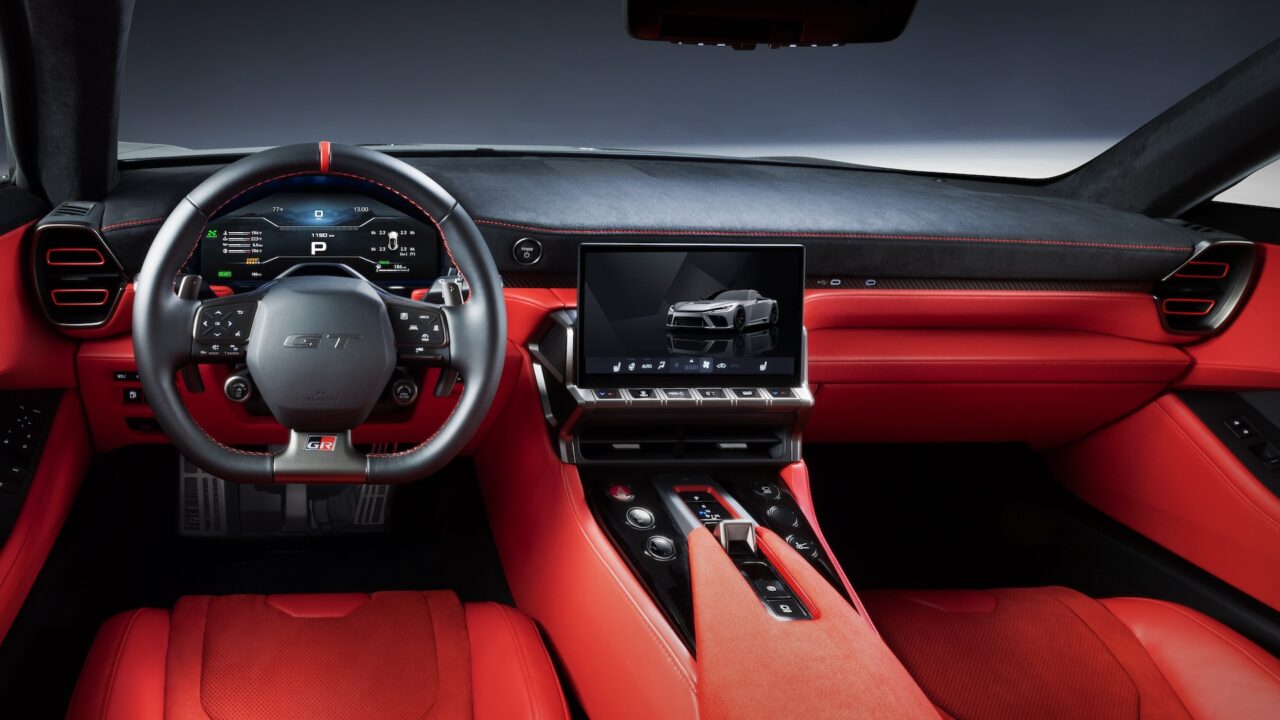
The interior styling was also carefully designed without compromise. The optimal driving position from the perspective of a professional racing driver became the basis in this, with controls within easy reach and the visibility needed for driving at the limit. Naturally, attention was also paid to suitability for everyday use.
GR GT3 (prototype)
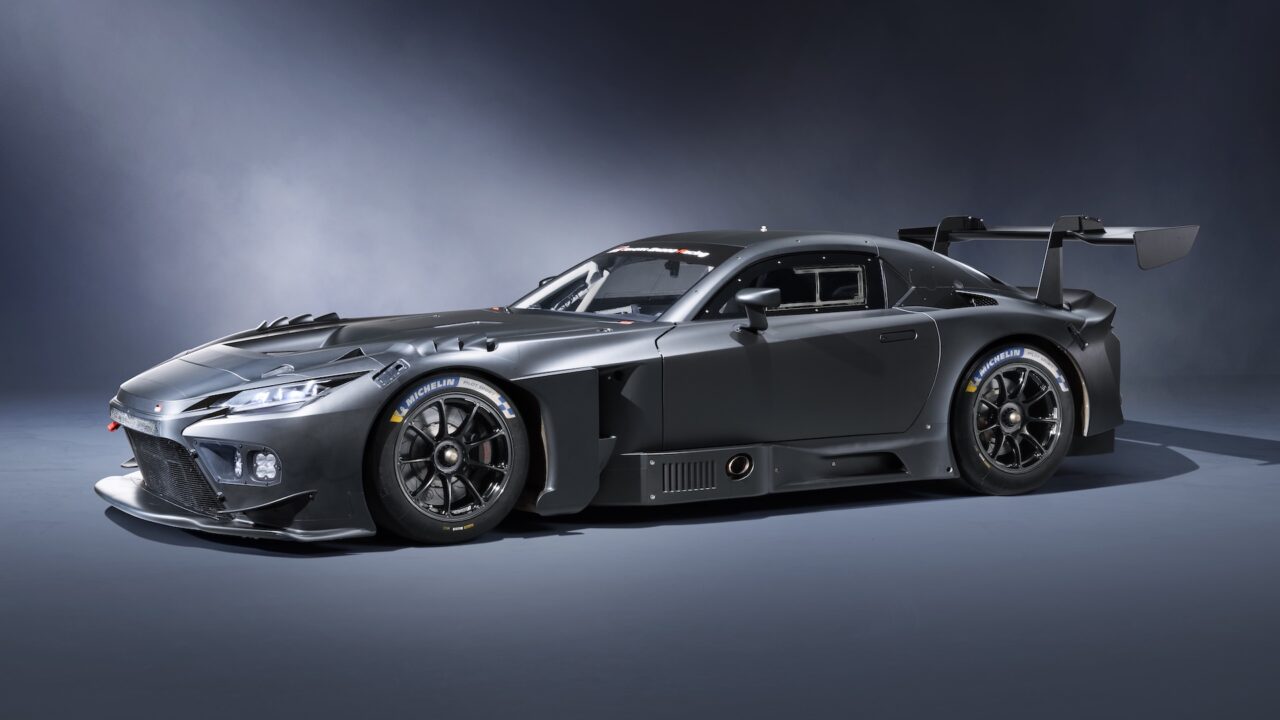
The GR GT3 has the same three elements as the GR GT on which it is based: a low center of gravity, low weight with high rigidity and the pursuit of aerodynamic performance. It meets the specifications of the Fédération Internationale d’Automobile (FIA) GT3, the highest category of customer motorsports based on production vehicles. The GR GT3 is meant to be a car chosen by people who want to win, but easy for anyone to drive.
TGR believes that the principle of “the driver comes first,” which is equally important in the GR GT, is also of great importance in the GT3 race car category, where both professional drivers and amateur drivers are behind the wheel. At the same time, TGR is working not only to increase the competitiveness of the GR GT3 as a car, but also to establish an optimal support system for customers who race so that they can fully enjoy motorsports.
New development and production methods
TGR’s new flagship models, the GR GT and GR GT3, are characterized not only by the application of new technologies, but also by the fact that they were created by taking on the challenge of applying new development and production methods. In developing the GR GT and GR GT3, TGR used multiple methods that build on insights gained while participating in motorsports. The use of driving simulators for vehicle research and development, now common in race car development, is one example. By using driving simulators early in the development process, fundamental vehicle characteristics could be efficiently refined from the beginning.
Tests at Shimoyama, Fuji Speedway and the Nürburgring
In addition to the use of simulators in the design of each component, extensive field tests were conducted not only on test circuits, such as the one at the Toyota Technical Center Shimoyama, but also on tracks around the world, including Fuji Speedway and the Nürburgring, which allowed driving performance and durability to be tested under extreme conditions. The GT GR was also tested on public roads to ensure that the model is exciting, easy to drive and reliable in everyday use.
Efforts to make ever better cars accelerated
Like other GR models, the GR GT and GR GT3 have been repeatedly refined, pushed to the limit and repaired during the development phase to make them models that meet all drivers’ expectations. As TGR accelerates its efforts to make better and better cars, the company continues to develop the GR GT and GR GT3, which are scheduled to hit the market around 2027. More details will be announced as they become available.
GR GT key specifications (prototype development goals, internal measurements)
| Bodywork | Length | 4,820 mm | |
| Width | 2,000 mm | ||
| Height | 1.195 mm | ||
| Wheelbase | 2.725 mm | ||
| Body structure, cabin | Frame | Full aluminum body frame | |
| Seats | 2 | ||
| Vehicle weight | Weight | 1,750 kg or lower | |
| Weight distribution | Front: 45; rear: 55 | ||
| Drivetrain | Displacement | 3.998 cc | |
| Bore x stroke motor | 87.5 × 83.1 mm | ||
| Engine Type | V8 | ||
| Turbocharger | Twin-turbo | ||
| Electric motor | Transaxle-integrated hybrid with one engine | ||
| Transmission | Newly developed 8-speed automatic transmission | ||
| Maximum system power | 650 hp or more | ||
| Maximum system torque | 850 Nm or more | ||
| Drive train, suspension, tires | Drivetrain | Front engine, rear-wheel drive | |
| Suspension | For | Double wishbone with coil spring | |
| Rear | Dual wishbone with coil spring | ||
| Brakes | Front | Carbon-ceramic disc brakes | |
| Rear | Carbon-ceramic disc brakes | ||
| Tire size | Front: 265/35ZR20; rear: 325/30ZR20 | ||
| Other | Top speed | 320 km/h or higher | |
GR GT3 specifications (prototype development goals, internal measurements)
| Bodywork | Length | 4,785 mm |
| Width | 2.050 mm | |
| Height | 1,090 mm | |
| Drivetrain | Displacement | 3.998 cc |
| Engine Type | V8 | |
| Turbocharger | Twin-turbo | |
| Drive | Drivetrain | Front engine, rear-wheel drive |
The GR GT and GR GT3 are still under development. Several details are still subject to change.
Exterior styling pursuing aerodynamic and cooling performance
The styling of the GR GT was developed according to an “aerodynamics first” concept, with aerodynamics engineers and exterior designers working together as one team. With a top speed of more than 320 kilometers per hour, aerodynamic performance was one of the main focuses for the GR GT.
While in the development of conventional production vehicles, exterior styling is determined before considering aerodynamic efficiency and cooling performance, this process had to be revisited for the GR GT, which was designed as a public-road race car. Aerodynamics engineers with experience in developing FIA WEC competition vehicles joined the GR GT development team and spoke extensively with vehicle designers, leading to the establishment of an overall vehicle layout based on an “aerodynamic model,” which represented the aerodynamic design team’s proposal for the ideal shape. Only then did the exterior designers create design sketches with production in mind, which ultimately led to the final styling of the GR GT.
Interior design that prioritizes functionality and operability
The interior design of the GR GT focuses on optimizing the driving position and visibility, with the goal of achieving a design suitable for both professional and amateur drivers, and for both track and daily use. In the pursuit of the ideal driving position, combined with attention to interior design, the importance of adequate visibility and a sense of security has again been recognized. Particular attention has been paid to excellent operability, with driving switches placed close to the handlebars and positioned and shaped for intuitive operation. For easy visual recognition, even during track riding, great attention has also been paid to the gauges, with the width, height and position of information displays, such as the shift and gear indicators, determined through a process of trial and error.
Newly developed 4.0-liter V8 twin-turbo engine and transaxle
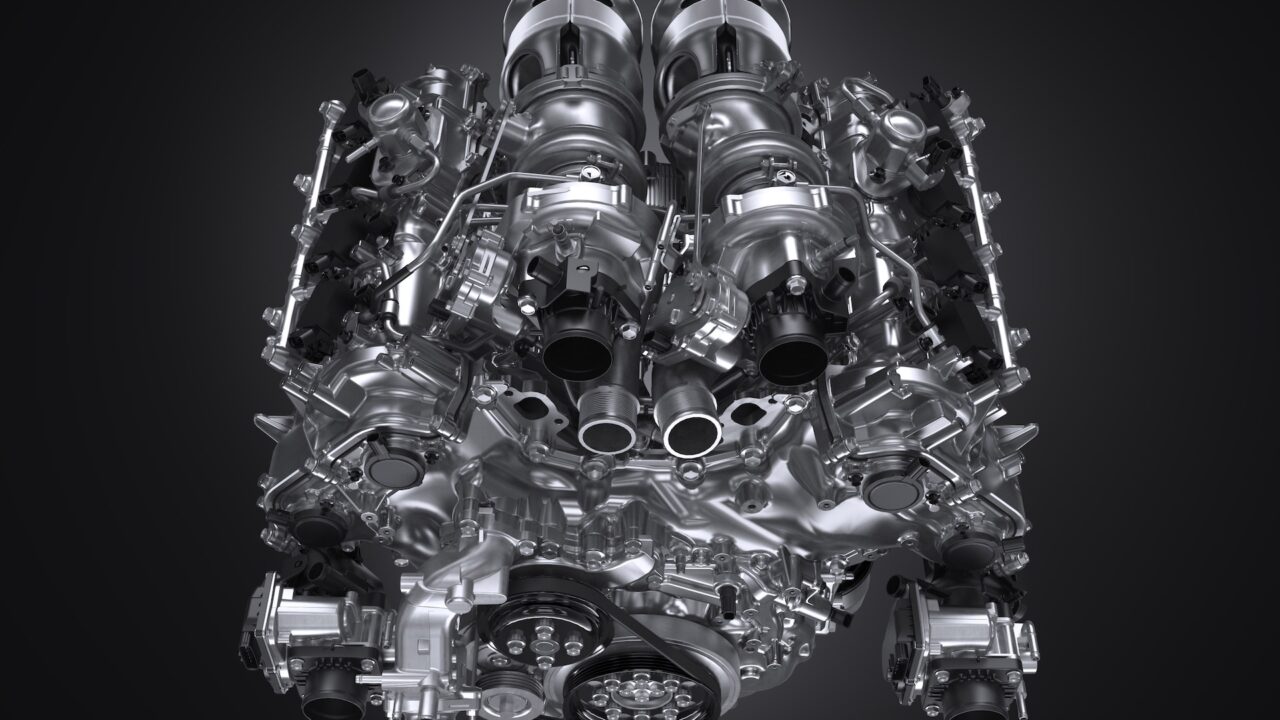
The GR GT’s 4.0-liter V8 twin-turbo engine, Toyota Motor Corporation’s first to be fitted in a production vehicle, was developed based on an “extremely compact and light” design concept to achieve the GR GT’s “low overall height and low center of gravity.
With a bore and stroke of 87.5 x 83.1, the engine’s short stroke reduces the overall height of the engine, while the hot V configuration positions one of two turbos in each engine bank. The engine also features dry-sump lubrication and an oil panel made thinner than usual.
Eight-speed automatic
Power from the engine is transmitted to the rear transaxle via a CFRP torque tube. In addition to an engine-generator, the transaxle is equipped with a newly developed eight-speed automatic transmission, which uses a wet starting clutch instead of a torque converter, and a mechanical limited slip differential. The engine-generator, placed in front of the transmission, is used to compensate for the temporary delay in torque response during acceleration and shifting.
The GR GT’s eight-speed automatic transmission offers a direct feel that surpasses that of the Gazoo Racing Direct Automatic Transmission in the GR Yaris and GR Corolla and is engineered to achieve world-class shifting speed. There is also the option of self-shifting with the shift paddles, even in automatic D mode.
Mechanical limited slip differential
To minimize the wheelbase, the rear transaxle, after transmitting the power transmitted from the engine and through the electric motor and automatic transmission, uses a bevel gear to reverse the direction of that power, then drives the driveshaft through the mechanical limited slip differential. This structure is unique among front-engine, rear-wheel-drive vehicles and represents the optimization for use in the GR GT of the mechanism used in all-wheel-drive vehicles.
For very powerful performance, the development target for maximum system power is 650 hp or higher and the development target for maximum system torque is 850 Nm or higher. In addition, the use of a rear transaxle and the optimal placement of the drive battery, fuel tank and other heavy components resulted in a 45:55 weight distribution between front and rear, contributing to the car’s handling.
In the development of the driveline, racing development simulators and system benches were used on which complete driveline systems could be assembled. Thermal management, mounting position and serviceability were also considered. To continue sales, work is underway to develop a system that meets increasingly stringent emissions regulations. The GR GT3 is also equipped with a 4.0-liter V8 twin-turbo engine, many structural components of which are the same as those of the engine in the GR GT.
Distinctive V8 sound
The GR GT delivers not only high-quality performance, but also the distinctive racing sound of a V8 twin-turbo engine. Sound development was based on two pillars: creating a sound that allows interaction with the car and creating a sound that conveys changes in thermal energy. The structure of the exhaust pipe was carefully designed to produce a sound in sync with the car’s performance.

An all-aluminum body frame and chassis that prioritizes easy driving at the limit
The basis of the GR GT’s low weight and high rigidity is Toyota’s first all-aluminum body frame. High rigidity has been achieved by placing large aluminum castings in the main structure of the frame, by the optimal placement of aluminum profiles and other components, and by the use of advanced joining technologies. In addition, the body panels of the model are made of aluminum and CFRP.
The suspension features a newly designed, low-mounted double-wishbone system with forged aluminum arms at both the front and rear. Its features have been developed from scratch, with an emphasis on linear response and a high degree of controllability, from daily use to driving at the limit. The tires are Michelin Pilot Sport Cup 2 tires developed exclusively for the GR GT. From the early development phase, the design of both the suspension and tires involved collaboration with professional drivers in the use of simulators and flexible test drives and simulator evaluations to achieve optimal performance for the GR GT, allowing the driver to seamlessly interact with the car on racetracks, as well as on twisty and other public roads.
Powerful brakes and adjustable Vehicle Stability Control
Brembo carbon-ceramic discs are used for the brakes, and handling control during braking was developed together with professional drivers. The GR GT’s Vehicle Stability Control system allows multi-stage adjustment of drive force and brake control, allowing the driver to select the level of difficulty of vehicle control based on his driving ability and weather conditions, for an enjoyable and safe driving experience. This arrangement is also used in TGR’s cars for the Nürburgring 24-hour race and is an example of technology perfected through participation in motorsport. In addition, the basic structures of the aluminum spaceframe chassis and front and rear double wishbone suspension system have been developed so that many of their components can be shared with the GR GT3.