
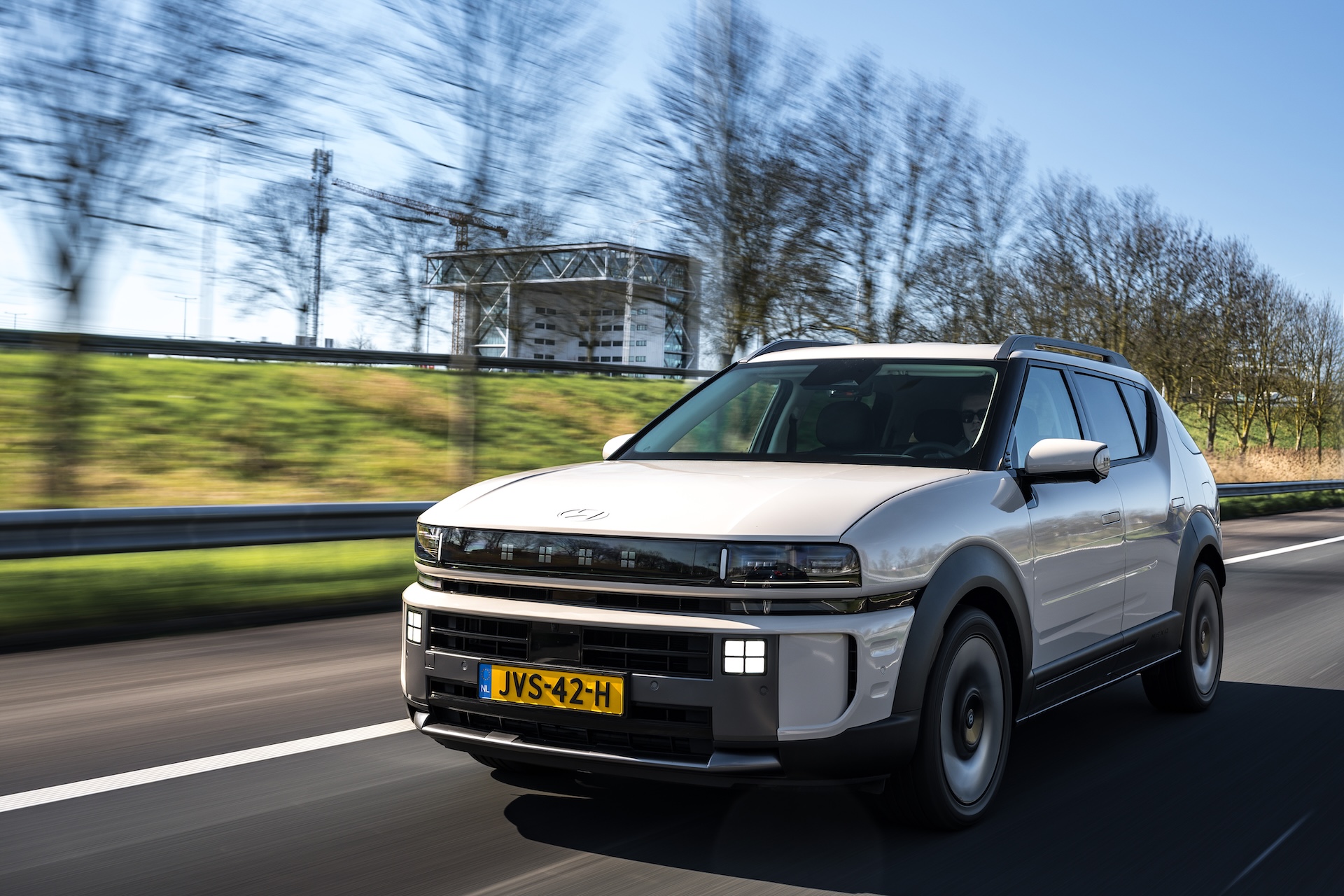
Review – Hyundai Nexo (2026) need not be a sales buster
Hydrogen in full development in the Netherlands
Before we dive into the new Hyundai Nexo, let’s take a quick look into the world of hydrogen. After all, what is the current situation? Sensationally, hydrogen seems to be at a low ebb in the Netherlands. But is that really the case? Actually, the opposite is true. There is plenty of investment behind the scenes in hydrogen technology. The Netherlands now has about 25 hydrogen refueling locations and there should soon be more.
Operational public hydrogen refueling stations (measurement as of 08/11/2024)
| Location | Address | Filling pressure (bar) | Operator | Vehicle | Payment |
| Rhoon (NL) | Green Cross Road 397 | 350/700 | Air Liquide | Car/Truck | Card/Pin |
| Arnhem (NL) | Westervoortsedijk 71 | 350/700 | TotalEnergies | Car/Truck | Card/Pin |
| The Hague (NL) | Binckhorstlaan 100 | 350/700 | Kerkhof & Zn | Car/Truck | Card/Pin |
| Amsterdam (NL) | Australia Harbour Road 116 | 350/700 | OrangeGas | Car/Truck | Card/Pin |
| Nieuwegein (NL) | Morse track 1 | 350/700 | Greenpoint | Car/Truck | Card/Pin |
| Pesse (NL) | Bultinge 2 | 700 | Green Planet | Car | Card/Pin |
| Groningen (NL) | Bornholm Street 35 | 350/700 | Holthausen | Car/Truck | Card/Pin |
| Assen (NL) | Germany Avenue 1 | 700 (slow-fill) | OrangeGas | Car | Card/Pin |
| Doetinchem (NL) | Braamtseweg 10 | 350/700 | Kuster Energy | Car/Truck | Card/Pin |
| Breda (NL) | Minervum 7001 | 350/700 | TotalEnergies | Car/Truck | Card/Pin |
| Horst (NL) | Station Street 92 | 350/700 (slow-fill) | Fishermen’s Energy | Car/Truck | Card/Pin |
| Veldhoven (NL) | The Run 4232 | 350/700 | TotalEnergies | Car/Truck | Card/Pin |
| Emmen (NL) | Phileas Fogg Street 45 | 350 | Shell | Truck | Card/Pin |
| Kolhorn (NL) | Port Road 14 | 700 (slow-fill) | AVIA Marees | Car | Card/Pin |
| Hoofddorp (NL) | Changing Lane 10 | 350/700 | DCB Energy | Car/Truck | Card/Pin |
| Amersfoort (NL) | The Wind Turbine 1-3 | 350/700 | Fountain Fuel | Car/Truck | Card/Pin |
| Eindhoven (NL) | Eisenhower Avenue 11 | 700 | AVIA Vollenhoven | Car | Card/Pin |
| Roosendaal (NL) | Accretion 4 | 350/700 | H2Point | Car/Truck | Card/Pin |
| Dordrecht (NL) | Avenue of the United Nations 113 | 350/700 | Greenpoint | Car/Truck | Card/Pin |
| Alkmaar (NL) | Diamond Road 32 | 350/700 | GP Large | Car/Truck | Card/Pin |
| Capelle a/d IJssel (NL) | Capelseweg 399 | 350/700 | TotalEnergies | Car/Truck | Card/Pin |
| Utrecht (NL) | The Heldrin Avenue 2 | 350/700 | TotalEnergies | Car/Truck | Card/Pin |
| Oude-Tonge (NL) | Tonisseweg 3 | 350/700 | Greenpoint | Car/Truck | Card/Pin |
| Amsterdam (NL) | Beira Road 3A | 350/700 | Holthausen | Car/Truck | Card/Pin |
| Deventer (NL) | Van der Landeweg 9t | 350/700 | TotalEnergies | Car/Truck | Card/Pin |
| Zaventem (BE) | Leuvensesteenweg 546 | 350/700 | Air Liquide | Car/Truck | Card/Pin |
| Halle (BE) | Zinc Street 1 | 700 | DATS 24 | Car | Card/Pin |
| Antwerp (BE) | Mexico Street 11 | 350/700 | CMB.Tech | Car/Truck/Boat | Card/Pin |
| Antwerp (BE) | Boomsesteenweg 950 | 350/700 | DATS 24 | Car/Truck | Card/Pin |
| Leuven (BE) | Geldenaaksebaan 448 | 700 | DATS 24 | Car | Card/Pin |
| Ollignies (BE) | Rue de la Verte Louche 2 | 350 | DATS 24 | Truck | Card/Pin |
| Erpe-Mere (BE) | Ghent Road 239 | 700 | DATS 24 | Car | Card/Pin |
| Herve (BE) | Outre-Cour 37 | 700 | DATS 24 | Car | Card/Pin |
| Bettembourg (LU) | ZI Scheleck 2 | 350/700 | TotalEnergies |
Hydrogen in the Netherlands
What’s the plan with hydrogen? Simple, by 2050 the Netherlands is aiming for a completely sustainable energy supply. The government is therefore encouraging the transition to hydrogen, including through subsidies for large-scale projects such as a national transport network. In accordance with EU agreements, there must be a filling station in every major European city and every 200 kilometers by 2030. Until then, €259 million in support is available for investments in vehicles and filling stations. The target is electrolysis capacity of 3 to 4 gigawatts by 2035, supported by the right infrastructure and storage facilities.
The future need for hydrogen in the Netherlands is great, probably greater than its own production capacity. International cooperation, both within and outside Europe, is therefore essential for import and trade. Thanks to its strategic location and major seaports, the Netherlands can act as a crucial hub for the transit and storage of hydrogen. The expertise available in this field also offers significant economic benefits for the Netherlands.
The breakthrough of WATERSTOF!? – Review HYUNDAI NEXO (2026) – AutoRAI TV
Construction of infrastructure
The foundation of this new market is infrastructure construction, including a national transmission network and future offshore connections. For the national network, existing gas pipelines will be reused to save costs and time. This approach will make hydrogen readily available to the four main industrial clusters along the Dutch coastline between 2030 and 2032. Trucks are first expected to switch to hydrogen on a larger scale. This in turn will result in more filling stations, which in turn will lead to more hydrogen-powered passenger cars.
Hydrogen projects
Yet some players are already getting in early. Hyundai is not the only one. Toyota is also embracing hydrogen, as is BMW. Here and there you see more and more projects popping up. At Schiphol Airport grounds in September 2025, a pilot project started with hydrogen-electric vehicles as part of emission-free ground operations. Among other things, a prototype Toyota Hilux with hydrogen fuel cell is driving around there and a specially developed aircraft towing vehicle, also with fuel cell.
Not on the back burner
Hydrogen on the back burner? Anything but! Now Hyundai comes out with this new Nexo, with a completely new powertrain. First the most important question: what does such a Hyundai Nexo cost? You can drive it in the Netherlands from 72,495 euros for the “entry-level” model. The Nexo Plus – the top model – requires an investment of 80,295 euros. With Hyundai Operational Lease, by the way, a Nexo is on your doorstep for 949 euros per month excluding VAT (60 months/10,000 km/year).
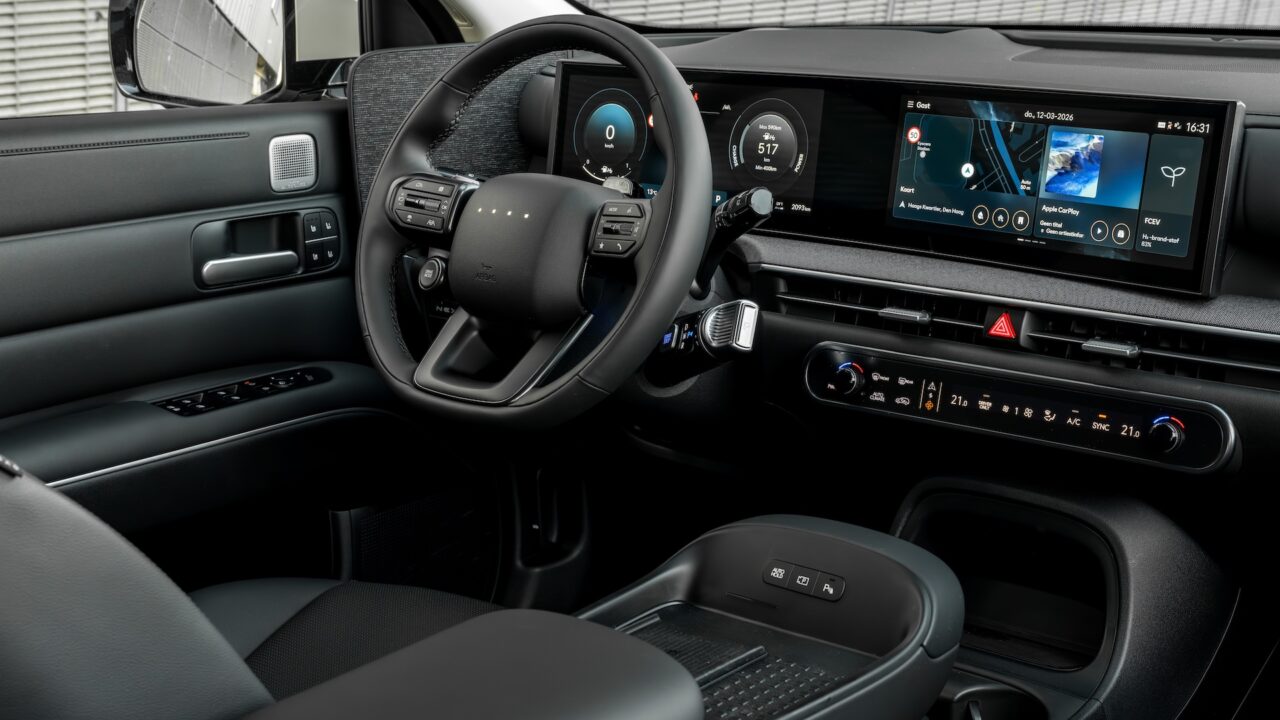
Hyundai NEXO Plus
Compared to the base version, the Plus top version does have a nice lot of extras, such as adaptive noise reduction, a Bang & Olufsen premium audio system with fourteen speakers, laminated glass front and rear, a head-up display, suede headliner, privacy glass, leather seat upholstery, heatable front and rear seats, ventilated and power-adjustable front seats, and a suede finish for the sun visor. It almost sounds like we are describing the equipment of a Bentley, but in this case we are really talking about the Nexo. A luxury car, in other words.
Dimensions
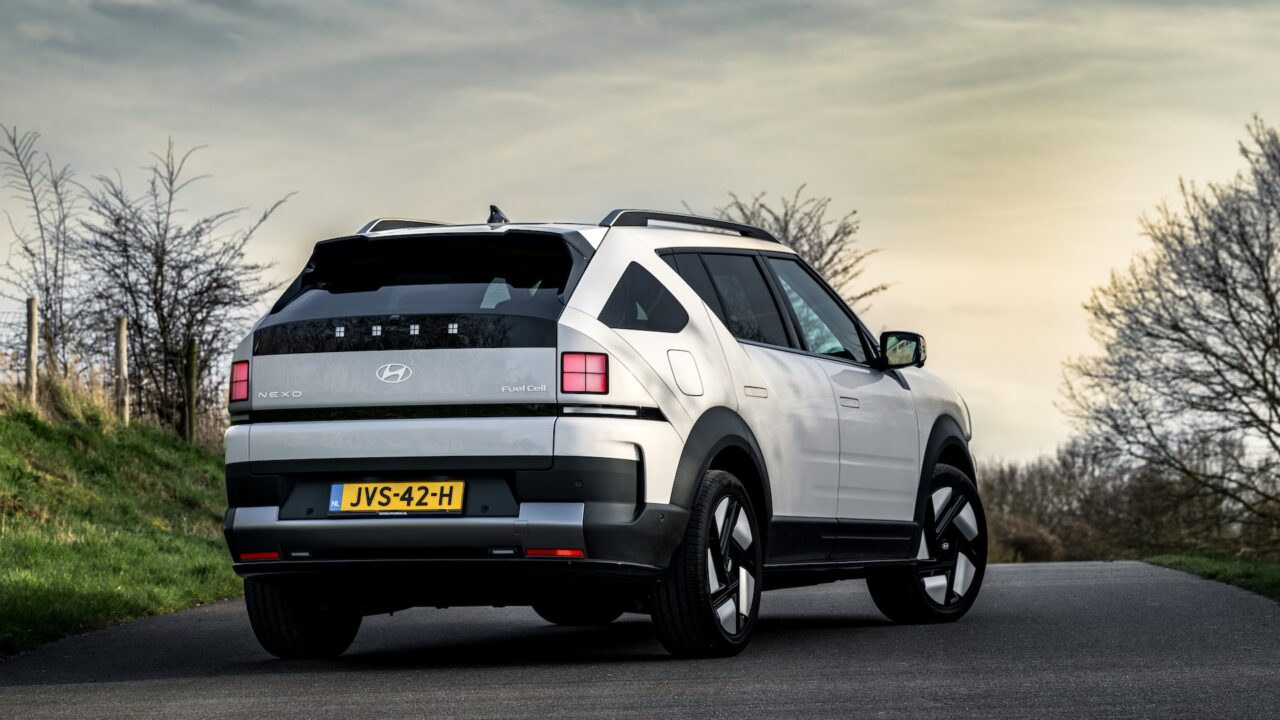
The new Hyundai Nexo has a length of 4,751 mm, a width of 1,863 mm and height of 1,642 mm. The wheelbase comes out to 2,790 mm. Thus, the new Nexo has grown considerably compared to the first generation. That first generation Nexo did quite nicely in the Netherlands. From 2018 to 2022, Hyundai sold a total of 363 units. Sales of the Nexo are concentrated in areas where hydrogen refueling stations are also available. Someone who does not have a filling station nearby will not buy a Nexo.
Not successful? No problem
Anne Lobbes, Hyundai Netherlands spokeswoman, said, “We have a global strategy where we look at customer needs. We look at what is in demand per region. Therefore, in addition to HEV, PHEV and BEV, we also do FCEV. It’s a strategic pillar for us and what’s more, Hyundai Motor Group also has the financial clout to develop this technology, just as it does robotics. Behind the scenes, a lot is secretly already happening with hydrogen. The goal is to have all commercial vehicles available with FCEV from 2028, including the Staria. Meanwhile, 100 examples of the Xcient Fuel Cell Trucks are already driving around Europe. Hydrogen buses of ours are also driving around in Vienna and Munich. So there is a lot of potential especially for heavy transport. By the way, we have been working on hydrogen since 1998. Hyundai is engaged in the production, storage, transportation and filling of hydrogen. We are investing heavily in infrastructure and see potential in the application of hydrogen throughout our business operations chain. Most importantly, we want to produce hydrogen as green as possible.”
Refueling of hydrogen
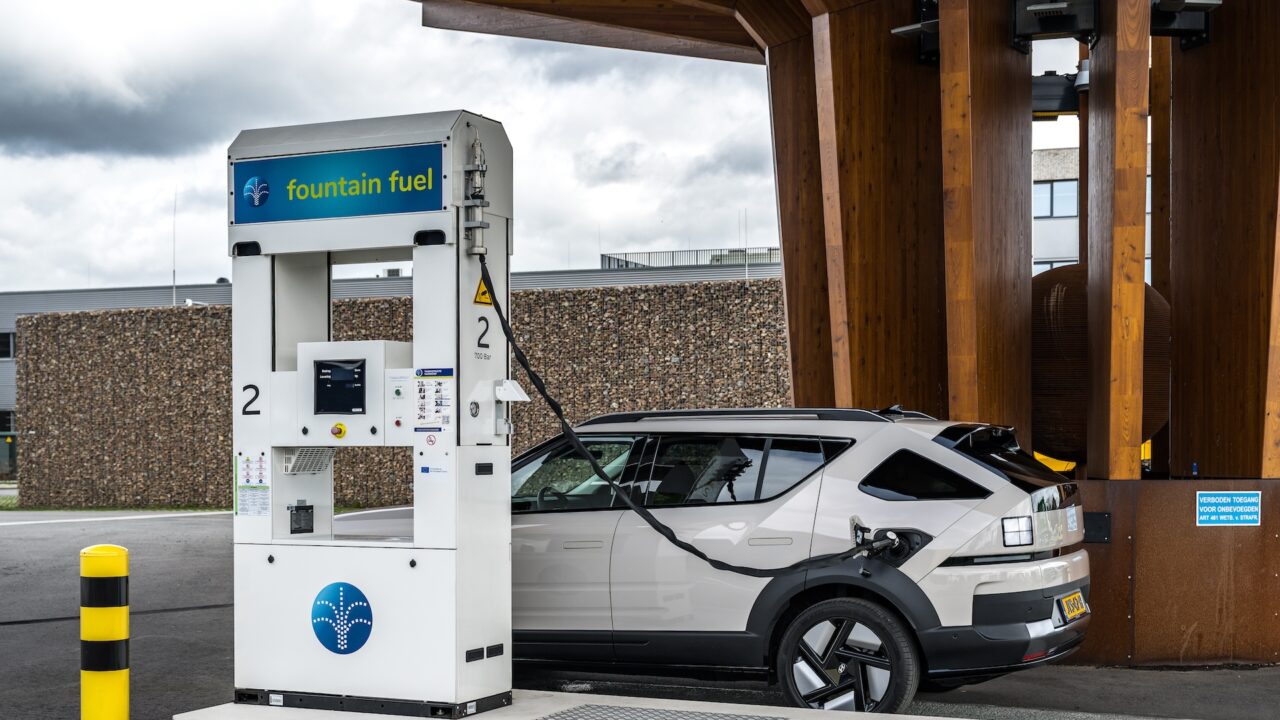
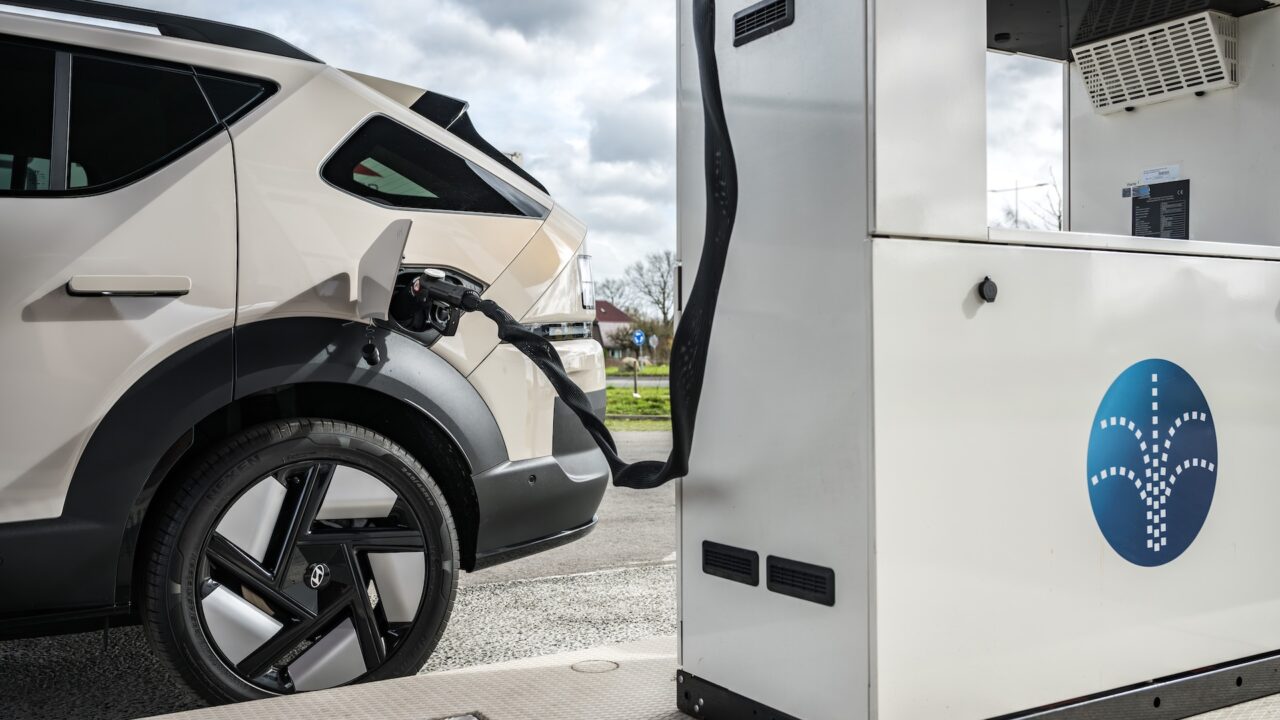
So how does hydrogen refueling work? Simple. You park your car at the filling station. Walk up to the ATM, enter your PIN and you can fill up. Or rather, fill up with hydrogen. After about three to four minutes you’re done at the 700-bar station we visited. The price at this station is 18.95 euros per kilogram of hydrogen. This Nexo has 6.69 kilograms on board. So a full tank will cost you 126.77 euros. In this case – after filling up with 3.19 kilograms of hydrogen – we have to deduct an amount of 60.45 euros. In theory, the Hyundai Nexo has a combined hydrogen consumption of up to 0.89 kilograms per 100 kilometers. If we calculate that back to the price per 100 kilometers, we arrive at 16.86 euros.
Toyota Mirai for a bargain!
A salient detail in between: the employee of this hydrogen filling station in Amersfoort drives a hydrogen car himself under the guise of “practice what you preach. A 2021 Toyota Mirai. He got it from Denmark. The car had less than 50 kilometers on the odometer when he bought it. The price? 17,000 euros. Quite a bit of depreciation, but an excellent deal, especially if you work at a hydrogen fueling station. A free tip of the house: an absolute must as a hydrogen car owner is the app H2.LIVE. With it, you always and everywhere have an up-to-date overview of hydrogen refueling locations, know exactly what the price per kilo is and if there are any breakdowns.
Powerful powertrain
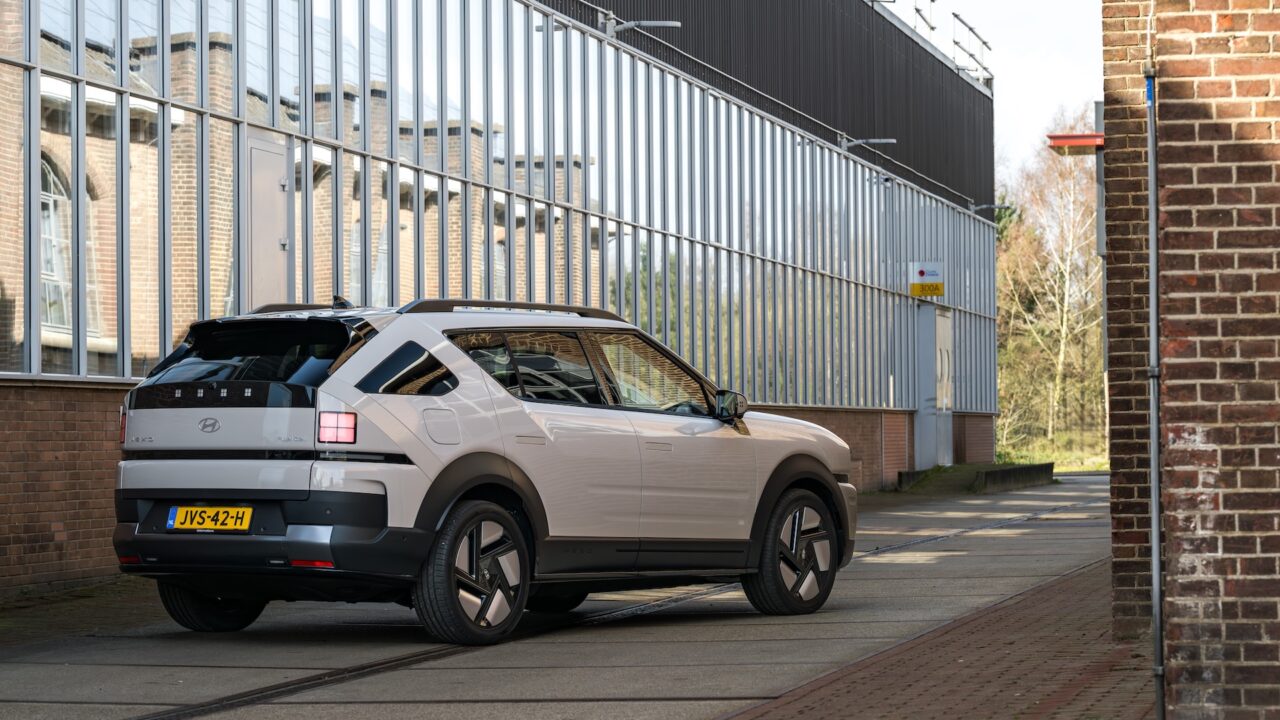
OK, back to the Hyundai Nexo. Thecar has an improved fuel cell and a more powerful 2.64 kWh battery pack. Battery power has doubled to 80 kW, while the hydrogen fuel cell now delivers a gross output of 110 kW. This is a 16% increase over the previous generation. These upgrades result in a total system power of 190 kW. Thanks to the 150 kW – that’s 204 hp – strong electric motor with 350 Nm of torque, the Nexo sprints to 100 km/h in 7.8 seconds; over 1.4 seconds faster than before. This Nexo Plus – with some additional options – takes 8.1 seconds to do so. The Nexo has a driving range of up to 826 kilometers according to the WLTP test standard. The Nexo Plus gets 751 kilometers on paper. This is due in part to the larger 19-inch alloy wheels and additional equipment. The car weighs 1,955 kilograms roadworthy. Kerb weight is 1,880 kilograms. Braked, the Nexo can tow 1,000 kilograms.
How does the Nexo drive?
Surprisingly delicious, we can be honest about that. In this comfortable SUV you really unwind. It is quiet on board, the seats are comfortable, the seating position is well put together and all the materials give a premium feel. The suspension has a comfy tuning, precisely matched to the vehicle weight of the car. The powertrain does its job whisper quietly. The only thing we heard was some ticking coming from the luggage compartment. That turned out to be a loose repair kit. The luggage compartment itself has a capacity of 510 liters. With the rear seatback folded down, the luggage space maxes out at 1,630 liters – enough for four golf bags. You cannot fold down the backrest from the luggage compartment. Next to each rear seat are levers that instantly fold down the backrest flat. A flat cargo area is then created.
More than successful
Well, as a family SUV, this Nexo is more than successful. The Hyundai has also gotten a little smarter again. For example, the model has a new “Wake Up” technology that causes the fuel cells to be actively heated as soon as the car is unlocked or started in cold conditions. This allows the system to reach optimal operating temperature faster, leading to shorter start-up time and better response at low temperatures. About the power of the powertrain you don’t have to doubt. It is smooth enough! Not super fast, but just pleasantly quick.
The future of fuel
Hyundai labels hydrogen as “the future of fuel. The Nexo will always be Hyundai’s flagship car when it comes to hydrogen technology. A real sales topper the car need not be. Hyundai’s goal is hydrogen in general. That needs to be put on the map on a larger scale. There is only one way to do that: invest in the technology. The Nexo product proves that Hyundai has an excellent grasp of the concept of hydrogen. Even if you don’t believe in hydrogen: this car genuinely drives wonderfully.
Hyundai Nexo 2026 technical data
Engines & performance
- Motor type: Permanent Magnet Synchronous Motor (PMSM)
- Max. power: 150 kW (204 hp)
- Max. torque: 350 Nm
- Drive: front wheels
- Transmission: Automatic
- Top speed (km/h): 179 (Nexo) / 178 (Nexo Plus)
- Acceleration 0-100 km/h: 7.8 sec (Nexo) / 8.1 sec (Nexo Plus)
- Fuel: Hydrogen
- Driving range (WLTP): 826 km (Nexo) / 751 km (Nexo Plus)
Battery
- Max. fuel cell power: 110 kW
- Battery: Lithium-ion polymer
- Max. battery power: 80 kW
- Battery capacity: 2.64 kWh
- Voltage: 290 V
Suspension & wheels
- Front: McPherson with stabilizer bar Strut (gas)
- Rear: Multilink shock absorbers (gas)
- Wheels (standard):
- Nexo: 18-inch alloy | Tires: (Hankook) 225/55 R18
- Nexo Plus: 19-inch alloy | Tires: (Nexen) 245/45 R19
Weights & volumes
- Luggage space (upright / folded down): 510 liters / 1,630 liters
- Gross weight: 1,880 kg
- Kerb weight: 1,955 kg
- Max. permissible weight: 2,440 kg
- Max. trailer weight (unbraked / braked): 750 kg / 1,000 kg
- Max. nose weight / roof load: 100 kg / 100 kg
- Hydrogen tank capacity: 162.6 liters / 6.69 kg
Consumption & emissions
- Consumption combined (WLTP): 0.81 kg/100 km (NEXO) / 0.89 kg/100 km (NEXO Plus)
- CO₂ emissions combined: 0 g/km
- Emission standard: 2023/443AY
Dimensions (mm)
- Length: 4,751
- Width (without wing mirrors): 1.863
- Height (with roof racks): 1,642 (1,673)
- Wheelbase: 2,790
- Ground clearance (19 inches): 164 (165.3)
- Overhang for: 960
- Rear overhang: 1.001
- Length between seat and ceiling 1st row (without Sky): 972 (1,005)
- Length between seat surface and ceiling 2nd seat row (without Sky): 952 (988)
- Legroom 1st row of seats / 2nd row of seats: 1.054 / 981
- Interior width at shoulder height 1st seat row / 2nd seat row: 1.455 / 1.410
- Interior width at hip height 1st seat row / 2nd seat row: 1.363 / 1.330