
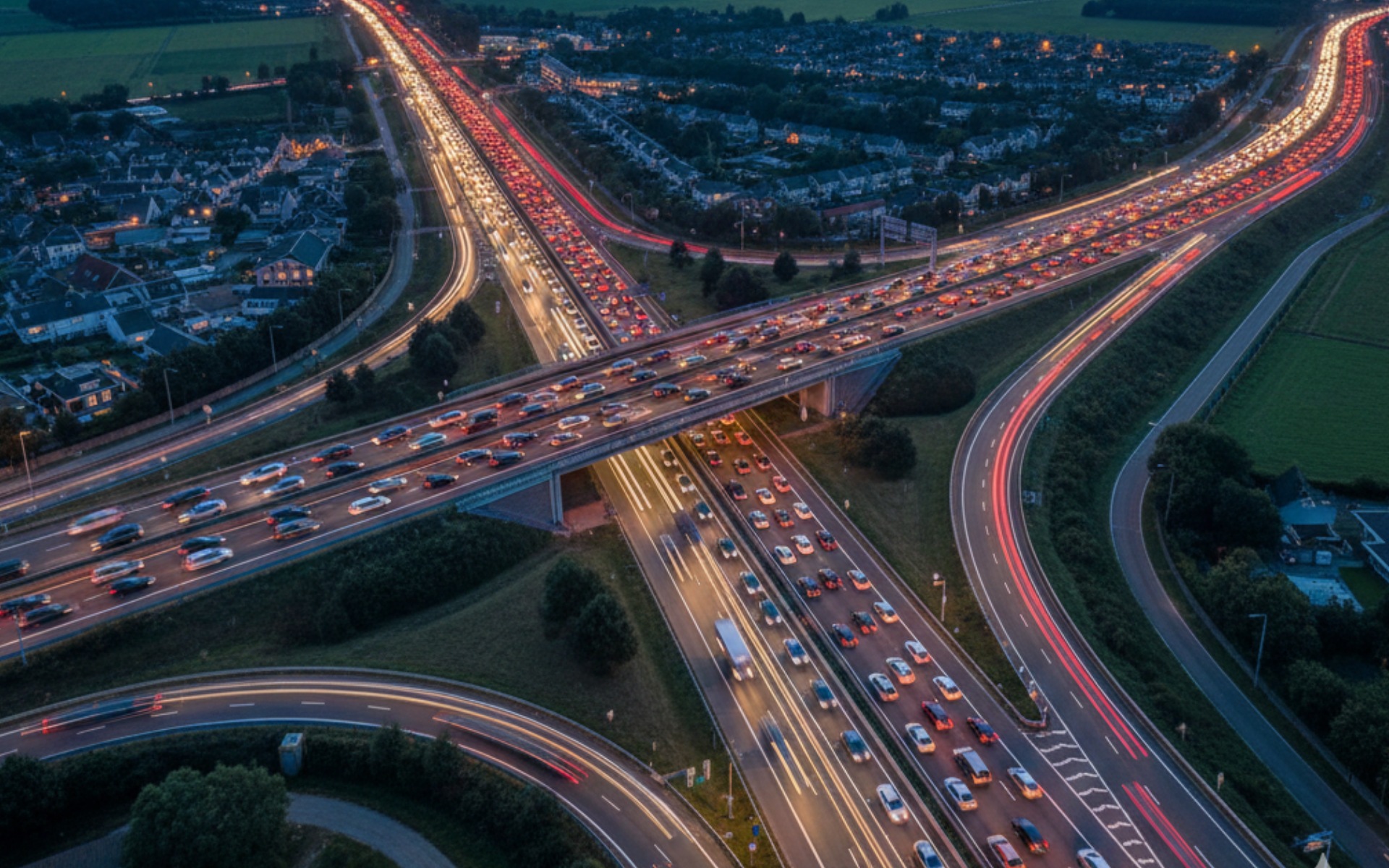
Nearly 10 million passenger cars in the Netherlands!
There is one constant: growth
If you look at the development of the Dutch car fleet over a longer period of time, you see one constant above all: growth. In 1900 the Netherlands had only 200 cars for a population of over 5.2 million. Cars were then a rarity, reserved for a small elite. Over a century later, that picture has been completely reversed. In 2025, there will be 9,621,272 passenger cars registered for a population of just over 18 million.
This growth occurred not gradually, but in distinct phases. Until World War II, the number of cars remained limited. In 1930 there were 67,000 passenger cars, which amounted to one car for every 118 inhabitants. The war even caused a temporary decline: in 1945 there were only 30,000 passenger cars left. Then the real motorization of the Netherlands began.
The 1950s
The 1950s and 1960s mark a turning point. In 1950 the Netherlands had 139,000 passenger cars, five years later already 268,000. With growing prosperity, the car became accessible to more and more households. In 1965, the car fleet passed the one million car mark, while the population at the time was around 12.3 million. That meant one car for every ten inhabitants.
Starting in the 1970s, growth continued briskly. In 1970 there were 2.4 million passenger cars; by 1980 there were over 4.2 million. Remarkably, the number of inhabitants increased at a much slower rate during the same period. Whereas the population grew from 13.0 to 14.1 million between 1970 and 1980, the number of cars almost doubled. The car definitely became a permanent part of daily life.
Vehicle fleet continues to grow
In the decades that followed, the car fleet continued to grow, albeit at a slower pace. Around 1990, the Netherlands had just over 5.1 million passenger cars, for nearly 15 million inhabitants. The ratio stabilized around one car per 2.7 inhabitants. That trend continued toward the turn of the century, with 6.3 million cars in 2000 and 7.3 million in 2005.
Since 2010, another clear acceleration has been visible. In that year, there were 7.8 million passenger cars registered. Fifteen years later, there are nearly 9.7 million. Population growth played a role in this, but does not explain everything. The population increased from 16.6 to over 18 million during that period, while the vehicle fleet grew by nearly 2 million vehicles.
Car is entrenched in Dutch society
The ratio of the number of inhabitants to the number of cars shows how deeply embedded the car is in Dutch society. In 2010, there was an average of one car for every 2.1 inhabitants. Since 2020, that figure has been around 1.9 and remains remarkably stable. In other words, roughly one in two Dutch people own a passenger car, although of course that says nothing about ownership per household.
The fact that the car fleet continues to grow does not automatically mean more driving. Factors such as urbanization, working from home, shared mobility and the emergence of alternatives play an increasingly important role. At the same time, the car remains indispensable for many people, especially outside the Randstad. The composition of the car fleet is also changing, with an increasing share of electric and hybrid vehicles.
10 million comes into view
With 9.6 million passenger cars in 2025, the symbolic limit of 10 million is fast approaching. If the current trend continues, it is probably only a matter of time before that milestone is reached. The figures thus show not only how the Netherlands has motorized, but also how mobility, population and use of space are increasingly intertwined.